

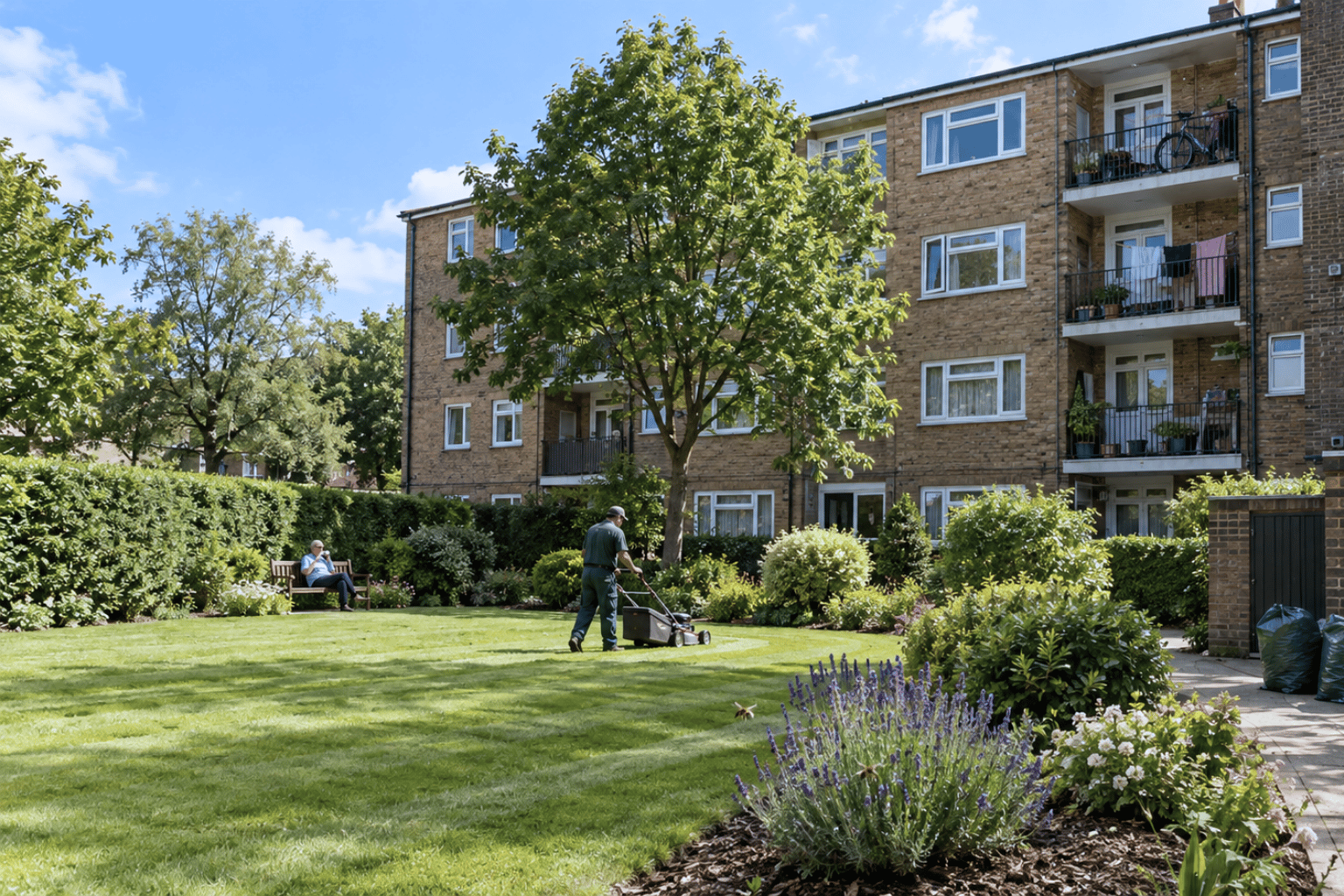
The grass behind the flats is at knee height, the bin store has brambles growing through it, and nobody in the building can tell you whose job it is. One leaseholder thinks the freeholder covers it. Another thinks it already comes out of the service charge. The tenant on the ground floor has been cutting the bit outside her window with a hand shear because she got tired of looking at it.
This guide covers communal garden maintenance for blocks and estates in South East London: who is responsible, how the cost reaches the service charge, what a visit includes, and what we charge for it in 2026.
What’s in this guide
- The short answer: who is responsible for a communal garden
- What the lease usually says: freeholder, managing agent, leaseholder, tenant
- How communal garden costs reach the service charge
- What a communal garden visit actually includes
- Communal garden maintenance prices in South East London (2026)
- Fortnightly, monthly or seasonal: which schedule a block needs
- The jobs that get missed in shared gardens every year
- Bin stores, side returns and the bits nobody claims
- Getting residents to agree: what a written spec should say
- The one-off rescue first: what a neglected block garden costs to clear
- Access, parking and keys: what slows a block job down
- What to ask a contractor before signing for a block
- A real job: communal garden in Woolwich SE18
- Communal garden maintenance in South East London FAQ
- How our garden maintenance service works for blocks and estates
The short answer: who is responsible for a communal garden
In almost every block of flats, the freeholder or their managing agent is responsible for maintaining the communal garden, and the cost is recovered from leaseholders through the service charge. Leaseholders and tenants are rarely responsible for shared ground, even the bit outside their own window.
The lease has to name the garden as common parts for that to work. If it does, the freeholder arranges the gardening, pays the contractor and bills it back. Our rate for that work is £83 for the first hour and £65 for every hour after, with no minimum charge.
Need a price for your block’s garden?
Send us photos and we will price the visit within 24 hours →
What the lease usually says: freeholder, managing agent, leaseholder, tenant
Four people get confused with each other, so here is what each one is.
The freeholder owns the building and the land under it. The lease normally makes them responsible for the common parts, and the garden is usually one of them.
The managing agent is the company the freeholder hires to run the block. They collect the service charge, book the gardener and answer the emails. The duty in law sits with the freeholder, but in practice the agent is who you speak to.
The leaseholder owns their flat for the length of the lease. They pay a share of the garden bill, they do not do the work, and they do not decide on their own what happens to the shrubs.
The tenant rents from a leaseholder, and almost never has any duty over shared ground. A private patio or a fenced strip of their own is a separate question, covered in our landlord or tenant garden responsibility guide for SE London.
Read the lease before you assume. Some older SE London conversions, particularly the two and three flat Victorian splits around Brockley SE4 and Peckham SE15, give the rear garden to the ground floor flat and leave the front to everyone. That one line changes who pays.
How communal garden costs reach the service charge
The freeholder pays the gardener, then divides the bill between the flats in the proportions the lease sets out. Often that is an equal share, sometimes it is by floor area, so the big top floor flat pays more than the studio.
One rule catches managing agents out. Once a one-off job would push any single leaseholder’s share above £250, an amount set by regulation 6 of the Service Charges (Consultation Requirements) (England) Regulations 2003 and not our rate, the landlord must run a formal consultation before the full cost can be passed on. Long term contracts have their own lower trigger and their own consultation process.
A regular gardening round rarely trips it, because the per flat share is small. A 12 flat block on monthly three hour visits costs £2,556 a year at our rates, which is £213 per flat, about £18 a month. The job that crosses the line is a full clearance of a garden left for three years, so plan the consultation before you book it.
What a communal garden visit actually includes
A block visit is a different shape to a private garden visit, with more hard surface, more edging and more rubbish.
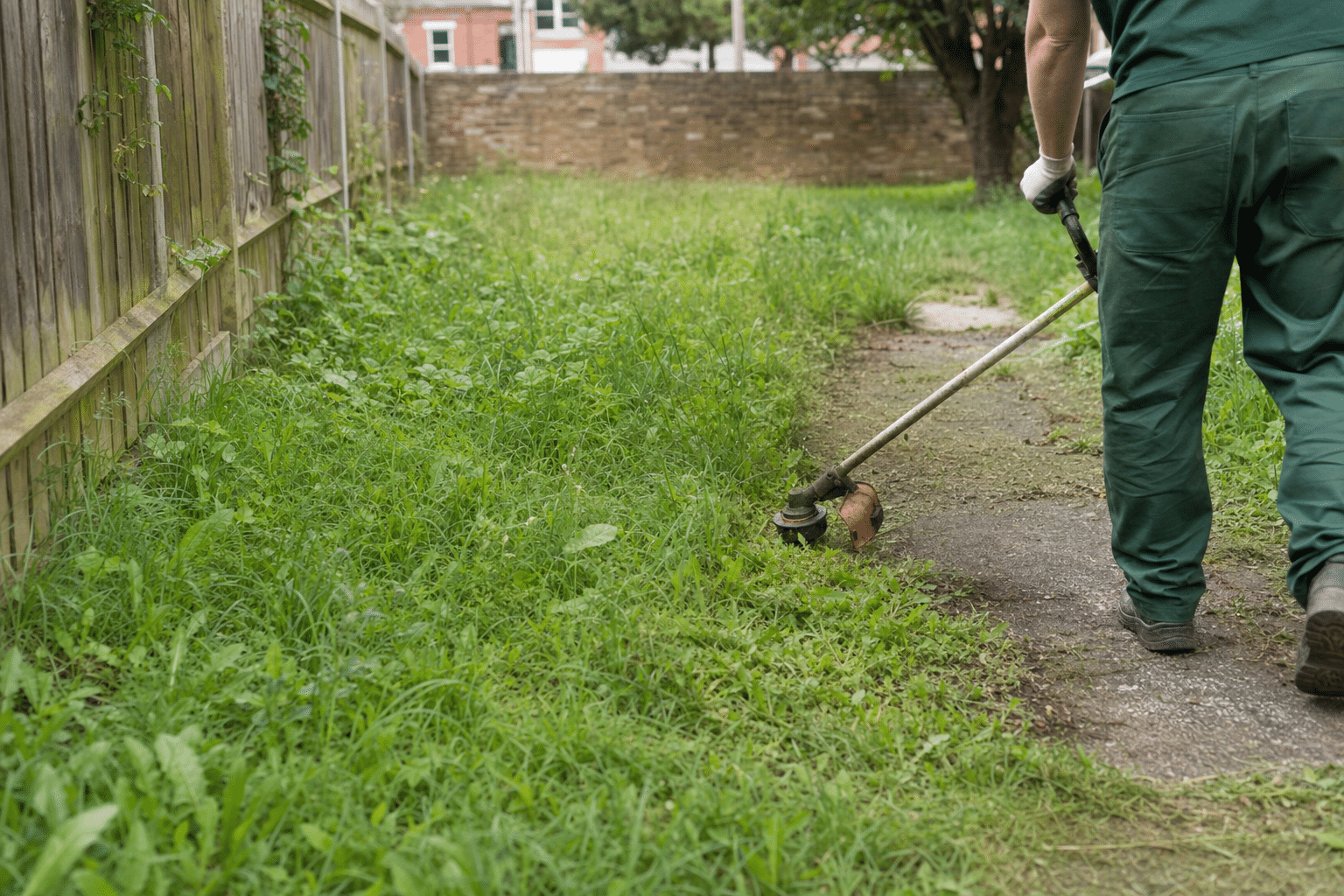
What we do on a communal round:
- Mow the shared lawn and strim what the mower cannot reach
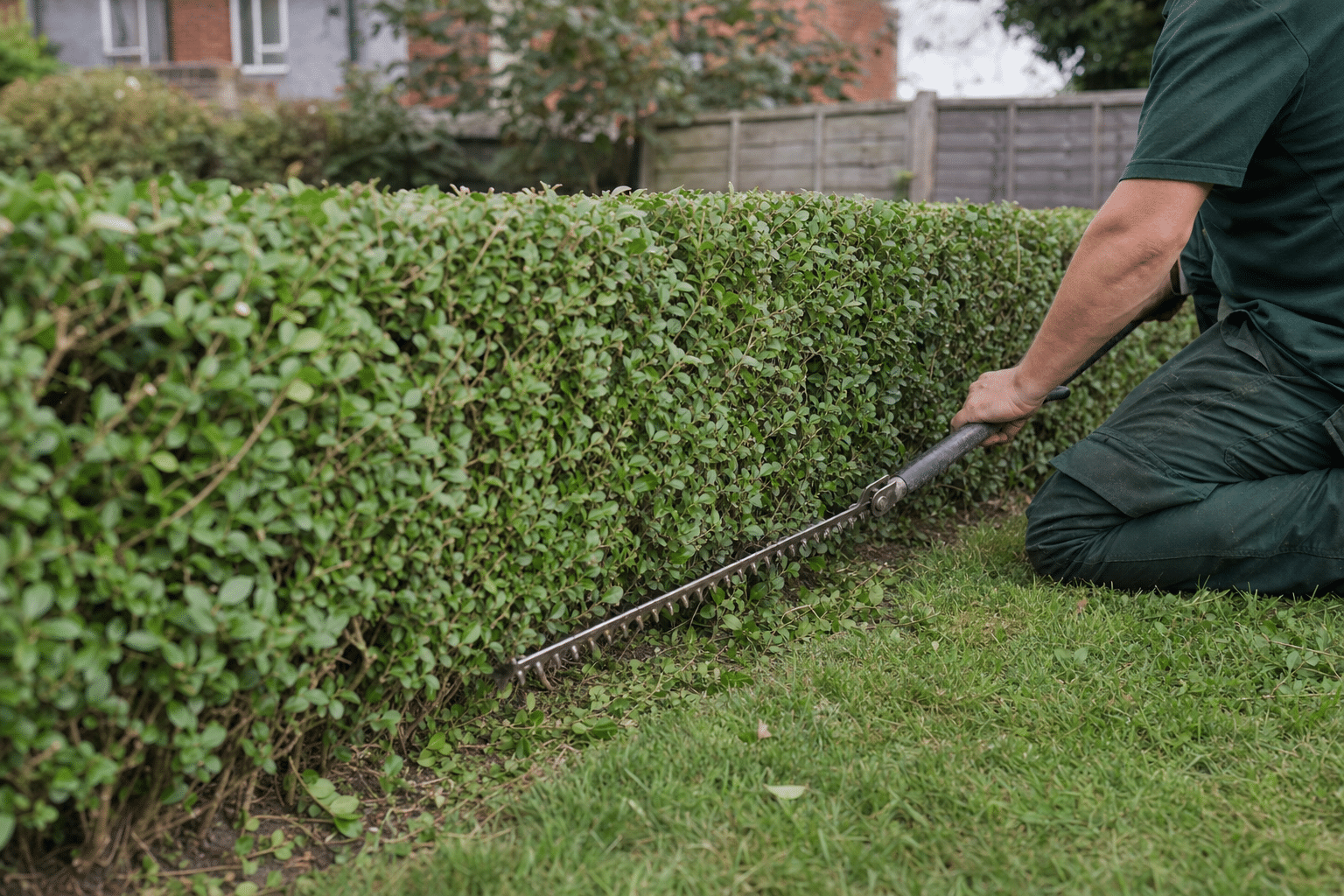
- Cut hedges and shrubs back off paths, doorways and parking bays
- Weed the planted beds and the cracks in the paving
- Clear leaves and litter from the drying area and the front approach
- Trim growth off windows, meter boxes and lighting
- Take every bag of green waste away
What is not in a gardening visit, and we will tell you so on site rather than quote for it:
- Anything above 3 to 4 metres, which is a job for a tree surgeon. Our guide on when to call a gardener rather than a tree surgeon in SE London explains the cost difference
- Fly tipped household rubbish, mattresses and building waste, priced as a clearance
- Pressure washing the communal paths, priced by the square metre under patio and driveway cleaning
- Fence and gate repairs, priced under garden fencing
Communal garden maintenance prices in South East London (2026)
Our rate is the same for a block as for a house. £83 for the first hour, £65 for every hour after, no minimum charge. We price by the visit, not by the metre, because a lawn cut a fortnight ago takes a third of the time of one last cut in June.
| Visit length | What normally fits into it | Our price for that visit (2026) |
|---|---|---|
| 1 hour | Mow the communal lawn, edge it, clippings away | £83 |
| 2 hours | Mow, edge, weed the front beds, sweep the paths | £148 |
| 3 hours | The above plus hedge faces and the bin store surround | £213 |
| 4 hours | The above plus shrub pruning and a full load of waste out | £278 |
Those are a realistic starting point for a block of 8 to 20 flats, not a fixed quote. One site visit tells us which row you are on.
For comparison, annual gardening contracts on a medium garden across London and the South East typically run £1,100 to £2,400, and per visit rates around £45 to £90 (market estimates from UK cost guides, not our rate). Most of those per visit figures cover one person with a mower on a small private lawn, which is why they look cheaper than a block round. Our garden maintenance cost guide for South East London applies the same rates to houses, and every rate we charge is on our prices page.
Want the hourly maths done on your own block?
Fortnightly, monthly or seasonal: which schedule a block needs
Grass in SE London grows hardest from late March to early October. A block with a real lawn needs fortnightly visits through those months or it looks neglected within three weeks. A block with shrubs, paving and no grass sits happily on monthly or quarterly.
| Schedule | Visits a year | Typical visit | Our cost for the year |
|---|---|---|---|
| Fortnightly, March to October | 17 | 2 hours | £2,516 |
| Fortnightly, all year | 26 | 2 hours | £3,848 |
| Monthly, all year | 12 | 3 hours | £2,556 |
| Quarterly, four seasonal visits | 4 | 4 hours | £1,112 |
Every figure there is our hourly rate multiplied out, not a fixed contract price. Winter visits are shorter, mostly leaves and cutting back, so the all year option usually costs less than the table suggests.
Honestly: if your communal area is a paved courtyard with three pots and a climber, four visits a year is enough, and anyone selling you a fortnightly contract is selling you idle time.
The jobs that get missed in shared gardens every year
A private garden gets looked at daily by the person who owns it. A shared one gets looked at by nobody in particular, so the same things rot away every year.
Ivy on the boundary walls is the big one. It gets into mortar joints and behind fence panels, and by the time a resident reports it the wall needs repointing. Our guide to removing ivy from a garden in South East London shows how far it gets into brick.
Gullies at the bottom of external stairs silt up with leaves, then the ground floor flat floods. Boundary hedges creep over 2 metres and bring a complaint from next door, which the rules on a neighbour’s hedge over 2m in SE London explain. Self seeded buddleia and sycamore take hold between the paving and the wall.
Cutting a hedge between March and August risks disturbing an active nest, which is an offence under the Wildlife and Countryside Act 1981. We check hedges before we start, and we will leave a section uncut and come back for it.
Bin stores, side returns and the bits nobody claims
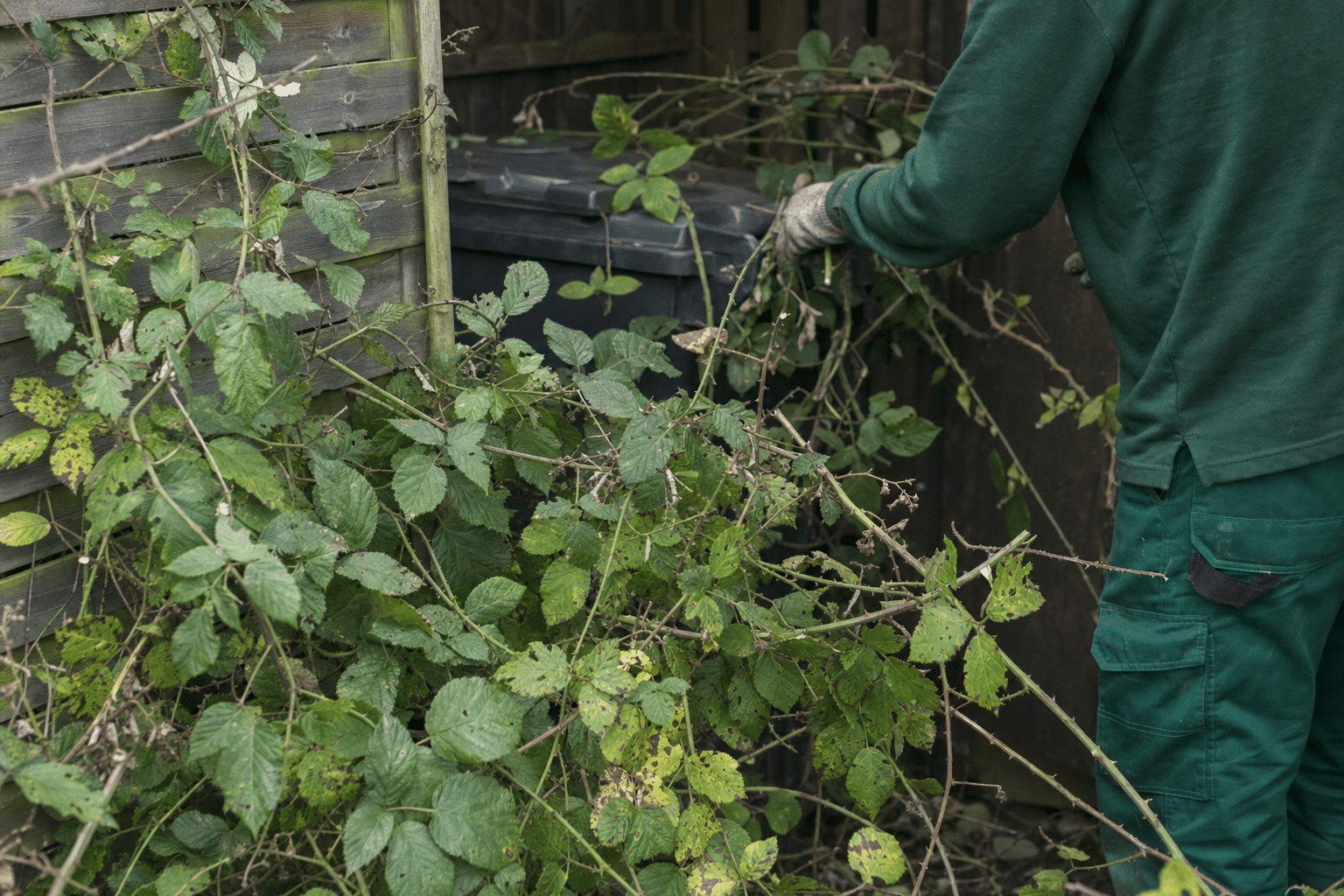
Every block has ground that appears on no plan and in nobody’s head: the gap between the bin store and the boundary wall, the narrow side return, the dead corner behind the bike racks.
These are where the rats, the fly tipping and the complaints come from. Twice a year is enough to keep on top of them, and three years untouched turns them into a clearance job.
Tell your gardener these bits are in scope, in writing. If they are not on the spec they are not in the price, and a contractor on an hourly rate does the visible lawn first every time.
Getting residents to agree: what a written spec should say
Residents argue about gardening because nobody wrote down what they were buying. A one page spec ends most of it:
- Which areas are covered, named, including the bin store and the side return
- How many visits a year, and roughly which months
- Whether green waste removal is included (with us it always is)
- What is excluded, so nobody expects tree work or pressure washing free
- Who the gardener reports to, and who signs off the visit
A block that keeps its lawn and planting in decent order is easier to let and to sell, because the garden is the first thing a viewer sees. Leaving a couple of shrubs to flower rather than clipping everything back keeps bees and birds in the block, and costs nothing.
Getting quotes for a block and want one that lists what is excluded?
The one-off rescue first: what a neglected block garden costs to clear
If the garden has been left two seasons or more, a maintenance visit will not touch it. The first job is a clearance, and that is a different service at a different rate: £85 per hour for a 2-person team, minimum 2 hours, all tools included, under garden clearance.
A typical block rescue in SE London runs one to two days for two people. After that the regular round holds it at two or three hours a fortnight. Chipping away at the rescue inside maintenance visits costs more, because you pay for travel and setup twenty times instead of twice. Our garden clearance cost guide for South East London breaks the day down, and the garden waste removal guide explains where it goes.
Access, parking and keys: what slows a block job down
Three things turn a two hour visit into a three hour visit on a block, and all of them are fixable before we arrive.
Parking. We come in a transit van with the mowers and waste bags in it, so if there is no bay within carrying distance every load of cuttings is a walk. Any parking or congestion charge goes on the invoice, confirmed with you first.
Keys and codes. Gates to rear communal gardens are locked and the code changes. Give us the code and a contact who answers a phone, or we spend twenty paid minutes stood outside.
Waste route. If the only way out with the cuttings is a communal hallway, say so at the quote stage so we bring floor sheets.
What to ask a contractor before signing for a block
Five questions that separate a gardener who has worked on blocks from one who has not:
- Is green waste removal in the price, or added per bag?
- What happens if a resident asks you to do something extra on the day?
- Will you flag work outside the spec rather than doing it and invoicing for it?
- Who actually turns up, and is it the same team each visit?
The last one matters most. A garden cut by a different crew every month gets mown, never shaped, and drifts backwards over a couple of years.
A real job: communal garden in Woolwich SE18
A 14 flat block off Plumstead Road had not had a gardener for about two years. The front lawn was more clover than grass, the privet along the pavement had reached the first floor windows, and brambles were through the bin store fencing.
We started with a clearance day: two of us, the hedge back to a proper line, brambles out, the side return cleared to the wall, eleven bags of green waste away. It then went onto fortnightly two hour visits from April to October, monthly through winter. The managing agent gets a photo after each visit, which stops the “the gardener never came” emails.
Other jobs we have done nearby are on our portfolio of recent SE London gardens. If a mature tree on your block has a preservation order, check with Royal Greenwich planning before anyone touches it.
Communal garden maintenance in South East London FAQ
Who is responsible for maintaining a communal garden in a block of flats?
The freeholder, in almost every case, with the managing agent arranging it for them. The lease names the garden as common parts and puts the duty on the landlord. Leaseholders pay through the service charge but do not have to do the work.
Can a managing agent put garden maintenance on the service charge?
Yes, as long as the lease allows the landlord to recover the cost of maintaining the common parts and the charge is reasonable. Regular gardening is a standard service charge item. Leaseholders can ask to see the invoices.
How much does communal garden maintenance cost in South East London?
We charge £83 for the first hour and £65 for every hour after, so a two hour block visit is £148 and a three hour visit is £213. Monthly three hour visits work out at £2,556 a year at our rates. Rescuing a neglected block garden is priced separately at £85 an hour for a 2-person team.
How often should a communal garden be maintained?
A block with a real lawn needs fortnightly visits from late March to early October, then monthly or less through winter. A paved courtyard with pots and a climber is fine on four visits a year. Street front hedges need two proper cuts a year on top.
Can leaseholders refuse to pay for the garden?
Not if the lease allows the cost and the amount is reasonable. They can challenge a charge they think is unreasonable, ask for the invoices, and insist on the formal consultation when one flat’s share of a one-off job goes over the statutory threshold. Refusing to pay while the charge stands puts them in breach of the lease.
In a shared garden, who cuts the grass, the landlord or the tenants?
The landlord, through the freeholder’s contractor, wherever the lawn is common parts. A tenant only cuts grass that belongs to their flat alone, normally a private patio or a fenced rear section named in their tenancy. Shared grass is not the tenants’ job.
Can residents do the gardening themselves instead?
Yes, and for a small block with one lawn and a hedge at head height it can work well. It falls over on the insurance if someone is hurt, the green waste, and the one resident who ends up doing all of it. If you try it, agree who does what in writing before spring.
Do you take the green waste away from a block of flats?
Yes. Every bag of cuttings, prunings and leaves goes with us at the end of the visit, and it is in the price. Nothing gets left by the bins for the council to refuse, the usual complaint after a cheap contractor has been.
How our garden maintenance service works for blocks and estates
We are a family run team based in Eltham SE9, 12 years in SE London, working with managing agents, freeholders and resident companies as well as homeowners. Tilyo surveys the block, Plami sets the schedule, and the same crew comes back each visit.
- Garden maintenance for communal grounds, £83 the first hour and £65 every hour after, no minimum
- Garden clearance for a neglected block garden, £85 an hour for a 2-person team, minimum 2 hours
- Lawn mowing on its own, £80 the first hour and £60 every hour after
- Patio and path cleaning at £4 per square metre, minimum £140 covering up to 40m²
We cover Woolwich SE18, Lewisham SE13, Greenwich SE10 and Deptford SE8, where purpose built estates and converted terraces need very different rounds. The full list is on the areas we cover page, and the team is on our about us page.
Ready to put your block’s garden on a schedule?
Related reading
- Artificial Grass Maintenance: The Complete Guide for South East London Gardens
- How Much Does Garden Maintenance Cost in South East London? (2026 Price Guide)
- Garden Waste Removal in SE London: What It Costs and Who Takes It
- Garden Tidy Up in South East London: 7 Things We Do (And What It Costs)
- 7 Tips to Grow A Herb Garden On a Budget

0 comments