

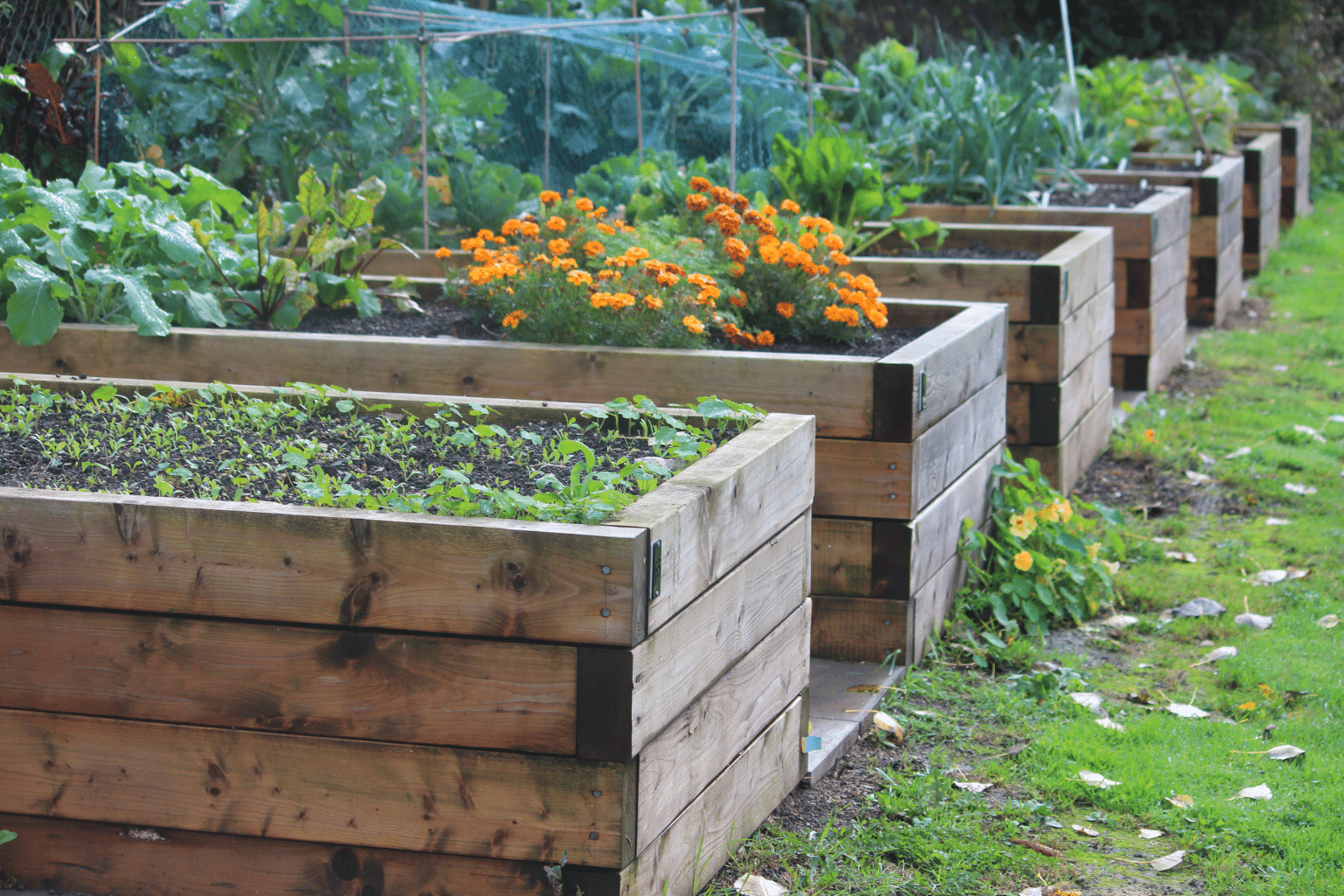
If your borders go from rock hard in August to a puddle in November, you are standing on London clay. Digging it over every spring does not fix it. Most people in SE London give up on the border and build up instead, which is why raised garden beds are now the most common small landscaping job we get asked for.
What’s in this guide
- The Quick Version: What Raised Beds Cost in South East London
- Raised Garden Bed Cost in SE London: 2026 Price Bands by Size
- Timber, Sleepers or Brick: What Each Costs and How Long It Lasts
- Why Raised Beds Are the Standard Fix on London Clay
- What Our Raised Bed Build Includes, and What It Does Not
- How Much Topsoil and Compost a Bed Needs, and What That Adds
- What Changes the Price: Access, Levels and Waste
- How Deep and How Wide a Bed Should Be for What You Are Growing
- Raised Beds on Paving, Decking and in Small Courtyards
- Will a Raised Bed Really Stop Weeds and Waterlogging?
- Best Time of Year to Build Raised Beds in South East London
- DIY Build vs Getting Us In: The Honest Comparison
- A Real Job: Raised Beds Built on Heavy Clay in SE London
- Raised Beds Across South East London Areas
- Raised Garden Beds in South East London FAQ
- How Our Gardening Services Can Help
The Quick Version: What Raised Beds Cost in South East London
A built timber raised bed typically runs £90-£350 across UK gardens, and a brick or stone one £250-£600, market estimates by size, not our rate. London and the South East sit roughly 10-25% above those national figures because labour here costs more.
Our raised beds sit under garden landscaping and design in South East London, which we price after a free on-site survey, with the written quote back to you within 3 business days. We do that because a bed on clay is never just the box. It is the digging out, the spoil, the barrow run and the soil to fill it.
The two stages before the bed are priced by the hour and those rates are fixed. We charge £85 per hour for a 2-person team on garden clearance, minimum 2 hours, and £90-£95 per hour for a 2-person team on garden levelling, equipment included.
Want to know what beds would cost in your garden?
Book a free survey and get a written raised bed quote →
Raised Garden Bed Cost in SE London: 2026 Price Bands by Size
| Bed size | Timber, built | Brick or stone, built | Whose money this is |
|---|---|---|---|
| Small, 1m x 1m | £40-£250 | £150-£400 | Market estimate across UK, not our rate |
| Medium, 2m x 1m | £60-£300 | £250-£600 | Market estimate across UK, not our rate |
| Large, 2m x 2m | £90-£350 | £400-£900 | Market estimate across UK, not our rate |
| Per square metre | £30-£300 | £100-£400 | Market estimate across UK, not our rate |
Those are a realistic starting point and nothing more. None of them include the soil to fill the bed, and on clay the soil is often the biggest single line. For the wider picture, see what garden landscaping costs across South East London.
Timber, Sleepers or Brick: What Each Costs and How Long It Lasts
Scaffold boards and thin fence-board beds are the cheap end. They look fine for a season, then the sides bow outward under wet soil and the corners pull apart. We do not build them.
Chunky wooden planks, the kind used for raised beds, are what most SE London gardens get. These are sleepers, and the pressure-treated softwood ones run about £15-£40 each from UK suppliers, market estimate, not our rate. A UC4 treated sleeper is rated for ground contact with a 15 year service life, and in a garden bed that is honest. We have seen untreated softwood go soft in 7.
Oak sleepers last longer with no treatment and cost noticeably more. Brick and rendered block last indefinitely, need a proper footing, and push the job into a different price band.
Why Raised Beds Are the Standard Fix on London Clay
Clay holds water, then shrinks and cracks as it dries. The British Geological Survey maps this across the capital in its shrink-swell hazard data, and large parts of SE London sit in the higher bands. In a border that means roots in cold wet soil all winter and baked ground by July.
A raised bed gets round it five ways, and all five are real:
- You choose the soil that goes in, so the plants are not stuck with what the builders left.
- Water drains down and out instead of standing around the roots.
- A defined edge makes weeds obvious and easy to pull before they root in properly.
- The working height is 30-45cm up, which saves your knees and back.
- The soil warms earlier in spring and holds heat later in autumn, so you plant sooner.
If standing water is your actual problem rather than just heavy soil, read how to fix poor drainage in a SE London garden first. A bed on top of a drainage fault still sits in a bog.
What Our Raised Bed Build Includes, and What It Does Not
Included in a bed build:
- Marking out and checking levels against the house and the path
- Breaking up the clay under the bed so roots can get down into it
- Cutting and fixing the timber, with internal posts or bars so the sides cannot bow
- A liner against the timber where it meets the soil, on request
- Filling with topsoil and compost, firmed and topped up
- Clearing up and taking the offcuts away
Not included unless we quote it separately:
- Clearing an overgrown garden first, which is £85 per hour for a 2-person team
- Digging out and removing clay spoil, which is charged by volume
- Levelling a sloped plot, at £90-£95 per hour for a 2-person team
- Plants, seeds and bulbs
- Paving or a new path between the beds
- Anything involving water supply or electrics, which is a job for a specialist, not us
How Much Topsoil and Compost a Bed Needs, and What That Adds
This is the number people get wrong. A bed 2m x 1m x 45cm deep holds 0.9 cubic metres of soil. A cubic metre is roughly one and a half builder’s bulk bags.
So two medium beds swallow about three bulk bags. Screened topsoil runs about £45-£90 a bulk bag from UK suppliers, and garden compost about £40-£80, market estimates, not our rate. Buy 10% more than the maths says, because soil settles and rain compresses it.
The Royal Horticultural Society’s raised bed guidance gives the mix we follow: three parts organic matter such as garden compost, leafmould or well-rotted manure, two parts sharp sand and seven parts topsoil. On a hard surface it shifts to four parts sand instead of two.
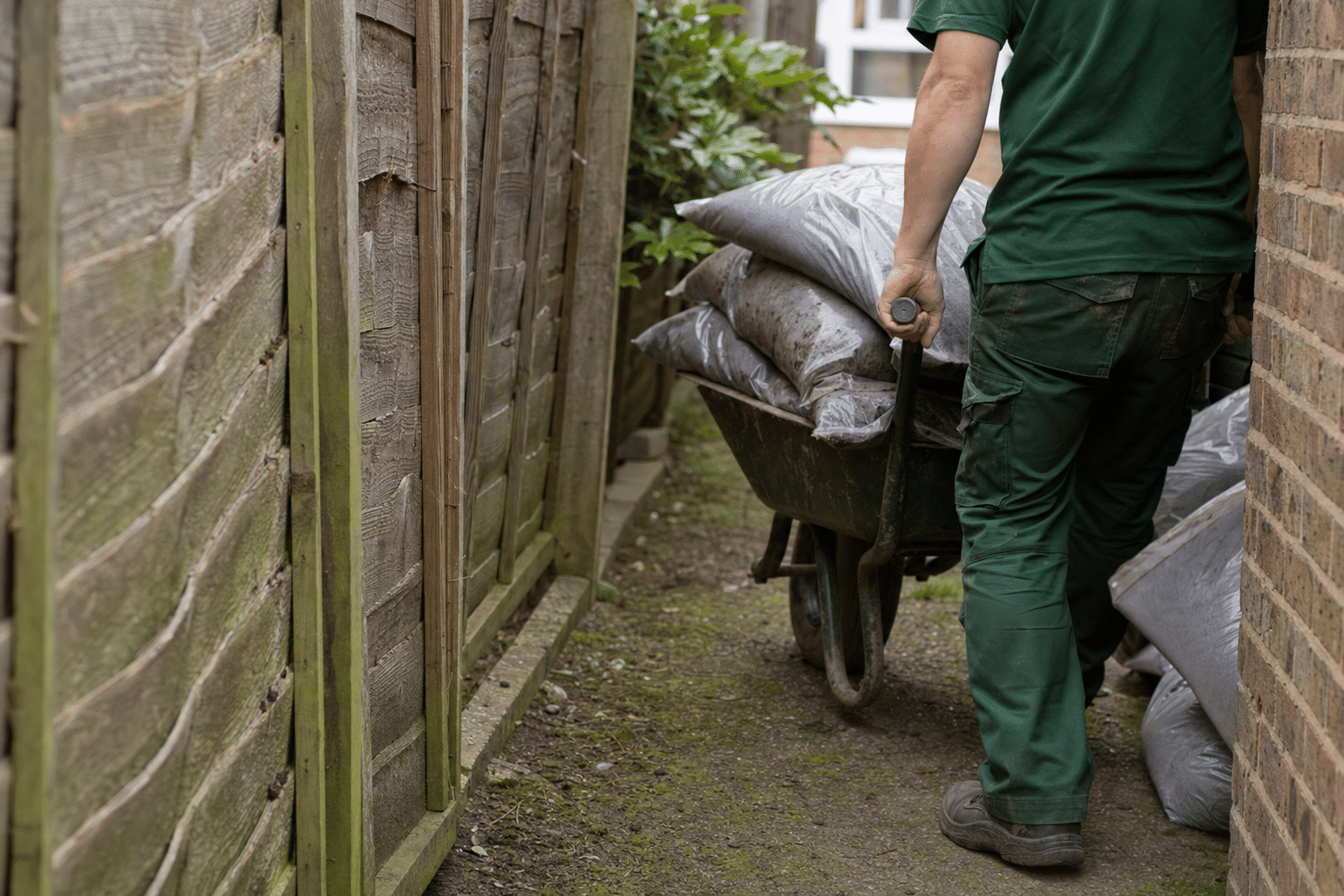 bulk bags of screened topsoil and compost being barrowed through a side return in Peckham SE15
Not sure how much soil your beds will swallow?
Send us photos and measurements for a raised bed price →
What Changes the Price: Access, Levels and Waste
Access
Sleepers are heavy and long. If they come through the house or down a narrow side return, two people carry each one and the barrow run doubles the hours. A garden with a rear or side gate costs less, every time.
Levels
A sloped garden needs the beds stepped, which means extra timber and a footing at the low end. Deeper than about 30cm of fall and it becomes a levelling job in its own right. We cover how that is priced in our guide to garden levelling costs on sloped plots.
Waste
Dug-out clay is heavy, wet and nobody wants it. A cubic metre weighs about 1.8 tonnes. Lewisham charges £100.63 a year for a garden waste bin subscription, which is their price, not our rate, and that bin takes clippings, not subsoil. Our note on what garden waste removal costs covers the difference.
How Many Beds
Four beds built in one visit cost less each than one bed built on its own. The van, the setting out and the delivery are the same either way.
What Is There Now
A bed going onto bare soil is quick. A bed going where a shed, a concrete base or a mat of brambles used to be is a clearance job first. Our soil preparation tips from the Eltham team show what the ground should look like before the timber goes down.
How Deep and How Wide a Bed Should Be for What You Are Growing
30cm deep is enough for salad leaves, strawberries and dwarf bulbs. Carrots and parsnips want 30cm as a floor and are happier at 45cm. Fruit bushes, shrubs and small trees need 45cm or more.
Width matters more than people expect. Keep a bed to 1.2m across if you can reach it from both sides, 60-75cm if it is against a wall or fence. Any wider and you end up standing on the soil, which compacts it and undoes the point. Leave 60cm between beds for a barrow, 45cm if you only walk through.
Raised Beds on Paving, Decking and in Small Courtyards
A bed can sit straight on a patio or on decking. Two things change. Roots cannot borrow depth from the ground below, so the bed has to be deep enough on its own, 45cm for anything more than salad. And water has nowhere to go unless you drill plenty of drainage holes through the sides at the base.
Weight is the other one. A full 2m x 1m bed at 45cm is well over a tonne and a half. On decking built on a wooden frame we check the joist spacing first, and often sit the bed over a bearer so the load spreads.
In a courtyard the honest answer is usually fewer, deeper beds rather than more shallow ones.
Will a Raised Bed Really Stop Weeds and Waterlogging?
Weeds, mostly yes. Fresh topsoil carries far fewer seeds than an old border, the edge stops grass creeping in, and anything that does appear stands proud where you can see it. Bindweed and horsetail already in the clay will find their way up through a bed within two seasons, so those come out properly before the timber goes down.
Waterlogging, partly. The bed drains, but the clay underneath does not. In a garden that floods, water rises into the bed from below. That is why we fork the clay base, and why in the worst cases we say so instead of selling beds. Our guide on what to do about a waterlogged garden is the honest read on that.
Best Time of Year to Build Raised Beds in South East London
Late summer through to early autumn is the best window on clay. The ground is dry enough to dig without turning the garden into a skating rink, and the RHS says the same thing about cultivating heavy soil. August to October is when we do most of them.
February and March are the busiest months for enquiries, because people want the beds planted by April. The soil is wetter, the digging is slower, and a wet clay garden takes damage from barrows.
December and January we will still build, but only where the access is hard-standing. Frozen or saturated clay is not worth the extra hours you pay for.
DIY Build vs Getting Us In: The Honest Comparison
A single 2m x 1m sleeper bed on flat soil with gate access is a genuinely good weekend DIY job. Four sleepers, long timber screws, a drill, a spirit level and a saw. Expect £100-£200 in materials from UK suppliers, market estimate, not our rate, plus the soil.
What catches people out is never the timber. It is the bulk bags of soil that arrive on the pavement and have to go through the house, and the barrow-load of clay coming back out the same way.
DIY makes sense for: one or two beds, level ground, side or rear access, and soil you can get delivered round the back.
Professional makes sense for: sloped gardens, three beds or more, any bed over 45cm deep, beds going on paving or decking, clay that has to be dug out and taken away, and anyone without a way to get a tonne of soil to the back of the house.
A Real Job: Raised Beds Built on Heavy Clay in SE London
A clearance we did in Catford SE6 is the honest before-picture for this: two seasons of growth over clay that had not been touched, written up in our Catford garden clean-up.
On a garden in that state the build runs in this order. The 2-person team clears and takes the green waste away at £85 per hour. The bed footprints are marked, then the clay is dug out a spade’s depth and forked below that, which on a garden with no rear access is the longest part of the day. The sleepers go in with internal bars across the span. Then the soil, three bulk bags for two medium beds, barrowed through and firmed in layers.
Two beds like that is a full day for two people plus the soil delivery. The build we quote after the free survey, because the digging and the spoil move the number, not the timber.
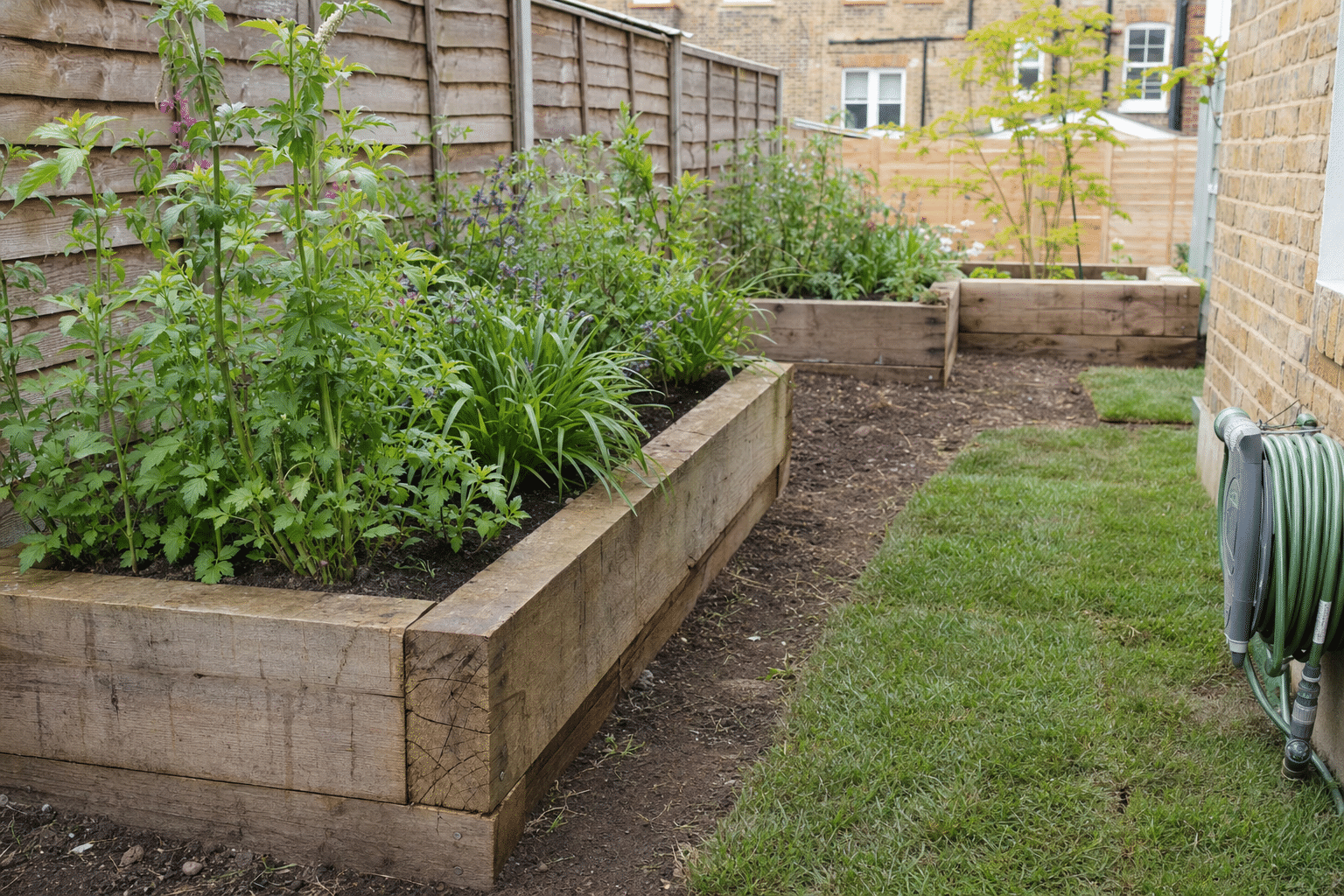 finished sleeper raised beds planted up in a clay back garden in Catford SE6
Raised Beds Across South East London Areas
In Blackheath SE3 and Eltham SE9 the gardens are bigger and usually have side access, so three or four beds go in together and the cost per bed drops.
In Peckham SE15 and Brockley SE4 it is terraced houses, so every sleeper and every bag of soil comes through the hallway. That adds hours and we say so in the quote rather than finding it on the day. Catford SE6 has a lot of gardens with a fall across them, which means stepped beds.
We also build beds in Sydenham SE26, Forest Hill SE23, East Dulwich SE22, Greenwich SE10, Woolwich SE18 and out into Bromley and Bexley. The full list is on the areas we cover page.
Raised Garden Beds in South East London FAQ
How much does it cost to build a raised garden bed in South East London?
A built timber bed is typically £40-£350 and a brick or stone one £150-£900 depending on size, market estimates across UK, not our rate, and London sits 10-25% above national figures. Our own beds are quoted after a free survey, with the written quote within 3 business days.
How deep should a raised bed be on London clay?
30cm minimum, 45cm if you want root vegetables, fruit bushes or shrubs. On clay we also break up the subsoil under the bed, which gives roots another spade’s depth without paying for more timber or more soil.
Do I need to dig out the clay underneath, or can you build straight on top?
Straight on top works if the garden drains at all. We still dig out a spade’s depth and fork the base, because clay left intact under a bed acts like the bottom of a bucket. Where a garden properly floods, we say so rather than building a bed that will sit in water.
What is the cheapest material for a raised bed that still lasts?
Pressure-treated softwood sleepers, around £15-£40 each from UK suppliers, market estimate, not our rate. The UC4 treated ones are rated for ground contact with a 15 year service life. Scaffold boards and fence boards are cheaper and bow apart within two or three wet winters.
How much topsoil and compost do I need to fill a raised bed?
A 2m x 1m bed at 45cm deep takes 0.9 cubic metres, which is about one and a half bulk bags. Mix seven parts topsoil, three parts compost and two parts sharp sand, and order 10% extra because it settles.
Are raised beds worth it in a small terraced garden?
Yes, and in a small garden they are usually the single best thing you can do with the budget. One 2m x 1m bed at a comfortable working height grows more than a whole clay border does. Our guide to growing your own vegetables in a small London garden covers what to put in it.
Can you build raised beds on a patio or on decking?
Yes. The bed needs to be 45cm deep because roots cannot reach the ground, and it needs drainage holes through the sides at the base. On decking we check the frame first, because a full bed weighs over a tonne and a half.
How long do timber raised beds last before they rot?
UC4 pressure-treated softwood sleepers carry a 15 year ground-contact service life and that matches what we see. Untreated softwood can go soft in 7. Oak lasts longer than both with no treatment. A liner between the timber and the soil buys you a few more years.
Can a raised bed go right against a neighbour’s boundary?
It can sit against your side of the boundary, but do not fix it to a fence that is not yours and do not let wet soil press against the panels, because that rots them from the bottom. We leave a 5cm gap, or build the bed free-standing. If the fence is already going, our garden fencing service sorts that first.
How Our Gardening Services Can Help
- Garden landscaping and design: raised beds, planting, paving and garden levelling, priced after a free on-site survey with the written quote in 3 business days
- Garden clearance: £85 per hour for a 2-person team, minimum 2 hours, tools and green waste removal included
- Garden maintenance: £83 for the first hour and £65 for every hour after, no minimum charge, which is what keeps the beds topped up and weeded once they are in
- Our 2026 price list and finished jobs across SE London, if you want to see the rates and the work before you ring
- Who we are: family-run from Eltham SE9 since 2016, 111 Google reviews, fully insured
Ready to get beds in before planting season?
Ask our landscaping team to design and build your raised beds →
Call us on 07760800457 or email office@urbangardeners.co.uk. Send photos of the spot and the way in, and you will have a price back within 24 hours.
Related reading
- Garden Waste Removal in SE London: What It Costs and Who Takes It
- Garden Tidy Up in South East London: 7 Things We Do (And What It Costs)
- Communal Garden Maintenance in South East London: Who Pays and What It Costs
- Waterlogged Garden in South East London: How to Fix It and What It Costs (2026)
- How Much Does Garden Clearance Cost in South East London? (2026 Price Guide)

0 comments