

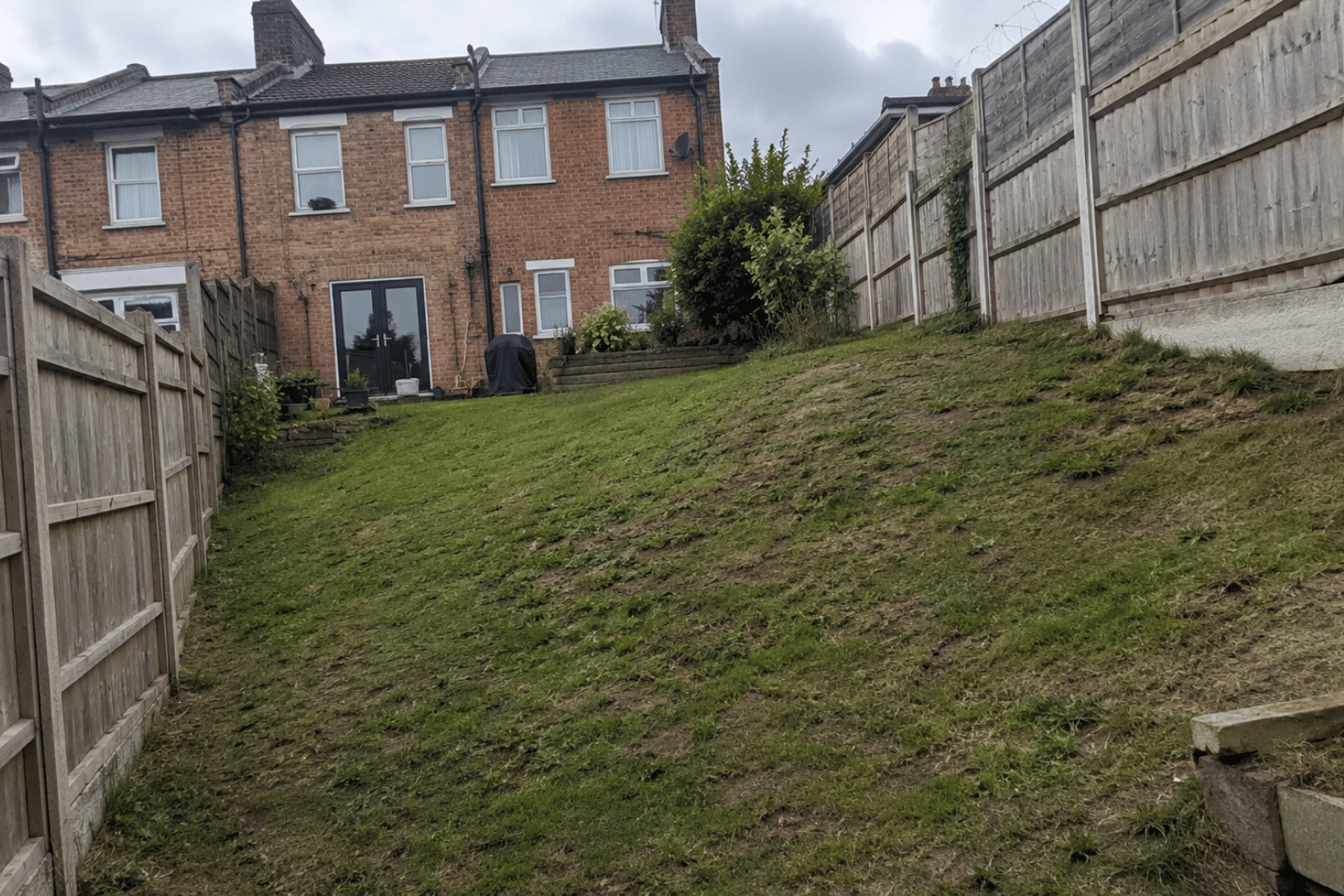
If your garden slopes so much that the trampoline sits at an angle, water pools at one end after every downpour, or mowing feels more like hillwalking, you're not imagining it. A lot of South East London gardens sit on genuinely uneven ground, and it's one of those problems that quietly makes everything else harder - from laying a patio to getting a lawn to establish properly.
This guide covers what garden levelling actually costs in South East London in 2026, the difference between full levelling and terracing, why our local geology causes this so often, and how to tell whether your garden is a straightforward day job or a bigger groundworks project.
The short answer: Urban Gardeners prices garden levelling at £90-£95 per hour for a two-person team with equipment included (prices subject to change at any time). It sits at the upper end of our rates because it's genuine groundworks - moving soil, machinery, sometimes retaining structures - rather than a standard maintenance or clearance job.
Got a sloped or uneven garden you want sorted? Book a free garden levelling survey or call 07760800457 (Mon-Sat 9am-6pm). We reply within 24 hours.
Why Trust These Prices?
Most garden levelling cost guides online are written by national directories pulling averages from across the whole UK. They'll tell you levelling costs anywhere from £100 to £8,000 - which is useless if you're trying to budget for an actual garden in Lewisham or Bromley.
We're different. Urban Gardeners has been operating across South East London since 2016, based in Eltham SE9. We've levelled sloped gardens on the hills of Blackheath, terraced steep plots in Forest Hill, and hand-dug soil through Victorian terraces in Brockley where a digger couldn't reach. The prices here are our real 2026 rates, and the advice comes from gardens we've actually stood in.
- 12+ years of hands-on groundworks experience across South East London's specific terrain
- 111 verified Google reviews at 4.5+ rating (Trustindex verified)
- Gardening and Landscape Design Business Diploma and Certificate
- Fully insured for all residential and commercial work
Browse our completed project portfolio to see real transformations, or read more about our team.
How Much Does Garden Levelling Cost in South East London? (2026)
Urban Gardeners prices garden levelling at £90-£95 per hour for a two-person team, tools and basic equipment included. This sits at the upper end of our hourly rates, alongside other groundworks-heavy jobs, because levelling genuinely involves moving soil rather than just tidying what's already there.
| Scope of Job | Rough Time | Estimated Cost |
|---|---|---|
| Small area, gentle slope (patio base prep, small lawn section) | 3-5 hours | £270-£475 |
| Medium garden, moderate slope, cut and fill | Full day (7-8 hours) | £630-£760 |
| Large or steep garden, terracing and retaining structures | Multiple days | Quoted after site visit |
Please note: garden levelling prices are subject to change at any time. The rates and estimates in this guide are accurate at the time of writing but may be updated without notice. For a confirmed, current price, contact us directly or book a free survey.
For a small, straightforward job, we can often give you a realistic estimate from photos. For anything involving a genuine slope, a larger area, or possible retaining walls, this becomes a project-based job like our garden landscaping and design service, and we'll always do a free on-site survey before confirming a final price - the same way we handle turfing, decking, and fencing.
A note on national pricing guides: Many online calculators quote garden levelling as a flat day-rate or a price per square metre without accounting for what's underneath the surface. A garden that just needs the top few centimetres evened out is a completely different job to one where soil has to be genuinely moved from one end to the other - and that difference isn't visible from a photo taken standing at the back door. This is exactly why the national sites give you a £100-£8,000 range that helps nobody.
If you're comparing levelling against other garden projects, our complete 2026 gardener cost guide for South East London covers every service we offer side by side.
Get an accurate price for your specific garden - book a free survey.
Full Levelling vs Terracing: Which Does Your Garden Need?
This is the first thing worth understanding, because it changes the whole approach and the cost.
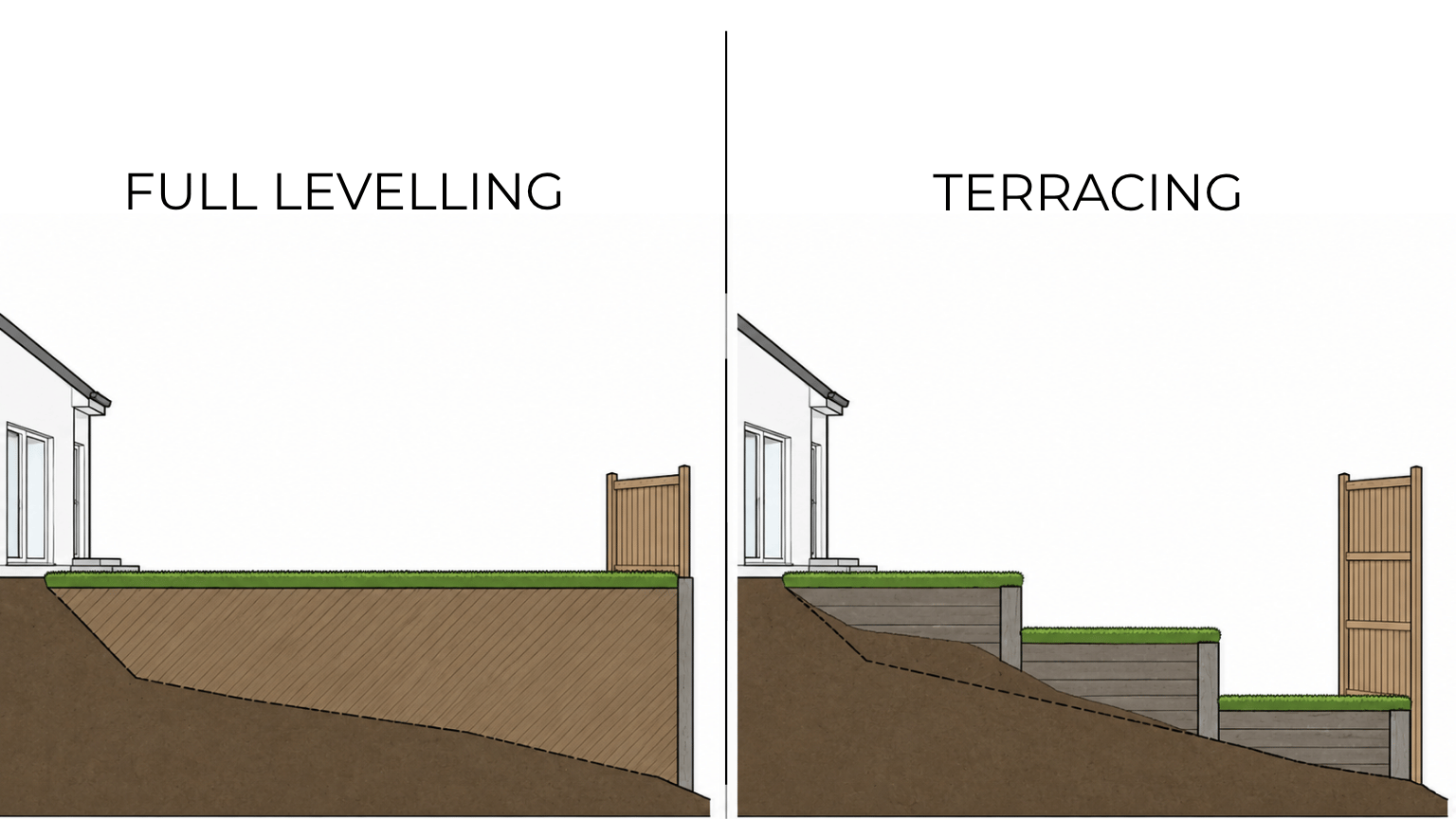
Full levelling works for gentle slopes, generally up to around a 1:10 gradient (roughly a 1 metre drop over 10 metres of garden). Soil is cut from the higher side and redistributed to the lower side until the whole area sits at one consistent level. This is the right approach for a garden heading toward a single flat lawn, a full-width patio, or a simple play area.
Terracing is usually the better answer for steeper gardens. Instead of forcing the whole plot flat, the garden is divided into a series of level platforms stepped down the slope, held in place by retaining walls or sleepers. This suits larger or steeper gardens where you actually want distinct zones - a seating area near the house, a lawn level below it, planting further down - rather than one uniform surface.
If your garden is on the steeper end, terraced decking is also worth considering as an alternative to full groundworks. It steps down the slope on a built structure rather than requiring soil to be moved, which can work out more cost-effective on genuinely steep plots. Our decking cost guide for South East London covers this in more detail.
A client in Honor Oak came to us convinced they needed their whole garden dug flat. It fell about 1.4 metres front to back over a 9-metre garden - too steep for comfortable full levelling without a retaining wall taller than they wanted. We terraced it into two levels instead: a patio platform by the house and a lawn level below, split by a low sleeper wall. It cost less than full levelling would have, kept more of their usable space, and gave them a far more interesting garden than one flat rectangle. The right answer often isn't the one people walk in expecting.
Why South East London Gardens Are So Prone to Slopes
This is where we can tell you things the national cost guides simply can't, because it comes down to the specific geography under your feet.
The North Downs ridge. A band of South East London sits on genuinely high, sloping ground where the land rises toward the North Downs. Forest Hill, Sydenham, and Crystal Palace are the clearest examples - Crystal Palace sits at one of the highest points in London, and gardens on these slopes were often built to follow the natural fall of the land rather than being properly graded when the houses went up.
Blackheath and Greenwich. Blackheath SE3 sits on elevated ground, and the streets running down toward Lewisham and Greenwich carry a real gradient. Gardens on these roads frequently slope noticeably from back to front, often on larger plots where terracing makes more sense than full levelling.
Bromley and Orpington. Bromley and Orpington have more varied ground than the flatter inner boroughs, with larger gardens that frequently include a genuinely sloped section - the kind of plot where a level lawn near the house gives way to a bank at the bottom.
Then there's the soil. Most of South East London sits on heavy London clay, which drains poorly, compacts under weight, and shifts as it dries out in summer. On sloped ground this becomes a bigger problem than on flat ground, because water doesn't just sit - it runs, carrying topsoil with it and eroding the lower sections of the garden over time. A slope that looked manageable when the garden was new can genuinely get worse year on year without intervention. This is also why levelling and drainage have to be planned together on clay - more on that below.
What's Included in Our Garden Levelling Service
- Assessment of the gradient and ground conditions before any work starts
- Cutting and redistributing soil to achieve a level or terraced surface, depending on the approach agreed
- Compaction of the levelled ground to create a stable base
- Removal of excess spoil where cut and fill doesn't balance out on site
- Basic grading to ensure water moves away from the house and toward appropriate drainage points
What's not included as standard:
- Retaining wall construction (available separately, priced after survey based on materials and height)
- Turf, patio, or decking installation on top of the levelled ground (separate services, though often booked together)
- French drains or other dedicated drainage systems beyond basic grading
- Structural work near existing foundations or boundary walls
We'll always confirm the full scope before starting, and flag anything that needs a specialist survey or additional permissions before doing extra work.
What Affects the Final Cost
Gradient and steepness. The steeper the slope, the more soil has to move, and the more likely the job needs retaining structures rather than a simple cut and fill. A gentle 1:15 slope is a straightforward day's work. A 1:4 slope on a decent-sized garden is a genuinely different job.
Size of the area. More square metres means more soil to move and compact - the single biggest driver of time on most levelling jobs.
Soil type and ground conditions. London clay is denser and harder to work than sandy or loamy soil, which means more time and often more effort per cubic metre moved. Buried rubble, old foundations, or tree roots (common in older SE London gardens) can also slow things down significantly once we start digging.
Access. A garden reachable from the side with a mini-digger is a very different job to one only accessible through the house. In parts of Brockley, New Cross, Deptford, and Peckham where Victorian terraces are built right up to the boundary, every barrowload of soil sometimes has to be moved by hand through the property, which adds real time to the job.
Cut and fill balance. If the soil removed from the high side is enough to build up the low side, spoil doesn't need to leave the site, which keeps costs down. If there's a surplus, or the ground needs imported topsoil to finish properly, that adds to the total.
Whether retaining structures are needed. Terracing with sleepers or a low retaining wall adds materials and construction time on top of the base levelling work. This is quoted separately once the survey confirms what the slope actually needs.
Real example: We quoted two jobs the same week that looked almost identical on paper - both around 40m2, both a moderate slope, one in Catford and one in Lee. The Lee garden had side access, so we brought a mini-digger in and finished cut-and-fill in a single day: about £680. The Catford garden was a mid-terrace with no side gate, so every barrowload went through the hallway by hand. Same slope, same size - but it took a day and a half and came to around £1,000. Access is the hidden cost the national guides never mention.
Ready to get your garden onto level ground?
£90-£95 per hour for a two-person team. Free survey for anything beyond a small area.
Explore our services: Garden Landscaping and Design, Turfing, or Decking Installation.
Do You Need Planning Permission for Garden Levelling?
For most standard residential gardens, straightforward levelling doesn't require planning permission. That said, a few things are worth being aware of before you start.
Retaining walls above a certain height can fall under building regulations rather than planning permission specifically, particularly if they're structural or near a boundary. If your project involves a wall of any real height, it's worth checking with your local council before work begins, and we'll flag anything that looks like it needs this during the site survey.
The Party Wall Act may be relevant if your levelling work is close to a shared boundary or could affect a neighbour's fence, wall, or foundations. This is more likely to come up with terracing and retaining walls than with a simple cut-and-fill job on a gentle slope.
Conservation areas and listed properties. If you're in a conservation area (parts of Blackheath and Greenwich are), or your property is listed, it's always worth a quick check with the council before any significant groundworks - even if the work itself would normally be permitted.
We're not planning consultants, so for anything borderline we'll always recommend confirming with your local authority rather than guessing. But for the vast majority of garden levelling jobs we do across South East London, this isn't something that ends up being a problem.
Garden Levelling and Drainage: Getting It Right First Time
Levelling and drainage go hand in hand, and this is where a lot of DIY attempts and rushed jobs go wrong.
A garden that's perfectly flat but has nowhere for water to go is often worse off than one with a gentle, intentional slope away from the house. Professional levelling isn't just about making the ground even - it's about grading it so water moves where you want it to go rather than pooling against a wall or flowing back toward the house.
This matters even more on South East London's clay-heavy soil, which already drains slowly. If your garden has had ongoing waterlogging or flooding issues, read our guides on dealing with poor drainage in South East London gardens and managing flooding and mud during the rainy season alongside this one, since levelling and drainage work are often best planned together rather than as separate projects.
DIY Garden Levelling vs Professional
Garden levelling is one of the jobs where the gap between DIY and professional results tends to be the widest.
The physical reality. Moving soil by hand is genuinely hard, slow work. A moderate garden can involve shifting several tonnes of soil, and doing it with a spade and wheelbarrow over a weekend is realistic only for very small areas. Anything beyond a small patch typically needs machinery to be worth doing properly.
The compaction problem. This is the part most DIY attempts miss. Soil that's been moved needs to be properly compacted, not just raked flat, or it will settle unevenly over the following months, undoing the work. Professional teams use compaction equipment appropriate to the ground; without it, a lawn or patio laid on freshly moved soil often develops dips and uneven patches within a season.
The drainage risk. Getting the grading wrong is the single most common DIY mistake. It's easy to level a garden and accidentally create a new low point where water now collects - sometimes closer to the house than the original problem. This is where professional experience with SE London's clay soil genuinely pays off.
DIY makes sense for: very small areas, gentle unevenness rather than a genuine slope, and projects where you're comfortable hiring and operating compaction equipment properly.
Professional makes sense for: anything involving a real gradient, gardens where the levelled area will support a patio, decking, or a lawn you actually want to last, and any job where getting the drainage wrong would be expensive to fix later.
Not sure which side of that line your garden falls on? Send us a few photos and we'll give you an honest read - even if the answer is that you can handle it yourself.
Best Time of Year for Garden Levelling
Garden levelling can be done at most points in the year, but a few seasonal factors are worth knowing.
Drier periods - typically spring through early autumn - make the groundwork itself easier and faster. South East London's clay soil becomes significantly harder to work after a wet winter, when it holds water and turns heavy and sticky, which can slow down excavation and compaction.
If levelling is the first phase of a bigger project that includes turfing, timing the levelling to finish shortly before the ideal turf-laying window makes sense. Our guide on the best time to lay turf in South East London covers this if you're planning both together.
Winter levelling is still possible as long as the ground isn't frozen or completely waterlogged, but expect the job to take somewhat longer on heavy clay in the wetter months. Spring and summer also book up fastest - if you want the work done for summer, getting your survey booked in late winter gives you the best choice of dates.
Garden Levelling Across South East London
We handle garden levelling across South East London regularly, and it tends to show up in a consistent pattern by area.
In Blackheath SE3, some of the more elevated streets have gardens with a genuine, noticeable slope, often on larger plots where terracing makes more sense than full levelling.
In Eltham SE9 and Charlton SE7, we see a mix of flat, straightforward terrace gardens and pockets of more uneven ground depending on how close a property sits to the higher parts of these areas.
In Catford SE6 and Brockley SE4, gardens tend to be smaller and more consistently level, but access through Victorian terraces without side entry is the bigger cost factor here rather than the slope itself.
We also regularly handle larger sloped plots in Bromley and Orpington, and higher-ground areas including Forest Hill, Sydenham, and Crystal Palace. Visit our Areas We Cover page
Garden Levelling in South East London FAQ
Full levelling cuts soil from the high side and moves it to the low side until the whole garden sits at one consistent level - best for gentle slopes up to around 1:10. Terracing divides a steeper garden into stepped level platforms held by retaining walls or sleepers, keeping more usable space and creating distinct zones. Steeper gardens are usually better terraced than forced flat.
For most standard residential gardens, no. Planning permission generally isn't required for straightforward levelling. However, retaining walls above a certain height may fall under building regulations, and the Party Wall Act can apply if work affects a shared boundary. If you're in a conservation area or a listed property, check with your council first. We flag anything relevant during the survey.
It can, if done correctly - proper levelling includes grading the ground so water flows away from the house toward suitable drainage points. But levelling done badly can make drainage worse by creating new low spots where water collects. On South East London's clay soil, levelling and drainage should be planned together. For serious waterlogging, a dedicated drainage solution may be needed alongside the levelling.
For very small areas with gentle unevenness, yes - minor topdressing and raking is manageable DIY. For anything involving a genuine slope, tonnes of soil, or ground that will support a patio or lawn, it's professional work. The two things DIY attempts most often get wrong are compaction (leading to sinking and dips within a season) and grading (accidentally creating new drainage problems).
Where cut-and-fill balances out on site, no soil needs to leave - which keeps costs down. Where there's a surplus, we remove the excess spoil and this is quoted as part of the job. If the ground needs imported topsoil to finish properly, that's factored into the quote too.
Level first, then landscape - levelling is almost always the groundwork phase that everything else sits on top of. That said, tell us your end goal at the quote stage. If you already know you want turf, a patio, or decking, we can price and schedule the whole project together rather than treating levelling as a standalone job.
How Our Gardening Services Can Help
Garden levelling is very often the first step in a bigger project. Here are the services South East London customers most commonly book alongside it:
- Garden landscaping and design - full redesigns that typically start with levelling as the first phase
- Turfing - a fresh, level lawn once the ground is properly prepared, £15-£28 per sqm
- Decking installation - including terraced decking as an alternative to full levelling on steeper plots
- Garden clearance - if the sloped area is also overgrown and needs clearing before levelling can start, £85/hour
- Bamboo removal - if invasive rhizomes are part of what's making the ground unworkable, £80-£85/hour
- Hedge trimming - to reshape boundary planting once the levelled ground gives you a clean line to work with, £83 first hour, £65 after
- Garden fencing - a fresh boundary once levelling and any retaining structures are complete
Not sure whether your garden needs full levelling, terracing, or just better drainage? Send us a few photos and we'll give you an honest read on what it actually needs. Call 07760800457 (Mon-Sat 9am-6pm) - we reply within 24 hours.
You Might Also Like
Garden Levelling Cost in South East London: Sloped Gardens, Patios and Lawns (2026)
If your garden slopes so much that the trampoline sits at an
Best Time to Lay Turf in South East London (Month-by-Month Guide)

How Much Does Garden Landscaping Cost in South East London? (2026 Price Guide)
If you've ever tried to get a straight answer on garden landscaping

0 comments