

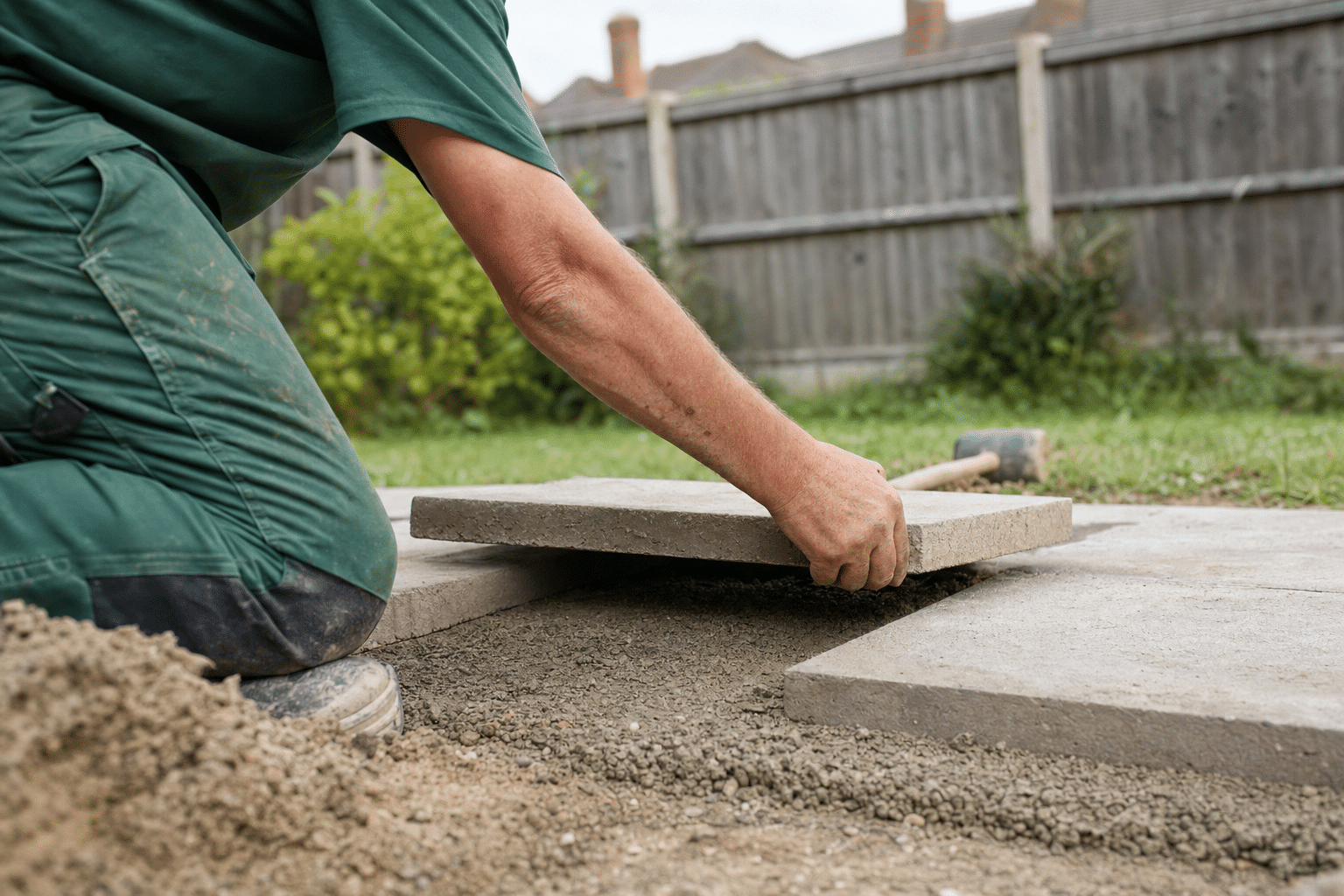
The car is parked two roads away again, the wheelie bins are chained to the railings because there is nowhere else for them, and the strip of grass at the front has been mud and dandelions since spring. So you start pricing a paved front garden, and within ten minutes you have read that you need planning permission, that you definitely do not, and that your neighbour did it in a weekend and nothing happened.
All three can be true on the same street. Here is what paving a front garden actually needs in South East London, which surfaces you can lay with no application at all, and the two local things that catch people out: the council ramp across the pavement, and London clay.
What’s in this guide
- The Short Answer: It Is the Surface, Not the Size
- Paving a Front Garden and Planning Permission: the Full Rule (2026)
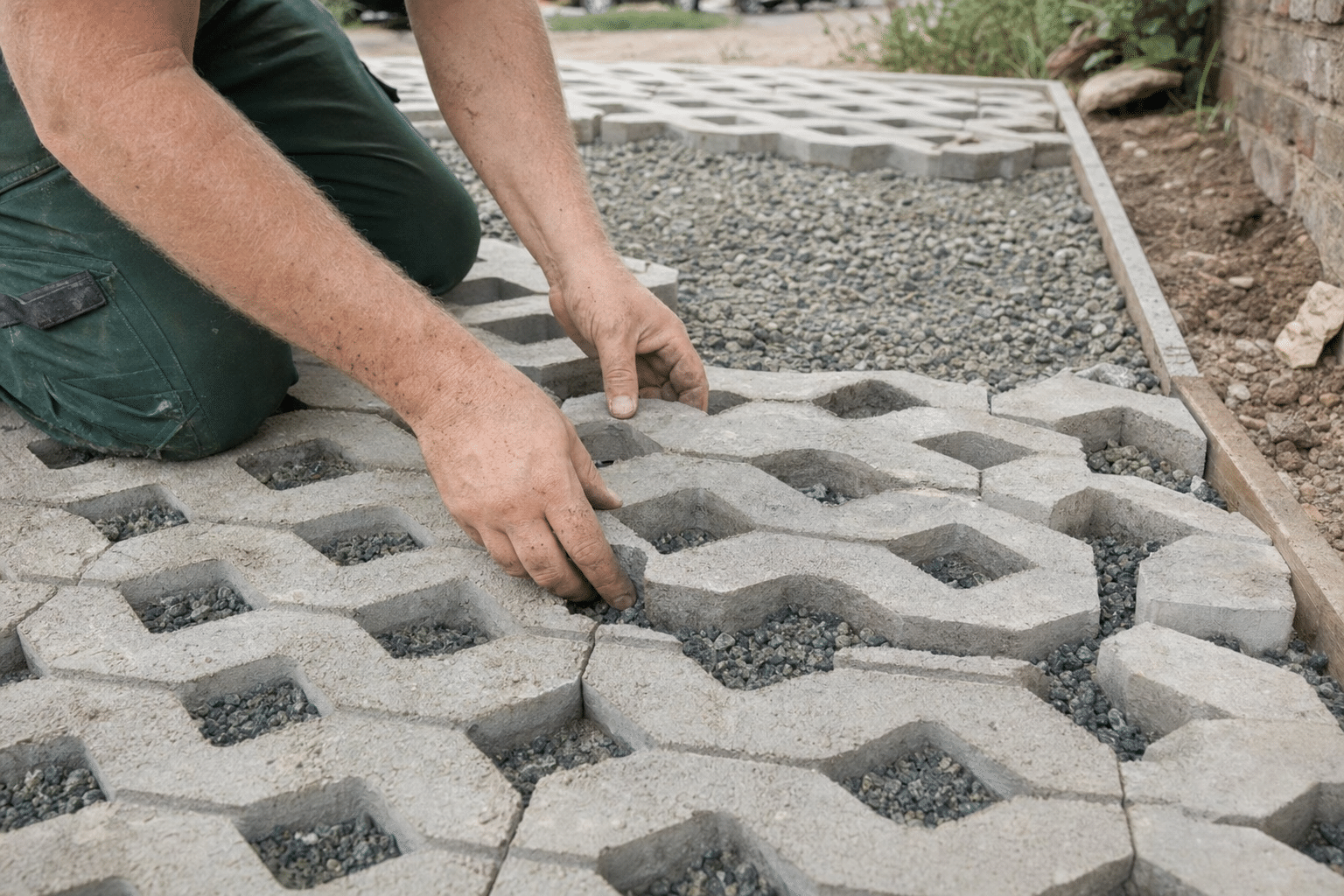
- What Counts as Permeable, and What Does Not
- The London Clay Problem: Why “Drain It Into the Border” Usually Fails Here
- What Clay Changes About the Build-Up Under the Paving
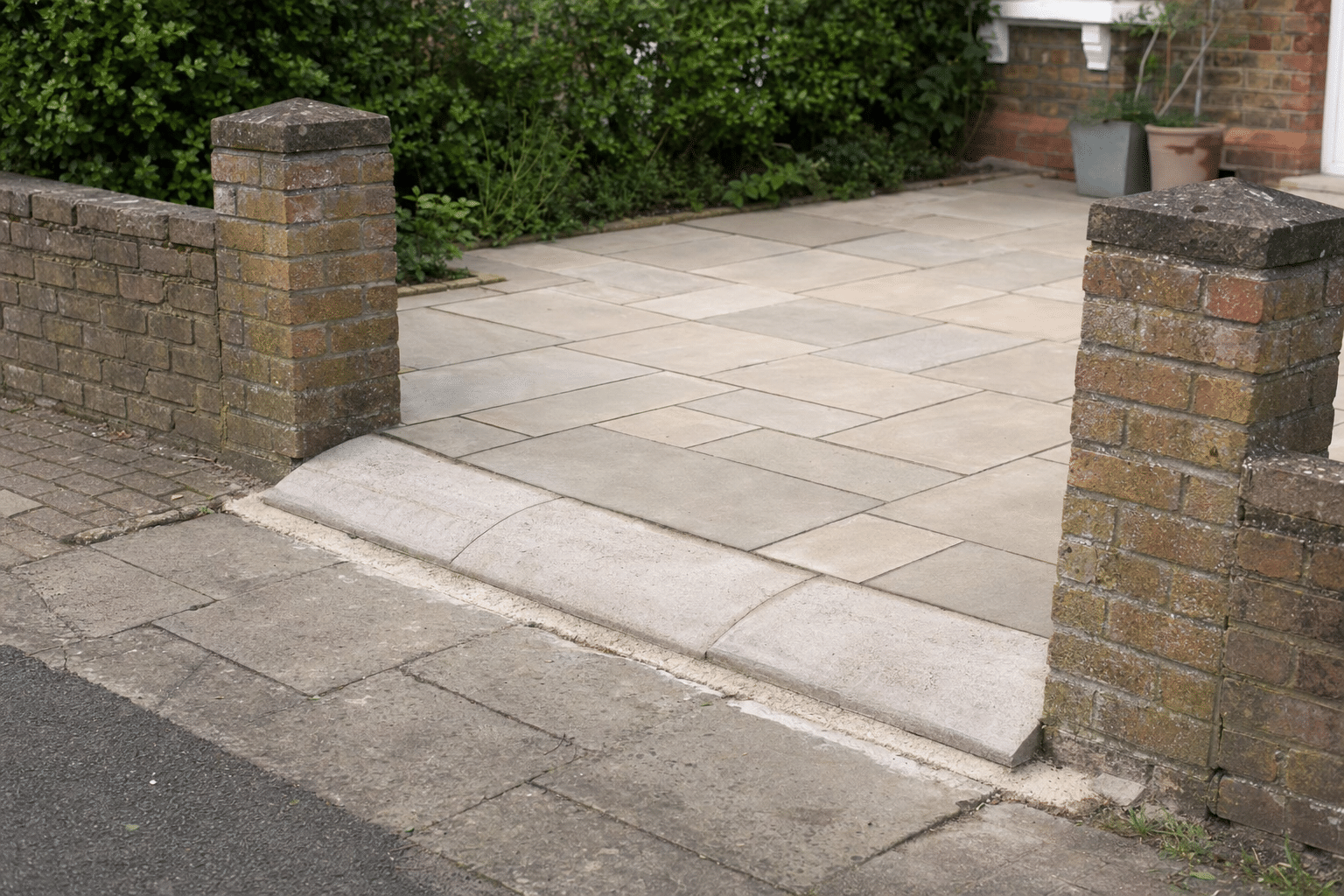
- Permission to Pave Is Not Permission to Drive Over the Pavement
- What Your Borough Charges for a Crossover
- Bin Store, Bike Store or Parking Space: Three Different Jobs
- What Is Included in a Front Garden Quote, and What Is Not
- What Changes the Price
- Best Time of Year to Pave a Front Garden in South East London
- DIY vs a Landscaping Team
- Front Gardens Area by Area in South East London
- Front Garden Paving FAQ
- How Our Services Can Help
- Posts You Might Like
The Short Answer: It Is the Surface, Not the Size
If the surface lets rainwater soak through, you can pave the whole front garden with no planning permission. Gravel, permeable block paving (blocks with wider gaps and loose stone between them, so water runs down instead of off), porous asphalt and resin-bound gravel all count.
If the surface is solid and sheds water, you can only lay 5 square metres of it before you need planning permission. Concrete, tarmac, standard block paving and sealed imprinted concrete are all solid. The government’s guidance on permeable surfacing of front gardens has worked this way since 1 October 2008.
There is a get-out: solid paving is also fine if the rainwater runs off into a lawn or border instead of the road. On London clay that is the part that fails, and we come back to it below.
Not sure if what you want needs permission?
Send us photos of your front garden and we’ll tell you what you can lay →
Paving a Front Garden and Planning Permission: the Full Rule (2026)
The permission question has three parts, and you have to pass all three.
Part one, the surface. Permeable, and the size does not matter. Solid, and 5 square metres is your limit, about one parking bay’s worth of slabs.
Part two, your property type. The permitted development rules that let you pave freely apply to houses, not to flats and maisonettes, converted houses, or homes created under certain permitted development rights. If your SE22 terrace was split into two flats, you apply whatever you lay.
Part three, what sits on top of your address. A conservation area, a listed building, or an Article 4 Direction (a notice your council puts on a street to switch off permitted development rights there) all change the answer. Parts of Blackheath, Dulwich, Greenwich and Brockley are conservation areas, and in those roads the front garden is part of what the designation protects.
What Counts as Permeable, and What Does Not
This is where most quotes go wrong. Two surfaces can look identical from the pavement and sit on opposite sides of the rule.
| Surface | Does water soak through? | Planning permission over 5m2? | Typical installed cost |
|---|---|---|---|
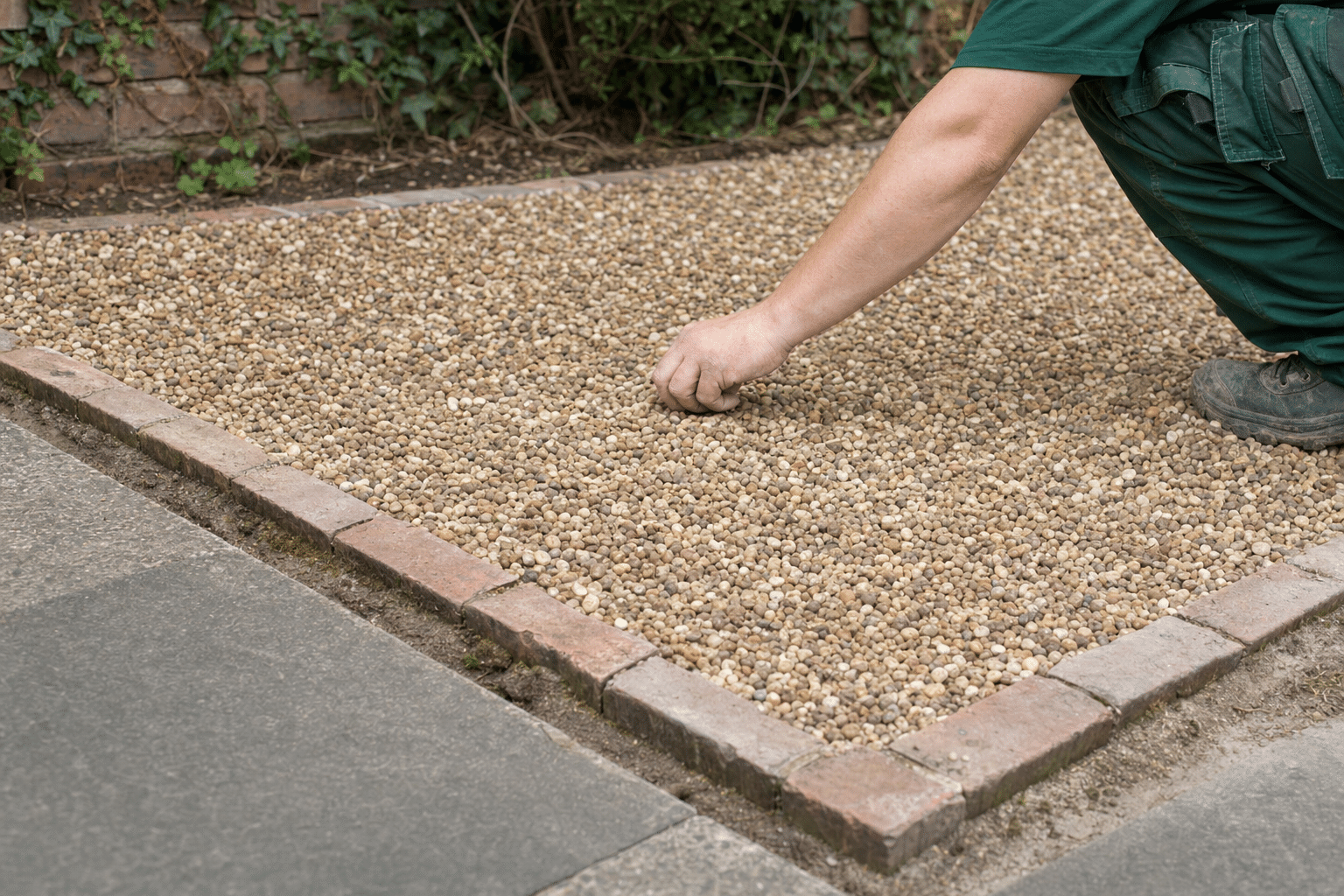
| Loose gravel | Yes | No | £40-£70 per m2, market estimate across the UK, not our rate |
| Permeable block paving | Yes, through the gaps | No | £130-£180 per m2, market estimate across the UK, not our rate |
| Resin-bound gravel | Yes, if the base under it is porous too | No | £60-£130 per m2, market estimate across the UK, not our rate |
| Standard block paving | No, it sheds off the top | Yes, unless the water goes to a border | £80-£140 per m2, market estimate across the UK, not our rate |
| Concrete or tarmac | No | Yes, unless the water goes to a border | £50-£100 per m2, market estimate across the UK, not our rate |
Those are realistic starting points for budgeting, gathered from UK cost guides, not a quote from us, and London usually sits 10% to 25% above national figures. We do not publish a per square metre paving rate and will not invent one: front garden work is priced after a free survey, with the written quote in your inbox within 3 business days.
One trap worth naming. Resin-bound gravel is only permeable if the layer under it is porous too. Poured over old concrete it looks permeable, drains like a sealed surface, and puts you back over the 5 square metre line.
The London Clay Problem: Why “Drain It Into the Border” Usually Fails Here
The rules let you lay a solid surface of any size as long as the rain runs off to a lawn or a planted border. On paper that is the cheapest way through. Under most of South East London it does not work.
Greater London drainage reports put the soak rate of London clay at roughly 0.4 to 4 millimetres an hour. A border taking the runoff from 20 square metres of concrete has to swallow several hundred litres in a heavy hour. Clay will not take it at that speed, so the water sits, then finds the lowest point, usually your own front door threshold or the neighbour’s.
You can see it on any SE6 or SE4 street after a downpour: a puddle still there the next morning, and a green tidemark across the slabs. It is the same clay behaviour behind poor drainage in South East London, and it is cheaper to design out at the build stage than to fix later.
What Clay Changes About the Build-Up Under the Paving
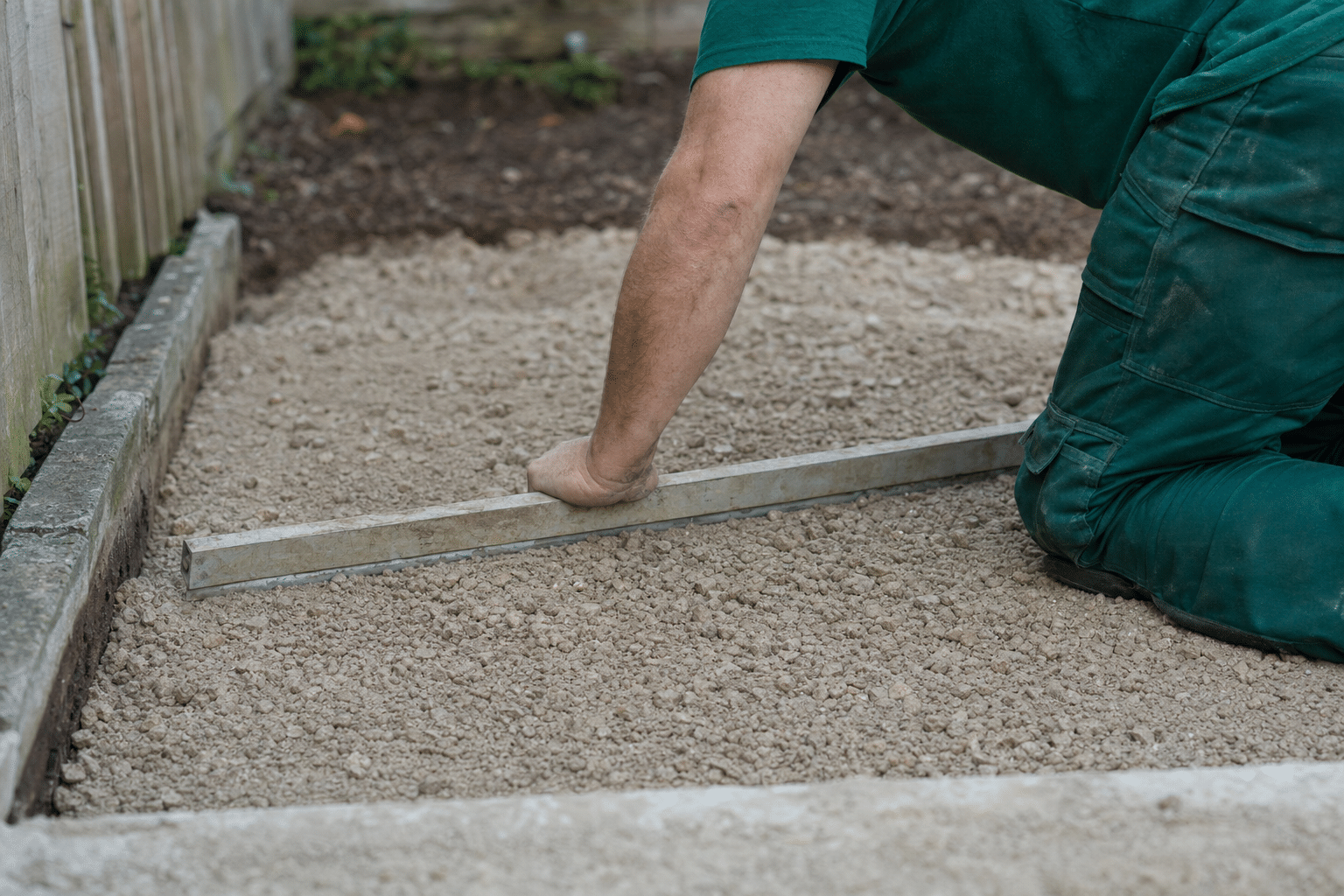
On free-draining ground, a front garden drive is a compacted stone layer with sand and blocks on top. On clay we build it to hold the water and release it slowly, because nothing is draining away underneath.
That means an open-graded stone layer, stone all one size with no fines filling the gaps, so roughly a third of it is empty space that fills with rainwater during a storm. It goes in deeper than a standard build-up, usually 250mm to 350mm rather than 150mm, with a liner and an outlet pipe at one end feeding your existing surface water drain at a controlled trickle.
It costs more and takes an extra day. Anyone quoting a clay front garden on a 150mm base has not looked at the ground.
Permission to Pave Is Not Permission to Drive Over the Pavement
You can have every planning box ticked and still not be allowed to park on your own front garden. The pavement outside your house belongs to the council, and driving across it without a vehicle crossover (the lowered kerb and strengthened footway the council builds, often called a dropped kerb) is against the law. Pavements are built for feet, not for a 1.5 tonne car, so the council builds a reinforced section at your cost.
This is a separate application to a separate department, and planning permission does not include it. You apply to your borough’s highways team, an inspector checks sight lines and street furniture, and the council sends a price. If the crossover is refused, your new paving is a smart patio with nowhere to park, so get that answer before you order materials.
Planning the front garden around a parking space?
Book a free survey and we’ll sequence the crossover and the paving for you →
What Your Borough Charges for a Crossover
These are council charges, published by the councils themselves, reviewed every April, and none of them is our rate.
Bexley lists a £60 application fee, a £1,433 traffic management order fee, a £240 utility inspection fee and construction from £1,750 depending on the size of the crossing, which is Bexley Council’s price, not our rate.
Lewisham works the cost out per square metre of footway, aims to send the estimate within five working weeks, and charges £137 on average for the optional white bar marking across your crossover, which is Lewisham Council’s price and again not our rate. Lewisham also requires their own highway contractor to do the kerb work, so no landscaper can do that part for you, us included.
In a controlled parking zone, expect a further charge for redrawing the bay markings and amending the traffic order. Budget the crossover separately from the paving and nothing lands on you halfway through.
Bin Store, Bike Store or Parking Space: Three Different Jobs
People use the word “paving” for all three, and the permissions are not the same.
A bin and bike store needs a hard, level standing of about 2 to 3 square metres. That is under the 5 square metre line even in solid concrete, so it almost never needs planning permission, and it never needs a crossover because nothing drives over the pavement. It is the quickest front garden job we do.
A front path and a planted strip is the same story. No car, no crossover, and if you keep the solid paving to the path and gravel the rest, there is no application at all.
A parking space is the one with paperwork: permission if the surface is solid and over 5 square metres, a crossover application, and the clay build-up underneath, because a car load needs more than a path does.
If you only want the bins off the front wall, say so when you ask for a quote. It is a far smaller job than the one most people describe.
What Is Included in a Front Garden Quote, and What Is Not
Included in our garden landscaping and design quotes for a front garden:
- Free on-site survey, written quote within 3 business days
- Lifting out the old surface, soil or grass
- Digging to depth and compacting the ground
- The stone layer, the liner and the outlet where clay needs one
- Edging, the paving or gravel, laying and jointing
- Making good where the new surface meets your path, steps or wall
Not included, and we say so before you sign:
- The council crossover and dropped kerb. Their work, their fee, never ours
- The planning application, if your surface needs one
- Utility covers, water meters or lamp columns that have to be moved
- Waste disposal, quoted separately and confirmed before anything leaves
- Gates, railings and front walls, which are garden fencing work on their own survey
What Changes the Price
How Much Comes Out Before Anything Goes Down
A front garden with 150mm of soil and a privet stump in it is a dig-out before it is a paving job. Where the front is overgrown we clear it first under garden clearance at £85 per hour for a 2-person team, all tools included, then pave on clean ground.
Access and Parking
Everything comes in and out through the front, which sounds easy until the road is a controlled parking zone with no loading bay. Our team arrives in a transit van and needs somewhere to put it; any parking or congestion charge goes on the invoice, confirmed with you first.
How Deep the Ground Has to Go
A bin standing needs 100mm of stone. A car space on clay needs 250mm to 350mm. That is two to three times the digging, the stone and the spoil leaving site, and it is the single biggest swing in a front garden price.
Levels and Falls
Front gardens in SE London are rarely flat. A Victorian terrace often sits a step or two above the pavement, and the new surface has to fall away from the house without leaving a kerb-height step at the gate.
Where the Water Is Going
An outlet into an existing drain is cheap. No drain nearby, and the stone store has to hold a whole storm, which adds depth across the whole area.
Best Time of Year to Pave a Front Garden in South East London
September to November is the best window. The clay is still workable, the ground is not yet saturated, and crossover applications are quieter than they are in spring. Work booked now gets the survey done before the weather turns.
December to February is possible but slower. Clay that has taken six weeks of rain turns to glue, machines churn it, and digging out costs more hours.
March to August is the busiest stretch and the one to book early. If a hedge or mature shrubs are coming out of the front garden first, check for nests before anyone cuts: bird nesting season runs March to August under the Wildlife and Countryside Act 1981, and an active nest stops the job until the birds have fledged.
DIY vs a Landscaping Team
Gravel over a membrane on a small front garden is a good DIY weekend. Edging, membrane and 50mm of 20mm gravel for 10 square metres runs about £250-£400 in materials from UK suppliers, market estimate, not our rate.
What catches people out is the spoil. Taking 300mm off 20 square metres is 6 cubic metres of London clay, about 9 tonnes, and no car boot is taking that to the tip. Councils charge for soil and hardcore at household waste sites, and clay is heavy enough that a skip fills before it looks full. That is why we cover what garden waste removal costs and who takes it separately.
DIY makes sense for: loose gravel over a membrane, a bin standing under 3 square metres, re-laying a few lifted path slabs, and anyone happy to hire a van for the spoil.
Professional makes sense for: anything a car will park on, anything needing a dug depth over 150mm, clay ground with nowhere obvious for the water to go, and any job that has to tie into an existing step, wall or drain.
Got an old concrete front garden you want gone first?
Front Gardens Area by Area in South East London
In Blackheath SE3 and Eltham SE9 the front gardens are deeper, so there is room to park a car and still keep a planted strip along the boundary. Keep it: it soaks up some of the rain.
In Catford SE6 and Brockley SE4 the terraced fronts are small and often raised above the pavement, so the job is as much about levels and a tidy step as it is about the paving. Several Brockley roads sit inside a conservation area, so check before you order.
In Peckham SE15 and Camberwell SE5 a lot of houses are split into flats, which takes the permitted development route off the table entirely and means an application whatever you lay.
In Woolwich SE18 and Lewisham SE13, Victorian terraces and newer builds sit on the same road with different ground under them, so we dig a trial hole before quoting.
We cover the SE postcodes plus Bromley, Bexley and Dartford: the full list is on our areas we cover page.
Front Garden Paving FAQ
Do I need planning permission to gravel my front garden?
No. Gravel lets water soak straight through, so you can cover the whole front garden at any size without an application. You still need a vehicle crossover from your borough before you drive onto it.
Is 5 square metres of concrete really allowed with no permission?
Yes, on a house, outside a conservation area, with no Article 4 Direction on your road. Over 5 square metres of solid surface you need permission unless the rainwater goes to a lawn or border, which on London clay often will not cope.
Can I pave my front garden if I live in a flat?
Not under permitted development. Those rules apply to houses, so a flat or maisonette needs a planning application for any front garden paving, permeable or not, plus the freeholder’s consent.
What happens if I pave over without permission?
Your council can serve an enforcement notice requiring you to take it up, and it can show up as a problem on the searches when you sell. It is a cheaper conversation before the job than after.
Does a permeable driveway still need a dropped kerb?
Yes. The surface rules and the pavement rules are separate. Permeable paving removes the planning application and does nothing about the crossover, which your borough still has to approve and build.
How long does a front garden paving job take?
A bin and bike standing is a day. A single parking space on clay, dug to depth with a stone store and an outlet, is usually 3 to 4 days for a 2-person team, plus the council’s own crossover timetable, which runs in weeks.
Can you just clean the paving that is already there?
Often, yes, and it is far cheaper than relaying. We charge £4 per square metre for patio and driveway cleaning, minimum £140 covering up to 40 square metres, with no harsh chemicals. Send a photo and we will tell you honestly whether it will come back up.
How Our Services Can Help
- Front garden paving, driveways and redesigns: free survey, written quote within 3 business days
- Clearing an overgrown front garden first: £85 per hour, 2-person team, all tools included
- Jet washing an existing drive or path: £4 per square metre, minimum £140 up to 40 square metres
- Keeping the planted strip and front hedge tidy: £83 for the first hour and £65 for every hour after, no minimum charge
- New front boundary fencing, gates and trellis: free survey, materials, labour, posts and concrete in the quote
Our rate card is on the prices page, finished jobs are in the portfolio, and the people who actually turn up are on the about us page. We are a family-run team in Eltham SE9, working across South East London since 2016.
Want the front garden sorted before the winter rain?
Posts You Might Like
- How much garden landscaping costs in South East London
- Outdoor tiling and patio paving in South East London
- Fixing a waterlogged garden on London clay
- Getting your garden ready to sell in South East London
Related reading
- Garden Fence on a Railway or Council Boundary in SE London: Who Repairs It and Who Pays
- Arranging Garden Maintenance for an Elderly Parent in SE London: Who Helps and What It Costs
- Rats Moving Into Overgrown South East London Gardens Before Winter: What Actually Stops Them
- Garden Waste Removal in SE London: What It Costs and Who Takes It
- Garden Tidy Up in South East London: 7 Things We Do (And What It Costs)

0 comments