

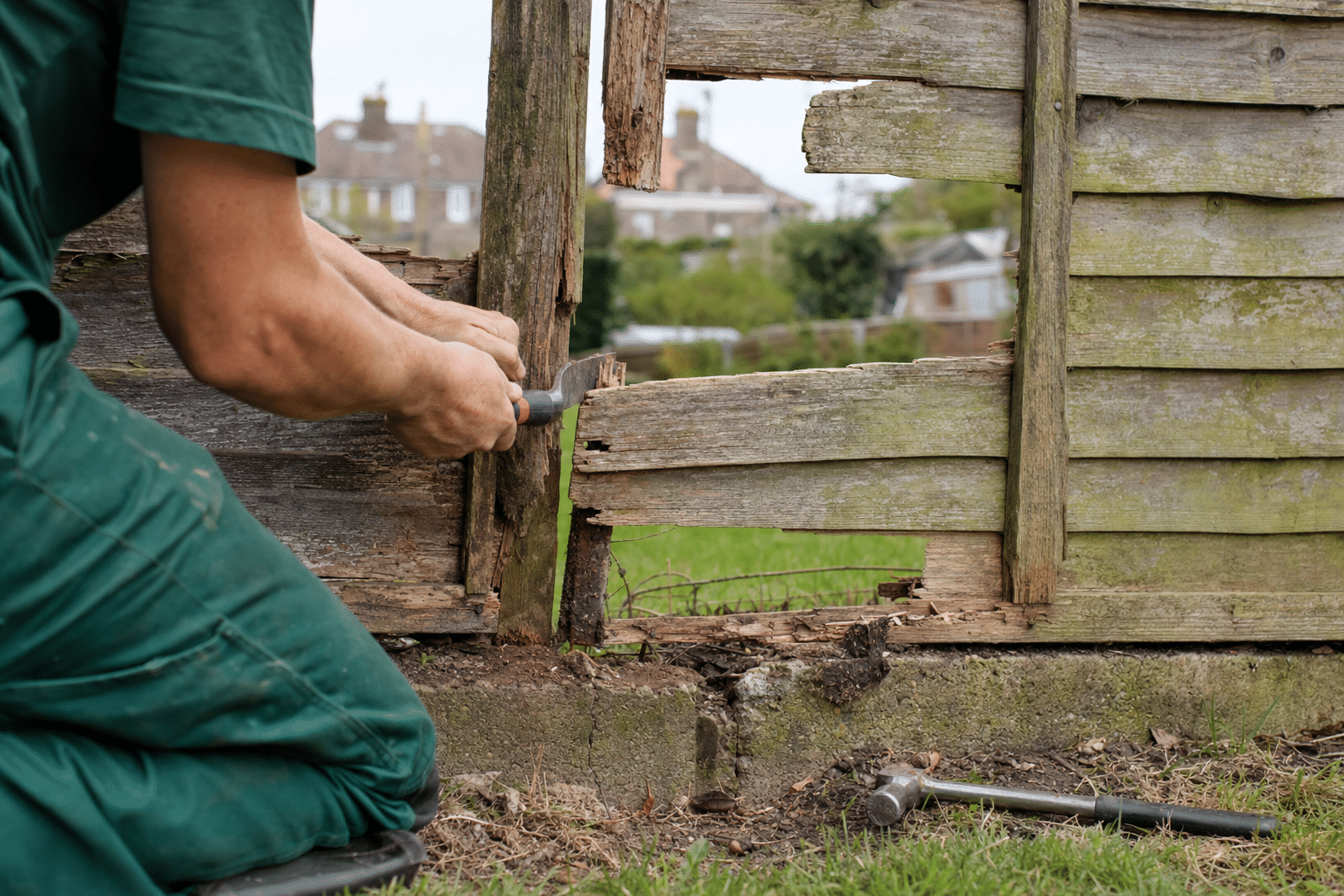
The 7.42 goes past and you can see it through the gap. The panels at the bottom of the garden have gone soft and grey, one is leaning into the brambles on the embankment, and there is a hole a fox walks through every night. You assumed the railway would sort it, because it is their embankment and their trains. Then you rang, and nobody is sending anyone.
This guide covers who is responsible for fence next to railway line, what changes when the boundary is a council estate, how to check your own deeds in an afternoon, and what replacing a rear fence involves when there is no way in from the other side.
What’s in this guide
- Who Is Responsible for the Fence Next to a Railway Line?
- The Boundaries SE London Gardens Actually Back Onto
- Which SE London Lines Run Behind Back Gardens
- How to Find Out Who Owns Your Boundary in One Afternoon
- Nobody Has a Legal Duty to Repair a Fence
- Never Attach Your New Fence to the Railway Fence
- When the Boundary Is a Council Estate
- Repair or Replace: Which One You Actually Need
- What Replacing a Boundary Fence Costs
- What Changes the Hours on a Railway or Estate Boundary
- What’s Included and What’s Not
- Best Time of Year to Do This in SE London
- DIY vs Professional on a Third-Party Boundary
- Gardens We Work In Along These Lines
- Frequently Asked Questions
- How Our Services Can Help
- Posts You Might Like
Who Is Responsible for the Fence Next to a Railway Line?
The short answer: Network Rail maintains the fence that forms the railway boundary itself. It does not maintain your fence, even when your fence is the one standing right next to the line. Their own guidance says that responsibility does not extend to other fences running parallel to the boundary.
So there are often two fences down there. The railway’s sits on railway land, usually tall steel fencing with spiked tops, or old chain link. Yours sits on your land a metre or two in front, and it is yours to repair and yours to pay for.
If the railway’s fence is the broken one, report it and they will fix or replace it. They inspect boundary fencing roughly once a year, patch a gap temporarily when a permanent job has to wait, and sometimes work at night when the trains stop. If your fence is the broken one, ringing them changes nothing.
Not sure whether the fence behind your garden is yours or the railway’s?
Send us a photo of the boundary and we’ll tell you who should be fixing it →
The Boundaries SE London Gardens Actually Back Onto
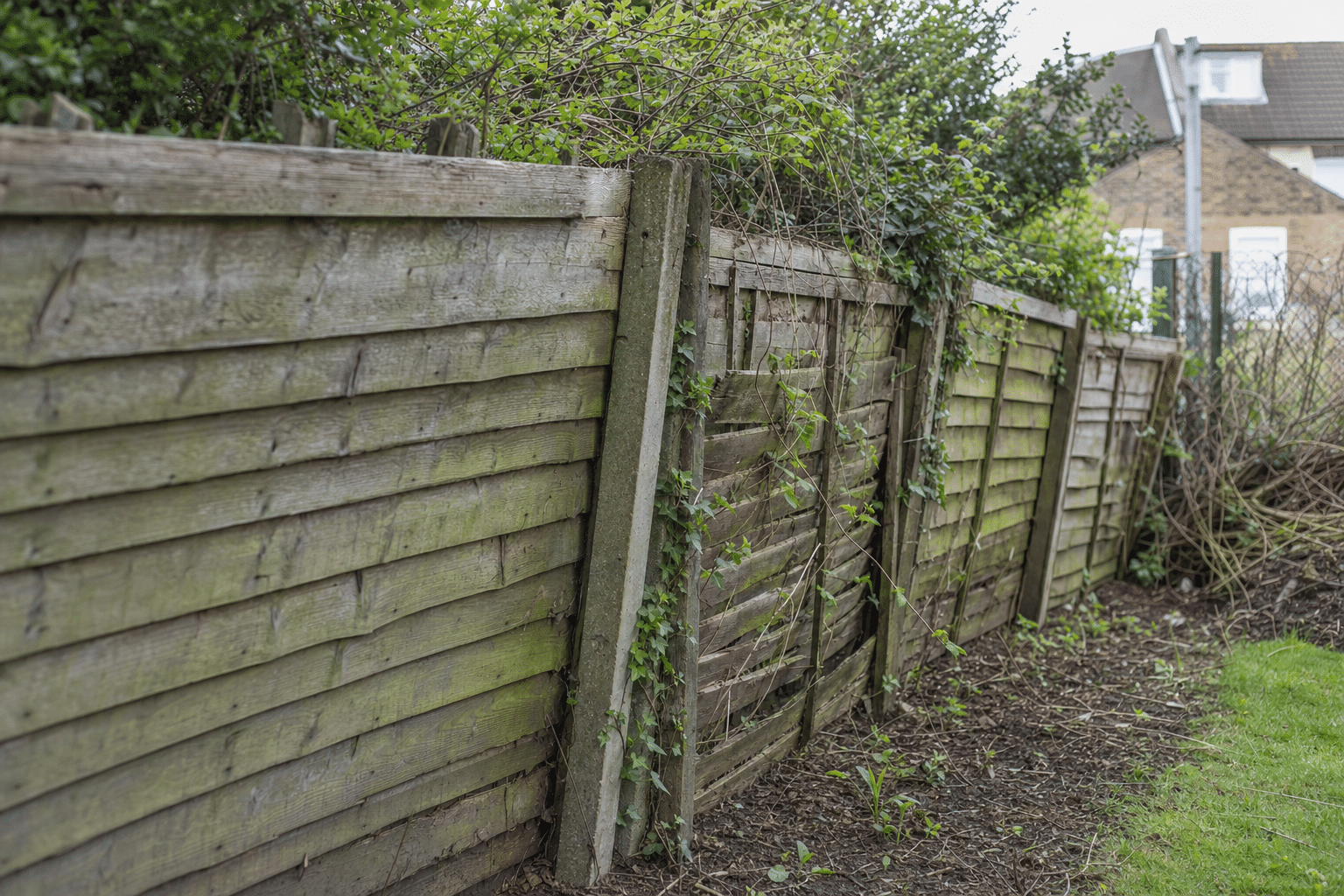
Most fence arguments round here are between two neighbours who both live there. On a boundary with a third party, the other side is an organisation with its own rules and no reason to hurry.
| Your rear boundary backs onto | Who usually owns that fence | Who repairs it | What to expect |
|---|---|---|---|
| A railway embankment or cutting | Network Rail owns the fence on railway land. Yours, in front, is yours | Network Rail for theirs, you for yours | A report gets logged and queued. Your panels are still your bill |
| A council estate garden | Whatever the deeds for your property say | Usually you | Housing repairs check whether that boundary is theirs first |
| A council alley, footpath or green | Often the council | The council | Lewisham maintains fencing forming a boundary with a highway, footpath or right of way |
| A private neighbour | Whoever the deeds or the T mark on the title plan say | That owner | A conversation, then a shared or split job |
Those are the normal patterns. Your deeds beat every row.
Which SE London Lines Run Behind Back Gardens
Much of the railway here runs at the bottom of ordinary gardens, not behind an industrial strip.
Around Lewisham SE13 the lines fan out in several directions at once, so terraces end up with a boundary against a curve or a junction. Hither Green has the sidings and the depot, with gardens tight against them either side. At Grove Park the Bromley North branch leaves the main line, so gardens in Grove Park and Lee SE12 back onto a cutting and an embankment within a few streets. Further west, Sydenham SE26 and Forest Hill SE23 have the Overground in a deep cutting, while in Brockley SE4 and Catford SE6 the line more often sits on an embankment looking down into the garden.
Which one you have changes the fence. At the top of a cutting on London clay the posts have nothing behind them, and the clay moves in a dry summer. At the bottom of an embankment the fence takes soil, water and bramble all year.
How to Find Out Who Owns Your Boundary in One Afternoon
Start with your own paperwork. The government’s guidance is blunt about the limits: in England and Wales there is usually no record of the exact boundary or of who owns the fence between two properties.
What you want on the title plan is a T mark. A T drawn on your side of the line means that fence is treated as yours to maintain. Two T marks facing each other, making an H shape, means it is shared. No mark at all is the commonest result, and then the deeds or an agreement with the other side settle it.
HM Land Registry charges £7 to download your title register or title plan, which is the government’s fee and not our rate, and both come from the Land Registry property search service. Buy both: the register is the words, the plan is the drawing, and the T mark is on the plan.
Nobody Has a Legal Duty to Repair a Fence
There is no general duty in England and Wales to put up a boundary fence or keep one standing. The duty exists only where a deed, a lease or a tenancy puts it there. If your deeds say nothing and the council says that boundary is not theirs, the broken fence is nobody’s legal problem but yours.
That is why the phone calls go nowhere and people lose three months to them. So fence inside your own line, on your own posts. You keep the timing, the height and the look, and you never need anyone’s permission for a fence standing entirely on your land.
Never Attach Your New Fence to the Railway Fence
Network Rail asks people not to attach anything to its fencing, including another fence, because whatever you fix to it gets damaged when they repair or replace their own. Bolt your panels to their steel and you will own a broken fence twice. Same on a council estate boundary: screw your panels to the estate’s posts and your fence comes down the day the housing team replaces theirs.
Build it free-standing instead. Own posts, own concrete, set a few centimetres inside your boundary line so every part is on your land. It costs a little more than bolting onto what is there, and it survives the other side’s maintenance.
Need a fence replaced where there’s no access from the other side?
Book a free survey for a rear boundary fence in South East London →
When the Boundary Is a Council Estate
Councils split it the same way. Lewisham’s own repairs responsibilities page, under council homes, puts fencing repairs to individual properties on the tenant, while the council maintains fencing and walls forming a boundary with a highway, footpath or public right of way.
So it depends what is behind your fence. An estate footpath or service road, and there is a good chance the council owns that fence and repairs it. A garden that happens to be a council tenancy, and you are back to the deeds.
Ask the housing repairs team for the written policy rather than an opinion on the phone.
Repair or Replace: Which One You Actually Need
The posts decide the bill, not how bad the panels look.
Push the fence at the top of a post. If the post stays put and the panel flexes, you need panels. If the post rocks in the ground, new panels on a rotten post buy you one winter. The full version of that check is in our guide to a leaning fence post in SE London clay.
Posts fail first on these boundaries more often than between two gardens, because nobody has cut the far side back in years and soil and leaf litter built up against the timber and kept it wet. The post rots in a band at ground level while the timber above still looks fine.
What Replacing a Boundary Fence Costs
We quote fencing after a free survey rather than off a price list, because a rear boundary against the railway is not the same job as a straight run between two gardens. The written quote covers materials, labour, posts and concrete. Waste disposal is quoted separately and confirmed with you before anything is taken away.
For the market shape of it: a single solid fence panel, supplied and fitted, runs roughly £55-£110 across the UK, and those are market estimates, not our rate. UK cost guides put a timber post replaced and concreted in at roughly £70-£160, again a market estimate and not our rate. London and the South East typically sit 10-25% above the national figures in those same guides, which is a market observation rather than a price from us.
Our own rates either side of a fence job are published. Garden clearance in South East London costs £85 per hour for a 2-person team with a 2-hour minimum, tools included, and that is the rate if the fence line has to be cleared first. Garden maintenance is £83 for the first hour and £65 for every hour after, no minimum, for keeping the new line clear. The rest is on our South East London prices page, with a longer breakdown in our 2026 garden fencing cost guide.
What Changes the Hours on a Railway or Estate Boundary
Access to the Fence Line
On a fence between two gardens you work from both sides. On a railway boundary you may not step onto railway land, so every post, panel and bag of postmix is handled from your side only. On a terrace with no rear access it all comes through the house.
How Overgrown the Far Side Is
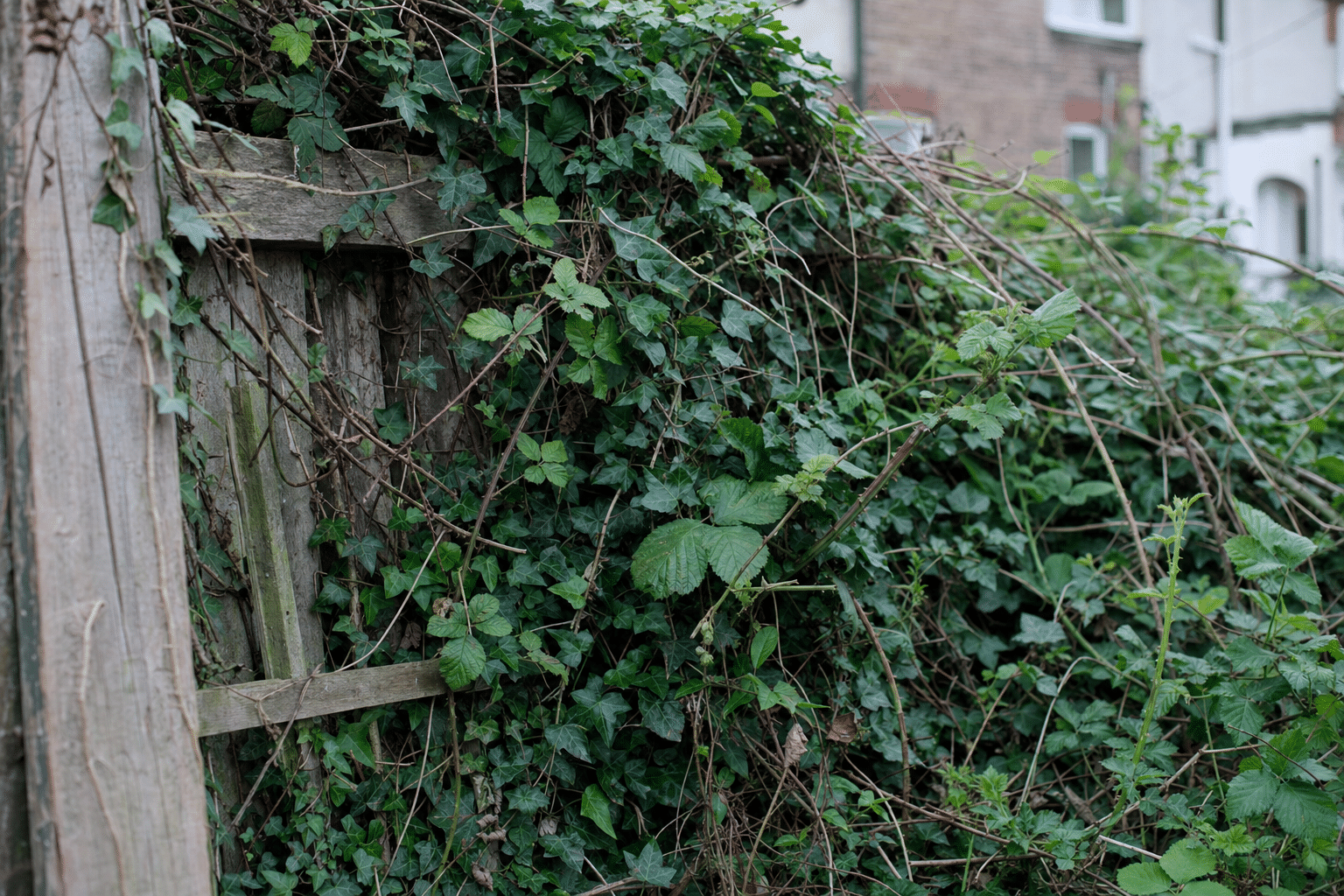
Railway embankments are not gardened. Bramble, buddleia, sycamore seedlings and ivy come over the boundary and have to come off before the fence can be measured. Enough of it, and that is clearance hours first.
Ivy Welded to the Old Fence
Ivy grows into the joints and holds panels together after the timber has gone. Ivy removal is £80-£85 per hour with a 2-person team, all tools included. Where it came through from the embankment, the old panels come away in pieces.
The Slope Behind the Fence
At the top of a cutting in Sydenham SE26 there is a drop behind the line, so a post hole cannot be dug as freely. At the bottom of an embankment in Catford SE6 the soil pushes forward, so the posts go deeper.
The Length of the Run
Rear boundaries behind SE London terraces are often 5 to 7 metres, while the Victorian plots in Blackheath SE3 and Eltham SE9 carry 20 metres along one line. Longer runs are better value per metre, because the setting up and the waste trips are the same whether it is 4 panels or 14.
What’s Included and What’s Not
Included in a fencing quote from us:
- The free on-site survey and the written quote
- Materials, delivery and all labour
- New posts, dug and concreted in on your side of the boundary line
- Taking the old fence down
- Setting the new line so it stands entirely on your land
Not included, so you are not surprised:
- Waste removal, quoted separately and confirmed with you before collection
- Clearing an overgrown fence line, which is clearance hours at the clearance rate
- Felling or reducing a tree on your side, a job for a qualified tree surgeon
- Anything on the far side of the boundary, which we do not touch on a railway or estate line
- Painting or staining the finished fence
- Parking or congestion charges, added only if they apply and only after we confirm them
Best Time of Year to Do This in SE London
Autumn and early spring are the practical windows. London clay in late summer is baked hard and post holes fight you, and in deep winter it holds water, so a new post sits in a wet hole for weeks. More on that in why autumn is the best time to install fencing and decking.
One date beats the weather. Bird nesting season runs March to August and nesting birds are protected under the Wildlife and Countryside Act 1981. Embankments and estate scrub are full of nests, so cutting into ivy or bramble in those months gets checked first, and sometimes it waits.
If the fence is already down and the garden is open to the line, that is a safety job and it happens now, whatever the month. A temporary panel holds the gap until the proper fence goes in.
Fence down and a gap onto the line or the estate?
Tell us today and we’ll get the boundary closed before the weekend →
DIY vs Professional on a Third-Party Boundary
Doing it yourself is genuinely reasonable on some of these. One panel between two sound posts, reachable from your own lawn, is a 40-minute job with a screwdriver and a spare pair of hands.
It stops being reasonable once posts are involved on a boundary you cannot reach from both sides. A bag of postmix per hole gets carried down the garden, and the old panels will not fit in a car. Working at the top of a cutting also puts you one step from land you are not allowed on, and trespass on the railway is a criminal offence.
DIY makes sense for: replacing one or two panels onto posts that do not rock, a fence you can reach comfortably from your own side, and a boundary with no drop behind it.
Professional makes sense for: any post replacement, a run at the top of a cutting or against an embankment, a fence welded together with ivy, a terrace with no rear access, and anyone who does not want to deal with the waste.
Gardens We Work In Along These Lines
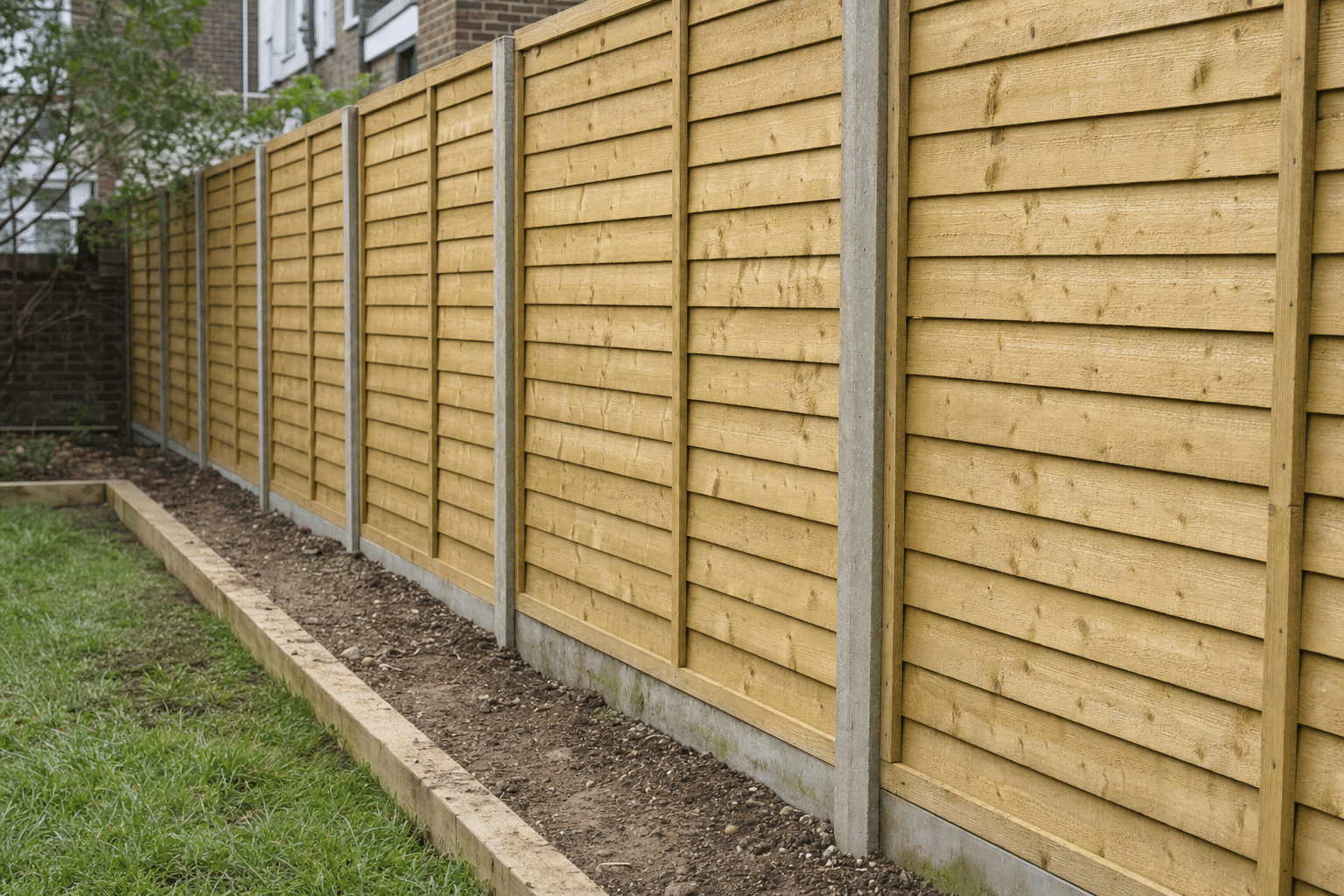
In Catford SE6 and Brockley SE4 the rear boundary is short, but the whole job comes through the house or a side return barely wide enough for a panel. The carrying is most of the labour.
In Blackheath SE3 and Eltham SE9 the plots are longer, so a boundary against a line or an estate can be a serious length of fence, with mature planting in front of it that gets worked around rather than cut down.
Around Crystal Palace SE19 the ground falls away steeply, so a boundary fence often holds a change in level as well as marking a line. There is a finished example in our fence repair in Crystal Palace SE19 project.
We cover the SE postcodes along these routes and out into Bromley, Bexley and Dartford, all listed on our areas we cover page.
Frequently Asked Questions
Will Network Rail pay for my fence if their embankment caused the damage?
Not as a matter of course. They look after the fencing forming the railway boundary and not fences running parallel to it, so a claim about damage from their trees or soil is a separate argument, made in writing with photographs and dates. Put it in while you get the fence sorted anyway.
The council says the fence is not theirs. Is that the end of it?
Ask for it in writing, and ask which boundary they checked. Councils separate a fence facing a public footpath, road or green, often theirs, from a fence between two gardens, usually not. A written answer naming the boundary lets you book the job.
Who owns the trees on the embankment behind my fence?
Trees inside the railway corridor are Network Rail’s to manage, and trees on your side are yours. If one on your land worries you, that is a job for a qualified tree surgeon rather than a gardener, and we will say so instead of quoting for it.
Do I need the other side’s permission to replace my own fence?
Not if every part of it stands on your land, posts and concrete included. That is why we set the new line a few centimetres inside the boundary.
Can you clear the fence line and replace the fence in one visit?
Usually, on a short rear boundary. The clearance hours go on at the clearance rate and the fence comes off the survey, so the two parts show separately on one quote. On a badly overgrown run we clear first, then measure.
How Our Services Can Help
- Garden fencing in South East London, quoted after a free survey, materials, labour, posts and concrete in the written price
- Garden clearance in Bromley BR1 and BR2 at £85 per hour for a 2-person team, for an overgrown fence line
- Garden maintenance at £83 for the first hour and £65 after, no minimum charge, for keeping the new boundary clear
- What ivy removal costs on walls, fences and trees at £80-£85 per hour with a 2-person team
- Garden landscaping and design where the boundary is part of a bigger rebuild, quote within 3 business days
Twelve years in SE London, a family team out of Eltham SE9, fully insured, Monday to Saturday. More on our about Urban Gardeners page, and finished jobs in the Urban Gardeners portfolio.
Got a boundary you think might not be yours?
Send photos through our contact page for a quote within 24 hours →
Posts You Might Like
- Garden Fence Blown Down in South East London? What to Do and How Much It Costs to Replace (2026)
- Garden Fencing in Peckham SE15: The Best Panels for Privacy, Security and Style
- Neighbour’s Hedge Over 2m in SE London: What You Can Legally Cut, Borough by Borough
- Landlord or Tenant: Who Maintains the Garden? SE London Guide
- Leaning Fence Post in SE London? The Screwdriver Test Decides the Fix
Related reading
- Arranging Garden Maintenance for an Elderly Parent in SE London: Who Helps and What It Costs
- Garden Waste Removal in SE London: What It Costs and Who Takes It
- Leaning Fence Post in SE London? The Screwdriver Test Decides the Fix
- Communal Garden Maintenance in South East London: Who Pays and What It Costs
- Best Time to Install a Fence or Decking in South East London: Month by Month (And When to Book)

0 comments