

What you will find in this guide
The short answer
Yes, a jet washer can damage your patio. But it is almost never the machine that causes the damage. It is the pressure setting, the distance, the angle, and using it on a surface that was never going to cope.
Done properly, jet washing is the standard way to clean paving and it will not harm a sound patio. Done badly, you can strip the jointing sand out in twenty minutes, blast layers off sandstone, and turn a tired-looking patio into one that genuinely needs repointing.
The frustrating part is that most of the damage is invisible on the day. The patio looks brilliant. Then the joints wash out over the next few months, weeds come through, and by the following spring the slabs are moving underfoot.
Which patios are actually at risk
Not all paving reacts the same way. This is the single biggest thing people get wrong, and it decides everything else.
| Surface | Risk level | What to watch for |
|---|---|---|
| Block paving | Low surface risk, high joint risk | The blocks themselves are tough. The kiln-dried sand between them is not, and it washes out easily. Expect to re-sand afterwards. |
| Pressed concrete flags | Low | Dense and hard-wearing. Usually fine at sensible pressure. |
| Wet-cast concrete slabs | Medium to high | Softer than pressed flags. The decorative surface layer can be etched or pitted, leaving a permanently rougher, patchier finish. |
| Indian sandstone | Medium to high | Very common on SE London patios laid in the 2000s and 2010s. Sandstone with a layered, laminar structure can have whole flakes blasted off by too much pressure. |
| Old York stone | Medium | Frequent in Victorian and Edwardian gardens around Blackheath, Brockley and Camberwell. Usually sound, but weathered stone with existing surface fractures can lift. |
| Porcelain | Very low | Almost impervious. The joints are the only vulnerable part. |
| Clay pavers | Low | Generally cope well with a normal domestic washer. |
| Anything sealed | High | Pressure washing strips sealant unevenly. You will end up with patchy, blotchy areas and a full re-seal to fix it. |
The independent UK paving reference site Pavingexpert makes an important point about this: manufacturers generally treat pressure-wash damage as user error rather than fair wear and tear, so a warranty claim is unlikely to succeed. You can read their detailed guidance on power washing paving for the technical background.
Not sure what your patio is made of? Send us a photo and we will tell you what it is and whether it will take a jet wash. No charge, no obligation. Get in touch.
What actually gets damaged
The joints go first
This is the most common damage by a wide margin, and it is the one people notice last. Jointing sand and older mortar pointing are far softer than the slabs around them. A concentrated jet at close range removes them faster than it removes the dirt.
Once the joints are gone, water gets under the slabs instead of running off them. In South East London that matters more than in most places, because the clay-heavy soil under most gardens holds water rather than draining it away. Slabs start rocking, weeds seed into the gaps, and in a hard winter the trapped water freezes and lifts them.
The surface gets etched
On softer paving, too much pressure removes a thin layer of the slab itself. It usually shows up as light streaks or a mottled, slightly rough patch where the lance lingered. It does not wash off, because there is nothing left to wash. The only fix is replacing the slab.
Pointing cracks and blows
Mortar-pointed patios, common on older SE London properties, tend to have joints that have already gone slightly friable with age. A jet finds every weak section and takes it out. You are then looking at repointing the whole patio rather than a few joints.
Sealant comes off in patches
If your patio was sealed at any point, pressure washing will strip it unevenly. The result looks worse than the dirt you were trying to remove, and the only route back is stripping the rest and resealing from scratch.
The four settings that decide everything
Marshalls, one of the largest UK paving manufacturers, publishes clear technical guidance on this, and it is stricter than most people expect. Their technical information for paving sets out the safe approach.
1. Pressure: medium, not maximum
Most domestic washers have far more power than a patio needs. Manufacturer guidance is that no more than medium pressure should be applied to paving. If your machine has a variable nozzle, start low. You can always increase it.
2. Distance: at least 200mm from the surface
Roughly eight inches. The instinct is to hold the lance close because the dirt shifts faster, and that instinct is exactly what causes joint loss and surface etching.
3. Angle: oblique, never straight down
Hold the lance at a shallow angle so the jet sweeps across the surface rather than driving into it. Pointing it straight down into a joint is the fastest way to empty that joint.
4. Attachment: use a rotary head if you have one
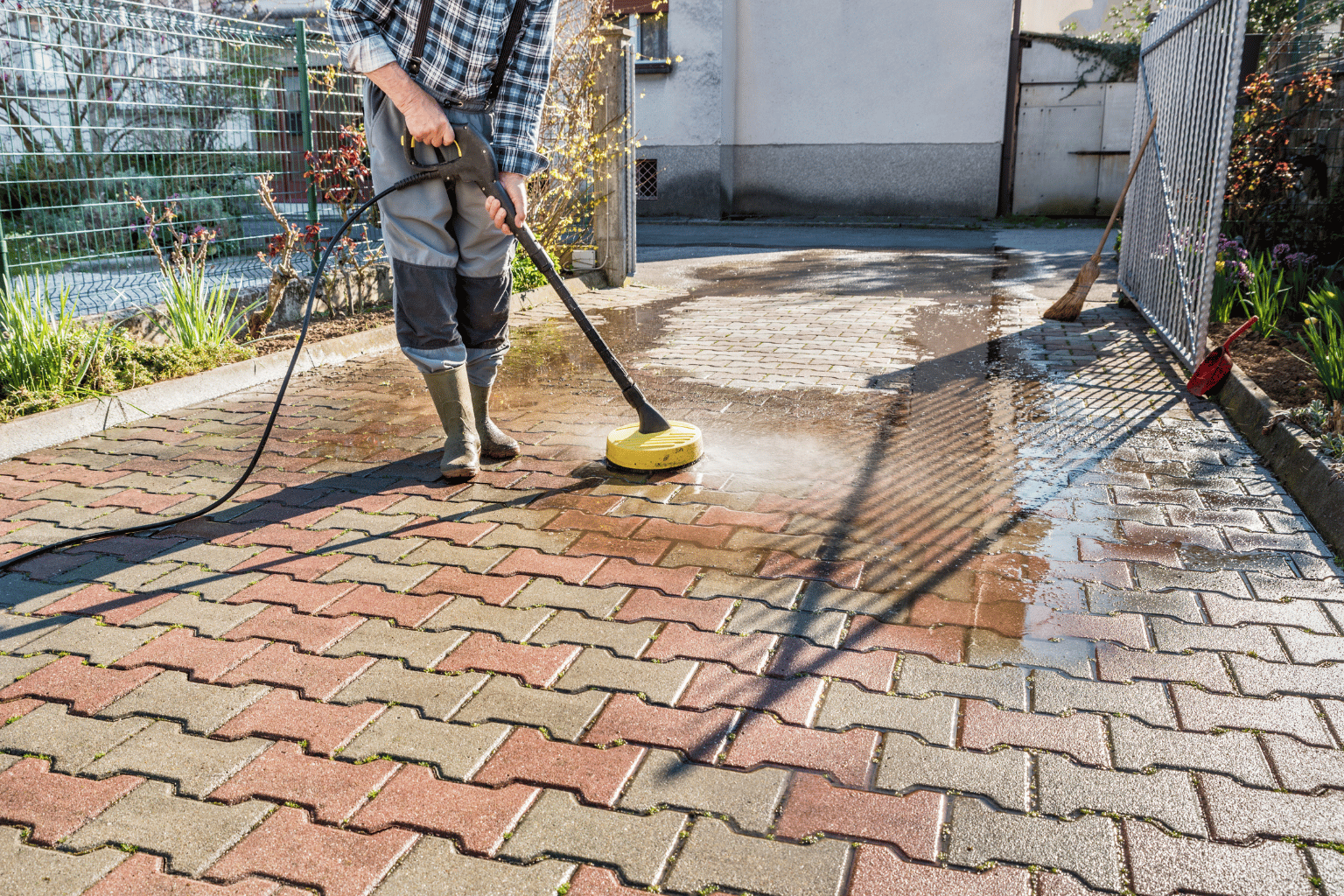
A rotary or flat-surface cleaning head is genuinely better than a bare lance for patios. It covers more area per pass, keeps the jet at a controlled angle, and the hood stops dirt spraying up your back wall. It is the single cheapest upgrade you can make to the job.
Rather not risk it? Our patio cleaning service in South East London uses commercial rotary equipment and re-sands the joints as standard. Request a free quote and we will reply within 24 hours.
Five checks before you start
1. Sweep it first
Loose grit is abrasive. Hit it with a high-pressure jet and you are effectively sandblasting your own patio with its own debris. Brush the whole area thoroughly before any water goes near it.
2. Test a hidden corner
Do a square metre somewhere out of sight, behind a planter or under where the table sits. Let it dry fully, then look at it in daylight. Wet paving hides etching completely, which is why people only discover the damage the next day.
3. Check the joints while they are dry
Poke a screwdriver into a few joints. If the sand is already loose or the mortar is crumbling, jet washing will finish the job. Those joints need repairing first, not cleaning.
4. Look for existing cracks and lifted edges
Any slab with a hairline crack or a lifted corner will get worse. Water driven under a loose slab has to go somewhere and it usually takes bedding sand with it.
5. Work out where the water goes
A patio wash generates a surprising amount of dirty runoff. If your garden already sits wet, you are about to make it worse for a few days. Worth reading our guide on poor garden drainage in South East London if you have puddling problems already.
When jet washing is the wrong tool
Some things a pressure washer will simply not fix, and trying harder makes it worse.
- Oil stains. Water spreads them. You need a degreasing compound made for paving.
- Rust marks. Usually from metal furniture or a dropped tool. Often permanent.
- Cement or mortar splashes. These need mechanical or chemical removal, not water.
- Deep-set black algae on porous stone. A chemical treatment left to dwell will do more than pressure will, with far less risk.
- A patio that is already moving. Cleaning a failing patio just makes a clean failing patio. If slabs rock underfoot, the bedding has gone and it needs relaying.
If yours falls into that last category, cleaning is money spent on the wrong problem. Our patio laying and outdoor tiling guide covers what relaying actually involves, and our garden landscaping cost guide gives realistic figures if you are weighing up replacement.
DIY or Hire Someone?
| DIY | Urban Gardeners | |
|---|---|---|
| Price | £40-£60 machine hire per day, or £100-£250 to buy one | £4 per square metre, £120 minimum |
| Small courtyard (approx 15m²) | £40-£60 hire, plus half a day of your time | £120 (minimum applies) |
| Average back garden patio (approx 25m²) | £40-£60 hire, plus most of a day | £120 (minimum applies) |
| Large patio (approx 40m²) | £40-£60 hire, likely two sessions | £160 |
| Very large patio or driveway (approx 60m²) | Two full days, plus re-sanding | £240 |
| Risk of damage | Real, especially on sandstone and wet-cast slabs | Low, and insured if it happens |
| Waste and runoff | Your problem | Handled |
DIY makes sense on block paving or porcelain, where the surface is tough and the worst case is re-sanding. It makes much less sense on Indian sandstone, wet-cast slabs, or anything sealed, where a mistake is permanent and one replacement slab plus labour costs more than the clean would have.
How to avoid the minimum charge
The £120 minimum applies to patio cleaning booked on its own, and it covers anything up to 30m². If your patio is smaller than that, there is a way around it.
We waive the minimum when pressure washing is combined with either of these:
It works for us because we are already on site with the van and the team, and it works for you because a small courtyard no longer costs the same as a full-size patio. If you have a maintenance visit booked anyway, that is the moment to get the patio done.
Ask us about combining services and we will quote both together.
Get a photo quote in 24 hours. Send a few pictures of your patio and we will tell you what it needs, what it costs, and whether jet washing is even the right answer. Request your free quote or see the areas we cover across South East London.


Before and after result you can expect
Frequently asked questions
Medium, not maximum. Manufacturer guidance for paving is no more than medium pressure with the lance at least 200mm from the surface and held at an oblique angle. Start lower than you think you need.
Almost always, yes. Pressure washing removes jointing sand even when done carefully. Let the paving dry fully, then brush in kiln-dried sand and sweep off the excess. Skipping this is what causes blocks to loosen over the following year.
It removes what you can see, not the roots, so they return within weeks. Worse, blasting out the joints creates the perfect seedbed for new ones. Treat the weeds first, clean second, then re-sand. Our guide on getting rid of unwanted plants covers the treatment options.
Not without stripping the sealant unevenly. If your patio was sealed, either clean it gently by hand or accept that you will need to strip and reseal the whole surface afterwards.
It is optional and depends on the material. Sealing makes future cleaning easier and slows algae growth, but it needs redoing every few years and it commits you to never pressure washing again. Porous sandstone benefits most. Porcelain does not need it.
With considerably more care. Timber is much softer than stone and a pressure washer will raise the grain and leave permanent furring if held too close. Composite decking is more forgiving. See our decking cost guide if yours is past cleaning and closer to replacing.
Late spring through early autumn. The patio needs to dry fully before re-sanding, which does not happen reliably in a London winter. Avoid doing it in freezing conditions, as water driven into joints and then freezing is what lifts slabs.
Late spring through early autumn. The patio needs to dry fully before re-sanding, which does not happen reliably in a London winter. Avoid doing it in freezing conditions, as water driven into joints and then freezing is what lifts slabs.
Only temporarily. Algae returns wherever the surface stays damp and shaded. Improving light and airflow, and clearing overhanging growth, does more for the long term than cleaning more often. Regular upkeep through our garden maintenance service keeps it in check.
Posts you might like
- How Much Does Patio Cleaning Cost in South East London? Jet Washing Price Guide 2026
- Expert Outdoor Tiling in South East London: Paving and Installing Patio Tiles
- Poor Drainage in the Garden: What to Do in South East London
- How Much Does Decking Cost in South East London? 2026 Price Guide
- How to Easily Get Rid of Mushrooms in Your Garden
- Garden Makeover South East London

0 comments