

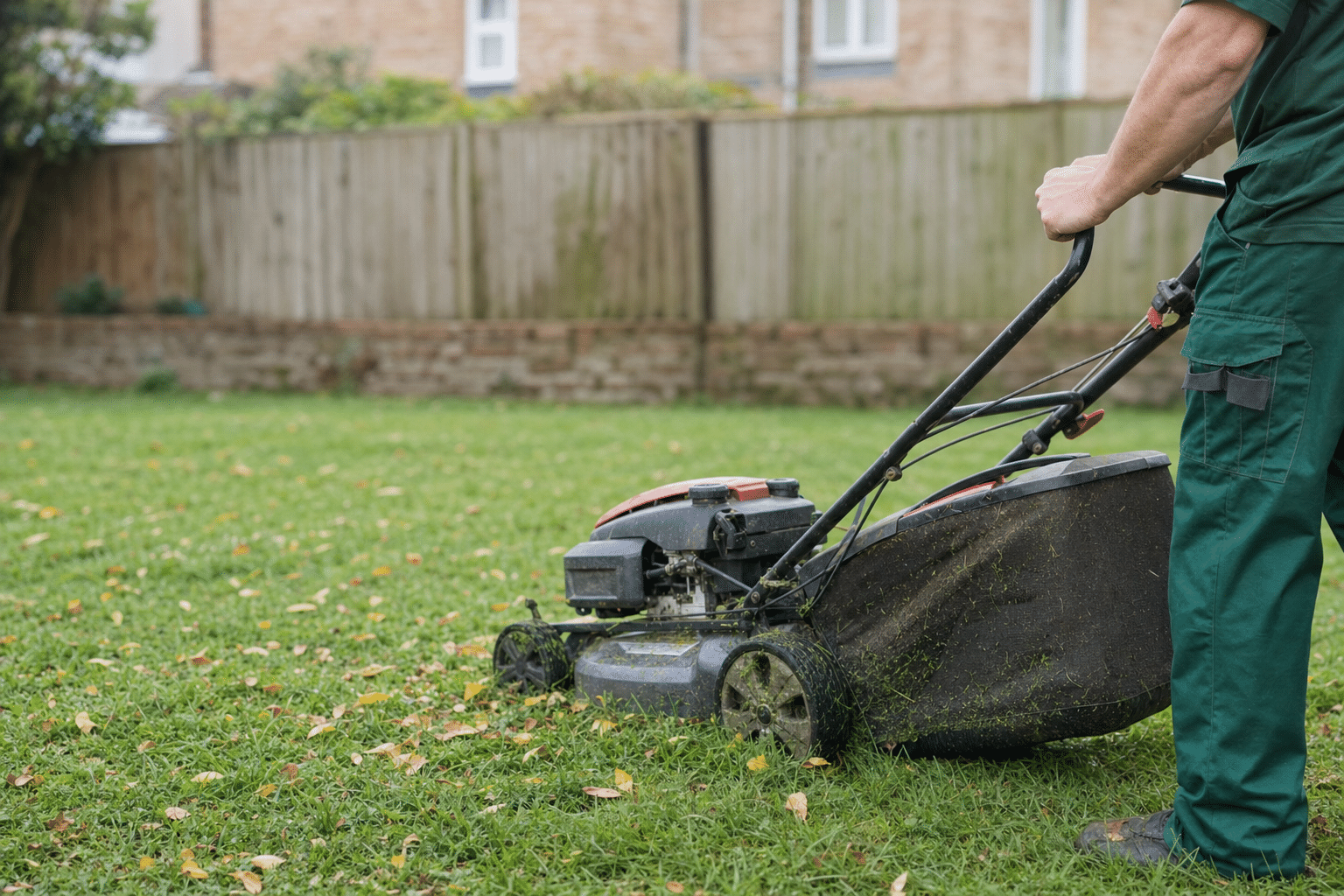
If your lawn has gone from “I’ll give it one more cut” to “it’s been three weeks and it still looks shaggy,” you are not alone. Every November we get the same call from Deptford, Catford and Blackheath. The grass is still growing a bit, the ground is wet, the leaves are down, and nobody can tell whether another cut will help the lawn or wreck it.
This guide gives you the triggers we use on when to stop mowing the lawn, what height to leave it at, the days not to touch it, and what a final visit costs.
What’s in this guide
- The short version: when to stop cutting in South East London
- Why November, not October, is the cut-off month here
- The two triggers: soil temperature and the first real frost
- How to tell the grass has genuinely stopped growing
- How high to set the blade for the last cut
- Wet grass, frost and clay: when not to cut at all
- Edges and borders on the final visit
- Leaves on the grass: more damage than a long cut
- What a last cut and tidy costs in South East London
- One visit or two: how we schedule the final cuts
- Mud, worn strips and dog runs before winter
- When a patch is past cutting and needs new turf
- Where the clippings and leaves go
- Getting the first cut of spring in the diary
- The last mow across South East London areas
- Frequently asked questions
- How we can help with the last cuts of the year
The short version: when to stop cutting in South East London
Most lawns in South East London get their last cut between the first week of November and the first week of December. Not a fixed date. Two things decide it: the temperature, and whether the ground is firm enough to walk on without leaving a print.
Grass keeps growing above 7°C, which is the figure the Royal Horticultural Society uses in its mowing guide. South East London sits warmer than that for most of November, so the grass here has usually not stopped by the end of October, whatever the national guides say.
Want the last cut of the year booked before the ground turns?
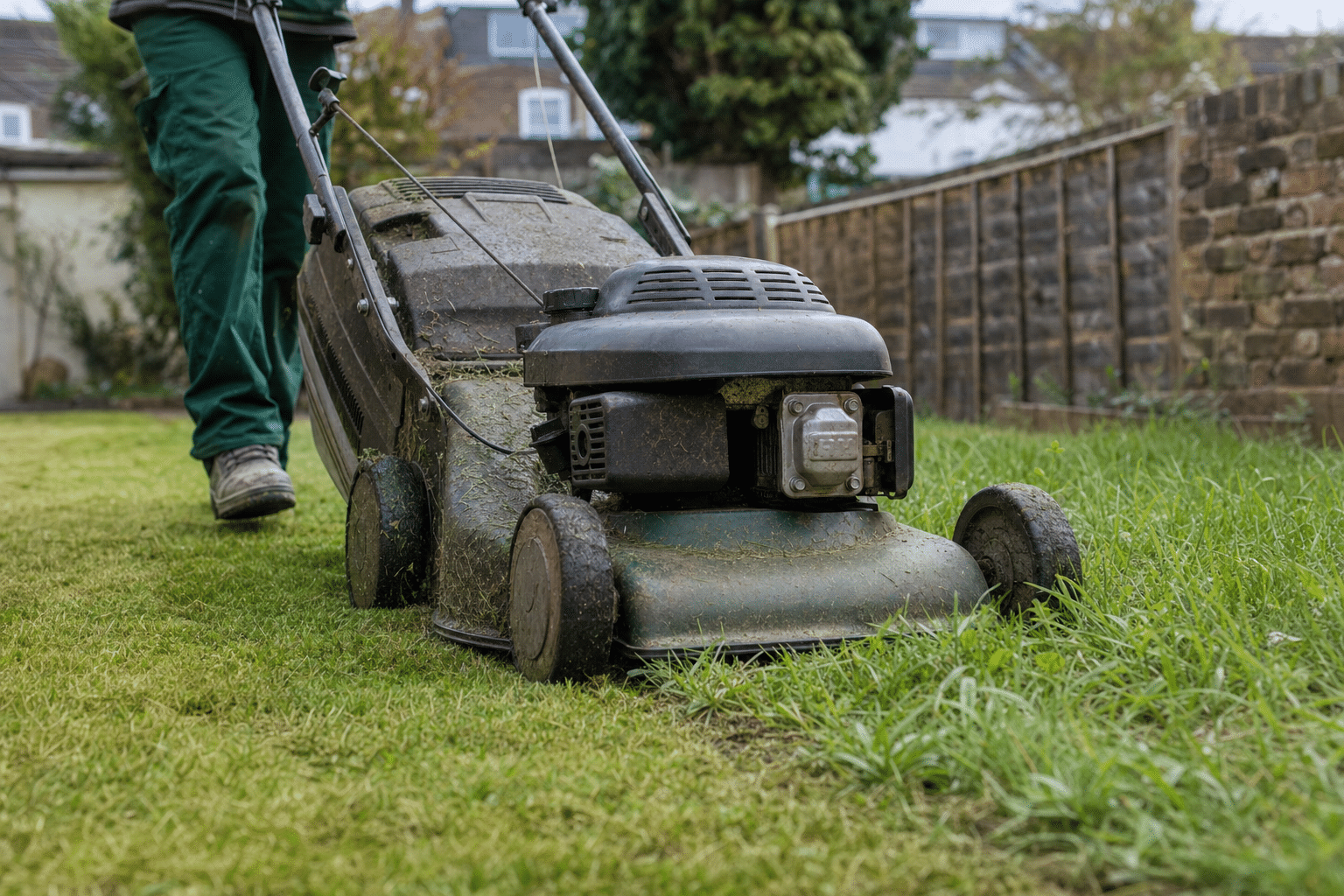
Why November, not October, is the cut-off month here
The national guides on this search give a temperature rule and stop there. They are written for the whole country, and the whole country is not South East London.
Two things push our date later. First, the heat the city holds. Brick, roads and terraces keep the air a degree or two warmer than open ground, so growth carries on in a Peckham back garden when it has stopped in Kent.
Second, London clay, a heavy sticky soil that holds water and holds warmth with it. That keeps roots ticking over into late autumn, and our gardens go soft weeks before they go cold, which is why the ground usually stops us before the temperature does.
So in Deptford SE8 and New Cross SE14 we are often still cutting in the third week of November, and the reason we stop is mud.
The two triggers: soil temperature and the first real frost
We watch two signals, and one on its own is not enough.
Trigger one: sustained temperature under 7°C. One cold morning means nothing. A week of days that never get above 7°C means growth has stalled. Soil holds its warmth longer than the air, so a 4°C dawn and a 12°C afternoon is still a growing day.
Trigger two: the first proper frost. Not a white roof. A frost still sitting on the grass at 9am, with the blades stiff and brittle. In East London records the first frost lands around 6 November on average, and in the middle of town it can be weeks later or never arrive.
When both have happened, the mower goes away.
| What you see | What it means | Cut or leave it |
|---|---|---|
| 2cm of growth in a week, ground firm | Still growing | Cut, blade raised |
| A little growth, ground soft and printing | Can’t take the weight | Leave it, wait for dry |
| A week under 7°C, no growth | Season over | Stop for the year |
| Frost on the grass at 9am | Blades brittle | Don’t cut or walk on it |
| Lawn under water | Soil will compact | Fix the drainage first |
Those are the signals we read on the day. A mild November can give you a cut in the first week of December.
How to tell the grass has genuinely stopped growing
Push a short bamboo cane in at the edge of the lawn, wrap a bit of tape round it level with the top of the grass, and look again in seven days. More than a centimetre of growth past the tape, it still wants a cut. Under a centimetre, you are done for the year.
The other tell is colour at the base. Growing grass is fresh green right down where the blade meets the soil. A lawn that has shut down goes a flatter, duller green, and the new shoots in the middle of each plant stop appearing.
How high to set the blade for the last cut
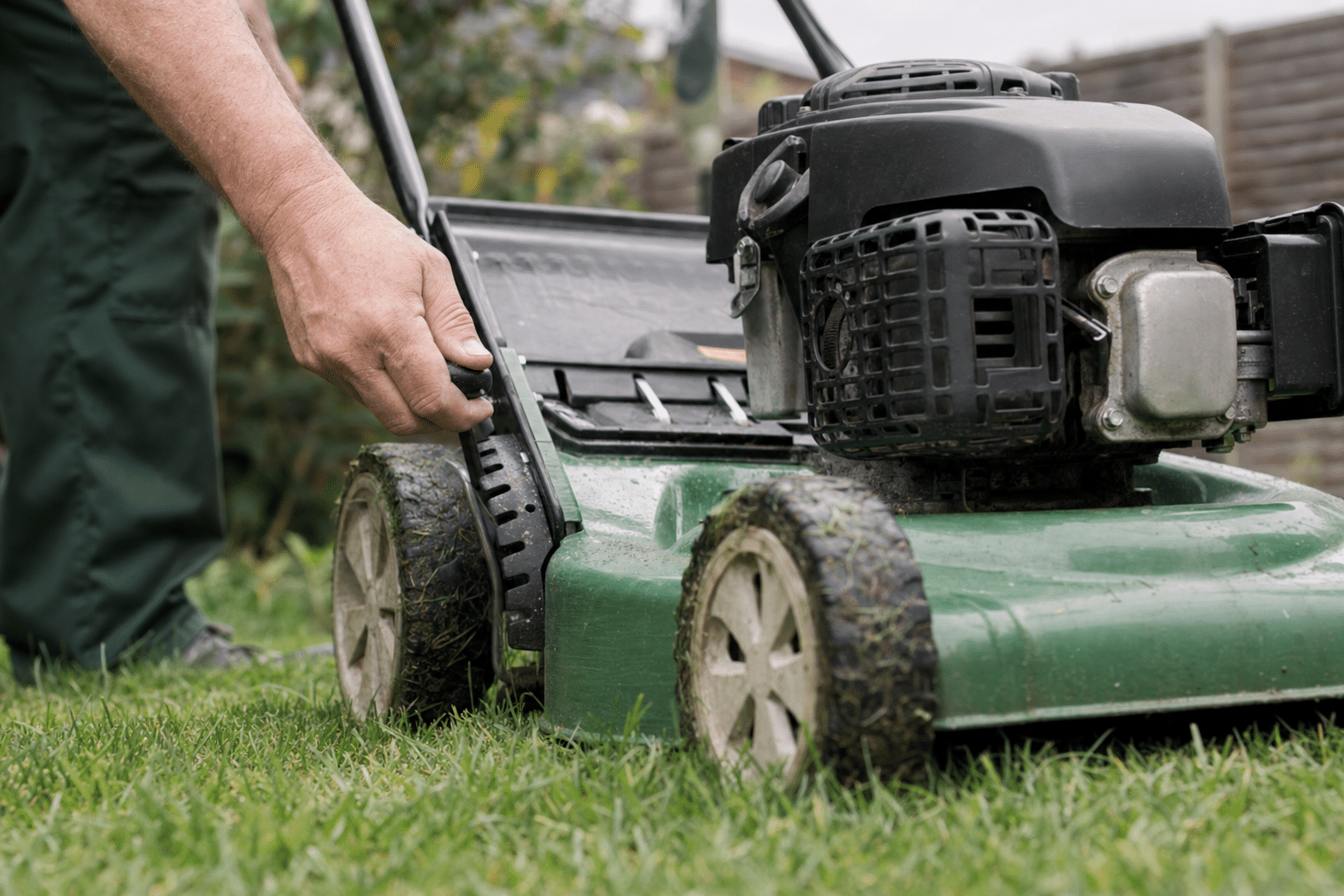
Higher than you have cut all summer. The RHS puts November’s height about 5mm above your summer setting, and we go further on clay.
Leave the last cut at 4cm. A little over an inch and a half, roughly your thumb from knuckle to tip.
Longer grass holds more leaf, which keeps the plant fed through a dark winter. It also shades the soil, slowing the moss and weeds that move into a thin lawn in January. A lawn scalped to 2cm goes into winter with nothing in the tank.
Do not go the other way either. Grass left at 8cm mats down flat under the first heavy rain, stays wet underneath, and comes out in March with yellow patches where it smothered itself.
Not sure what your lawn should be left at this year?
Wet grass, frost and clay: when not to cut at all
Three days to walk away from the mower.
Frosty grass. Cold blades go brittle, and a mower or a boot snaps them. You get brown footprints and wheel lines that sit there until spring. Wait for the afternoon once the lawn has thawed.
Soaking wet grass. Wet blades tear instead of cutting, leaving a ragged edge that goes brown and invites disease. The mower clogs and drops lumps of clippings behind it.
Waterlogged clay. Walk on sodden London clay and you squeeze the air out of it, which is called compaction, and the roots suffocate. Press a finger in. If water pools in the dent, stay off the lawn. If your garden does that every winter, cutting is not your problem, and our guide to a waterlogged garden in South East London and what fixing it costs is the one to read.
Edges and borders on the final visit
The edges matter more in winter than the middle does. A clean edge is the line between lawn and border, and cut in November it keeps the garden looking deliberate for four months while nothing grows.
Left ragged, grass creeps into the beds, roots itself in the soft soil, and in March you dig it out instead of cutting it.
On a final visit we strim round the borders, cut a straight edge along the beds and paths, and take the clippings. It adds about 30 minutes on a small terraced garden, and it is part of the visit, not an extra.
Leaves on the grass: more damage than a long cut
People worry about the grass being 1cm too long and then leave six weeks of leaves sitting on it. The leaves are the real problem.
Wet leaves block light and trap moisture against the grass. The RHS is blunt about it: rake fallen leaves off the lawn so they do not smother the grass. Three weeks under a soggy plane leaf mat gives you yellow grass. Six weeks gives you bare soil that fills with moss.
The quick way to clear them is the mower itself, high setting, box on. It shreds the leaves, mixes them with clippings, and they rot down far faster in a heap. On a dry day that turns 40 minutes of raking into 10.
In Forest Hill SE23 and Sydenham SE26, lined with big limes and planes, the clearing is the bigger half of the final visit. There is more on why fallen leaves are worth keeping once they are off the grass.
What a last cut and tidy costs in South East London
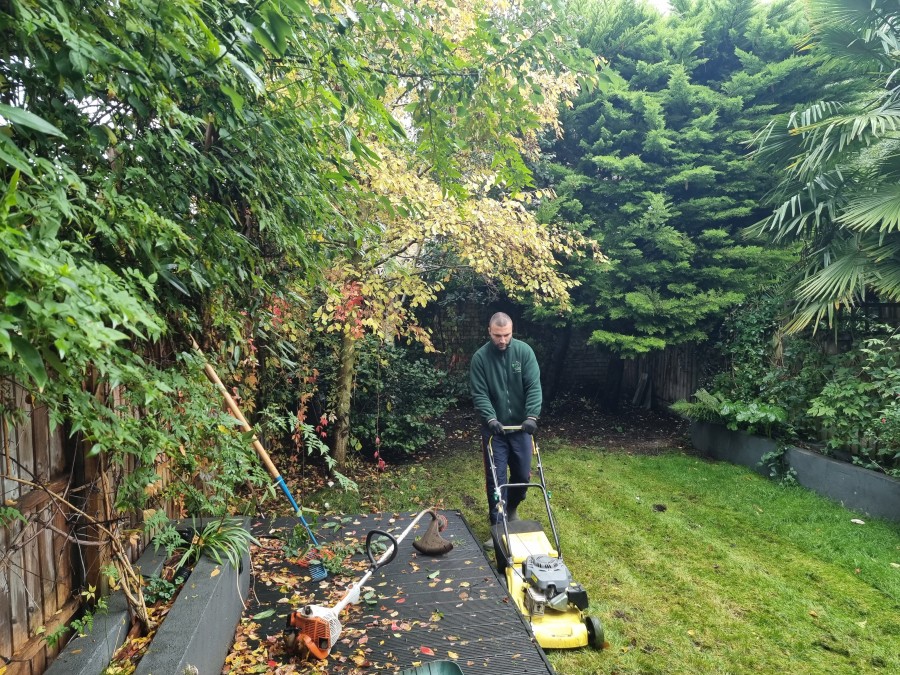
A final visit is almost never just a cut. There are leaves to clear, edges to do and green waste to shift, so it gets priced as garden maintenance rather than mowing on its own.
Urban Gardeners charges £83 for the first hour and £65 for every hour after, for a two-person team with all the tools. No minimum charge. That is our rate.
Most small to medium SE London back gardens are a 1 to 2 hour job for the cut, edges and leaves. A lawn untouched since August goes over onto garden clearance at £85 per hour, which is also our rate. We will tell you honestly which one applies off a photo rather than quoting the higher one by default.
| Line | Figure | Whose price |
|---|---|---|
| First hour, two-person team | £83 | Our rate |
| Each hour after | £65 | Our rate |
| Lawn left since summer, as clearance | £85 per hour | Our rate |
| One-off mow, London and the South East | roughly £30-£60 a visit | Market estimate, not our rate |
| Gardener labour, London and the South East | roughly £35-£60 an hour | Market estimate, not our rate |
Those are a realistic starting point, not a fixed quote. The numbers behind them are broken down in our guide to what mowing and a tidy cost in South East London.
What is in a final visit:
- the cut, blade raised to winter height
- edges along beds, paths and fences
- strimming where the mower cannot reach
- leaves off the lawn
- clippings and leaves taken away
What is not:
- anything on a frozen or waterlogged lawn, and we will say why
- new turf or bare patch repairs, quoted after a free survey
- treatments of any kind, which we no longer offer
One visit or two: how we schedule the final cuts
Two visits beat one on most gardens, and the second is the shorter.
The first lands in early November. Full cut at winter height, edges done, whatever leaves are down cleared. The second lands two to four weeks later and is mostly leaves, because the trees carry on dropping long after the grass stops. On a small garden that runs about an hour.
One visit makes sense if your garden has no big trees near it, or if you are happy to brush the leaves yourself. Plenty of our customers do exactly that.
Regular fortnightly customers need not think about any of this. We stop cutting when the two triggers hit, switch the visit to leaves, and tell you we have done it.
Mud, worn strips and dog runs before winter
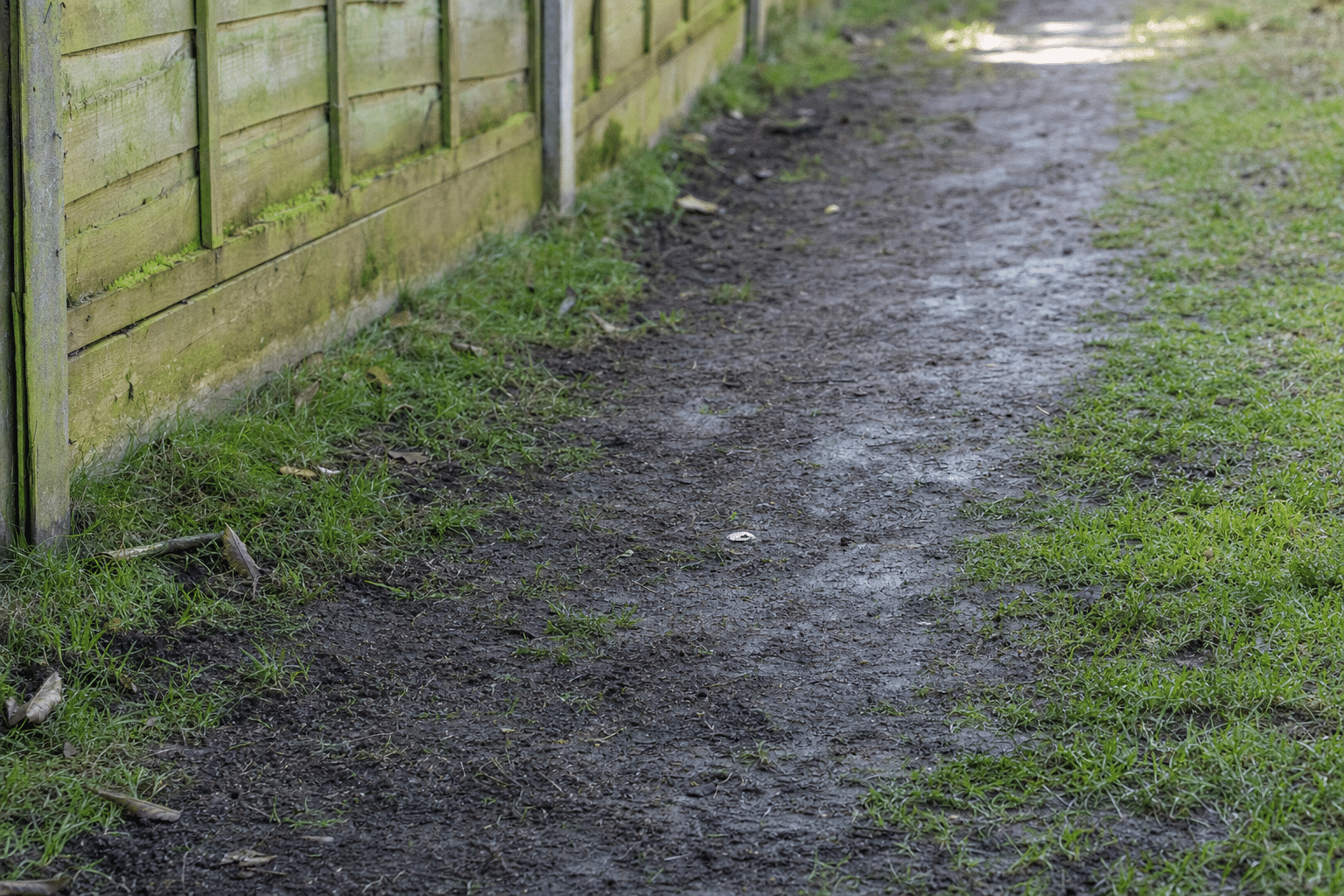
Every garden has the strip that goes first. The line from the back door to the shed, the patch by the gate, the lap the dog runs round the lawn.
Those strips are grass with the roots already thinned out, and November is when they give up. Once the soil is wet, every footstep squeezes it tighter, and tight soil grows nothing.
The fix is cheap and it is not cutting. Keep off those lines until March. A board, two stepping slabs or a bag of bark down the worn route carries the traffic through winter, and the grass comes back on its own. If the dog has taken out a metre-wide loop, that needs turf.
When a patch is past cutting and needs new turf
Some lawns in November are not a mowing job. Look at the bare bit and decide whether there is any living grass in it at all.
Thin grass with soil showing through usually recovers once the light comes back in spring. Bare soil, or pure moss, will not. If you are not sure which you have, our guide on telling a dead lawn from a dormant one walks through both tests.
Honest answer on timing: do not re-turf in deep winter. New turf needs root contact with the soil, and frozen or waterlogged ground gives it none. Our month-by-month guide to laying turf in South East London sets out which months work, and our turfing service starts with a free survey, so a November look costs you nothing.
Where the clippings and leaves go
Three options, and the cost sits differently on each.
Your council brown bin. Lewisham charges £100.63 a year for a garden waste subscription, which is their price and not our rate. Every borough runs its own scheme, so check yours. The catch in November is volume: one bin does not hold a garden’s worth of leaves.
A leaf heap in the corner. Free, and the best of the three. Leaves in a bin bag with holes punched in it, or in a wire cage behind the shed, rot down into leafmould in about a year. That is a dark crumbly material you spread on beds.
We take it. On a maintenance or clearance visit the green waste goes with us in the van.
Getting the first cut of spring in the diary
The last mow and the first mow are one conversation, and the spring one is the busier booking.
Grass here starts moving again when the temperature holds above 7°C, usually the back end of March. Our late March diary fills through February, so customers who fix the spring date at the November visit get the slot they want.
The first cut of the year is slower than a mid-season one, because the lawn has four months of growth, worm casts and leftover leaves on it. Book two hours, not one.
Ready to lock in the last cut and the first one together?
The last mow across South East London areas
The date moves by a fortnight across our patch, with the soil and the trees rather than the postcode.
In Blackheath SE3 and Eltham SE9 the gardens are bigger and more open, and the frost settles earlier because there is less brick holding the heat. We usually finish cutting there in the second week of November.
In Catford SE6 and Lewisham SE13, terraced gardens on heavy clay with a side return to carry the mower through, the ground calls time before the cold does. That kind of job is in our Catford garden tidy-up.
In Peckham SE15 and Greenwich SE10 the street trees run the timetable. Leaves fall into the first week of December, so the second visit matters more than the first.
We also cover Abbey Wood SE2, Charlton SE7, Lee SE12, Camberwell SE5, Woolwich SE18, Rotherhithe SE16, Sidcup DA14 and Welling DA16, all on our areas we cover page.
Frequently asked questions
When should I stop mowing my lawn in South East London?
Between the first week of November and the first week of December. Stop when you have had a week of days that never got above 7°C, and the grass has grown less than a centimetre in seven days. The calendar is not the signal.
Can I cut the grass in November if it is still growing?
Yes, and you should. Grass that goes into winter too long mats down and smothers itself. Raise the blade to 4cm, pick a dry day with firm ground, and cut it.
Is it bad to cut grass when there has been a frost?
Yes. Frozen blades are brittle and snap rather than cut, leaving brown wheel marks and footprints that stay until spring. Wait until the afternoon once the lawn has thawed.
How short should the last cut of the year be?
4cm, a little over an inch and a half, higher than a summer cut on purpose. Longer grass keeps the plant fed through the dark months and shades out the moss that moves into a thin lawn in January.
What if the lawn is too wet to mow?
Leave it. Press a finger into the turf, and if water pools in the dent the soil is saturated. Walking on wet London clay squeezes the air out and the roots suffocate. Wait for two or three dry days.
Do you do garden visits through the winter?
Yes, Monday to Saturday, 9am to 6pm, closed Sundays. December to February is mostly leaves, pruning, hedges and clearance rather than cutting. Our garden maintenance service runs all year.
How much does a one-off last cut cost?
£83 for the first hour and £65 for every hour after, for a two-person team with tools included, and that is our rate. Most small gardens are 1 to 2 hours. There is no minimum charge.
Should I leave fallen leaves on the grass over winter?
No, not on the grass. A wet leaf mat blocks light and moisture and leaves you yellow patches or bare soil by March. Leaves in beds and borders can stay where they land, which is what the RHS advises.
How we can help with the last cuts of the year
- Lawn mowing across South East London, weekly, fortnightly or as a one-off final cut, Monday to Saturday
- A last cut, edges and leaves priced as garden maintenance at £83 the first hour and £65 after, our rate, no minimum
- A lawn left since the summer, handled under clearance at £85 an hour, our rate, waste taken away
- New turf where a patch is past saving, after a free on-site survey
- Everything else is on the services page, and recent jobs are in our portfolio of South East London gardens
We are a family-run team based in Eltham SE9, cutting grass across these postcodes since 2016. There is more on the people who turn up on our about us page.
Want your final cut booked before the frost arrives?
Related reading
- How Much Does Lawn Mowing and Lawn Care Cost in South East London? (2026 Price Guide)
- Lawn Scarification and Aeration for The Vitality of The Garden
- How to Easily Get Rid of Mushrooms in Your Garden (And Stop Them Coming Back)
- Best Ornamental Grasses for SE London Clay Soil: 11 That Thrive (And When to Cut Them Back)
- Your Lawn in August in South East London

0 comments