

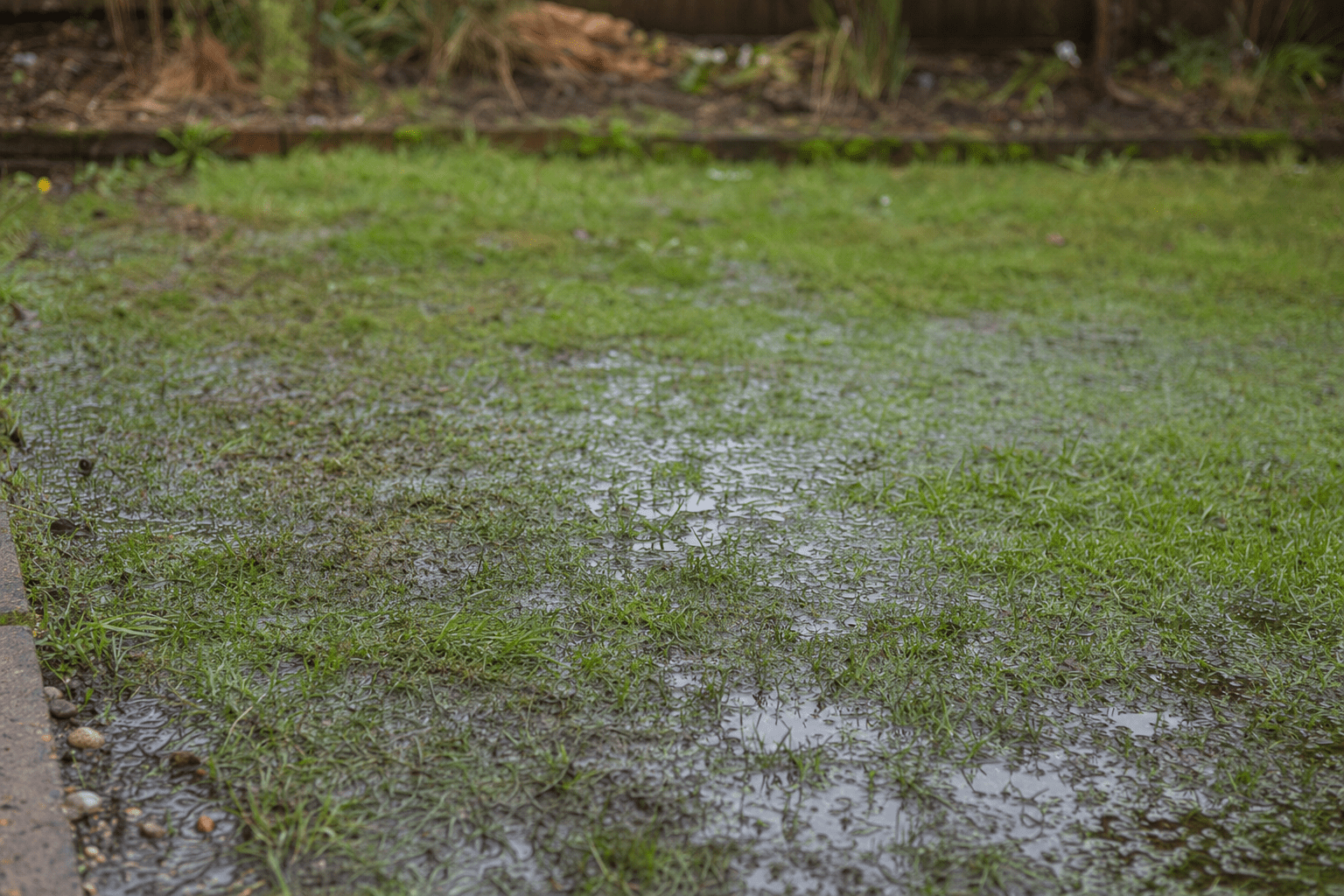
If your garden has gone from “a bit soggy in winter” to “I can’t cross it without losing a shoe,” you are not alone. Most of South East London sits on heavy clay, and clay does not let water through. The rain lands, it stays, and by November the lawn is mud. This guide covers the garden flooding solutions that work on SE London clay, what each costs in 2026, and the advice that makes it worse.
What’s in this guide
- The quick version: what actually fixes a waterlogged garden
- Why South East London gardens sit on the worst clay in the city
- Surface water, compaction or a garden sloping the wrong way: a 10-minute check
- What it costs to fix a waterlogged garden in SE London (2026)
- Levelling and regrading: the fix that solves most of them
- When the lawn is finished: re-turfing a drowned lawn
- Permeable paths and patios instead of a sea of mud
- Borders that drink: planting that copes with wet clay
- What not to do: the advice that makes clay worse
- When it is not your garden’s fault: gutters, neighbours and run-off
- When you need a drainage contractor rather than a gardener
- A real job: mud back to lawn in Catford SE6
- When to start the work: the SE London wet-weather calendar
- Waterlogged garden in South East London FAQ
- How our landscaping and levelling service can help
The quick version: what actually fixes a waterlogged garden
The short answer: on clay, the fix that works for most gardens is reshaping the ground so water runs away from the house instead of collecting, and Urban Gardeners prices garden levelling at £90-£95 per hour for a two-person team, tools and basic equipment included.
Four common cases, and what each one needs:
- Water sits in the same dip every time it rains. The ground falls the wrong way. Levelling and regrading fixes it.
- The whole lawn squelches, with no obvious dip. Compacted clay under a thin skin of topsoil. The surface comes off, gets broken up and rebuilt, then re-turfed.
- Water arrives from next door, a path or a downpipe. Sort the source first, or regrading just moves the puddle.
- Water stands for days after the rain stops and smells sour. That is ground water sitting high, and it is a drainage contractor’s job, not a gardener’s.
We do the first three. We say so on the fourth, because levelling a garden with a ground water problem underneath wastes your money.
Not sure which of those four your garden is?
Why South East London gardens sit on the worst clay in the city
Under most of SE London there is a thick bed of London Clay. It holds water like a sponge nobody wrings out. The Royal Horticultural Society puts it plainly: clay soils are wet in winter and baked hard in summer.
Low ground near the old rivers. Gardens in Catford SE6 and Lewisham SE13 sit in the Ravensbourne valley, so they take water off the higher ground around them as well as their own rain.
Victorian back gardens built over builder’s leftovers. Behind a terrace in Brockley SE4 you will often find 10cm of topsoil sitting on rubble and compacted subsoil. Water gets through the topsoil in minutes, then stops dead.
Hard surfaces everywhere. Every extension, patio and paved front garden on the street sends its rain somewhere, usually the low end of a back garden.
Surface water, compaction or a garden sloping the wrong way: a 10-minute check
Do this on a dry day, not mid-downpour. Dig one hole a spade deep, about 30cm, in the wettest part of the lawn. Fill it from a watering can and come back in four hours.
If it has emptied, your soil drains, and the problem is the shape of the garden or water coming in from elsewhere. If it is still full, the clay is the problem and the surface needs rebuilding, not just reshaping.
While you wait, lay a straight plank from the house to the back fence and put a spirit level on it. A garden falling towards the house is the most common cause we see.
| What you see | What it usually means | What fixes it |
|---|---|---|
| Water in the same dip every time | The ground falls the wrong way | Levelling and regrading |
| Whole lawn squelches, no dip | Compacted clay under thin topsoil | Strip, break up, rebuild, new turf |
| Water arriving from next door or a path | Run-off from outside your boundary | Sort the source, then regrade |
| Puddles only at the house wall | A blocked gutter or downpipe emptying there | Clear the gutter, look again after the next rain |
| Patio dry, lawn drowning | Paving with no fall and no soft edge | A permeable edge or path |
| Standing water for days, sour smell | Ground water sitting high | A drainage contractor, not a gardener |
What it costs to fix a waterlogged garden in SE London (2026)
| The job | Price |
|---|---|
| Garden levelling and regrading | Our rate: £90-£95 per hour, two-person team, tools and basic equipment included |
| Clearing a garden gone to mud and weeds first | Our rate: £85 per hour, two-person team, minimum 2 hours |
| Re-turfing a drowned lawn | Roughly £20-£38 per square metre supplied and laid in London, market estimate, not our rate |
| Cut-and-fill regrading | Roughly £30-£50 per square metre, market estimate across the UK, not our rate |
| A permeable path or patio in resin bound gravel | Roughly £50-£100 per square metre supplied and laid, market estimate across the UK, not our rate |
| Jet washing mud off existing slabs | Our rate: £4 per square metre, minimum £140 covering up to 40m² |
Those are a realistic starting point, not a fixed quote. Levelling is priced by the hour because a flat 40m² lawn with a wide side gate is a different day’s work from a sloped garden where every barrow goes through the house. For how the hours add up, read what garden levelling costs in South East London.
Want a real price for levelling your garden?
Levelling and regrading: the fix that solves most of them
Regrading means reshaping the surface so rain runs somewhere on purpose. Soil comes off the high spots into the dips, and the garden is graded to fall gently away from the house towards a border or a gravel strip at the bottom.
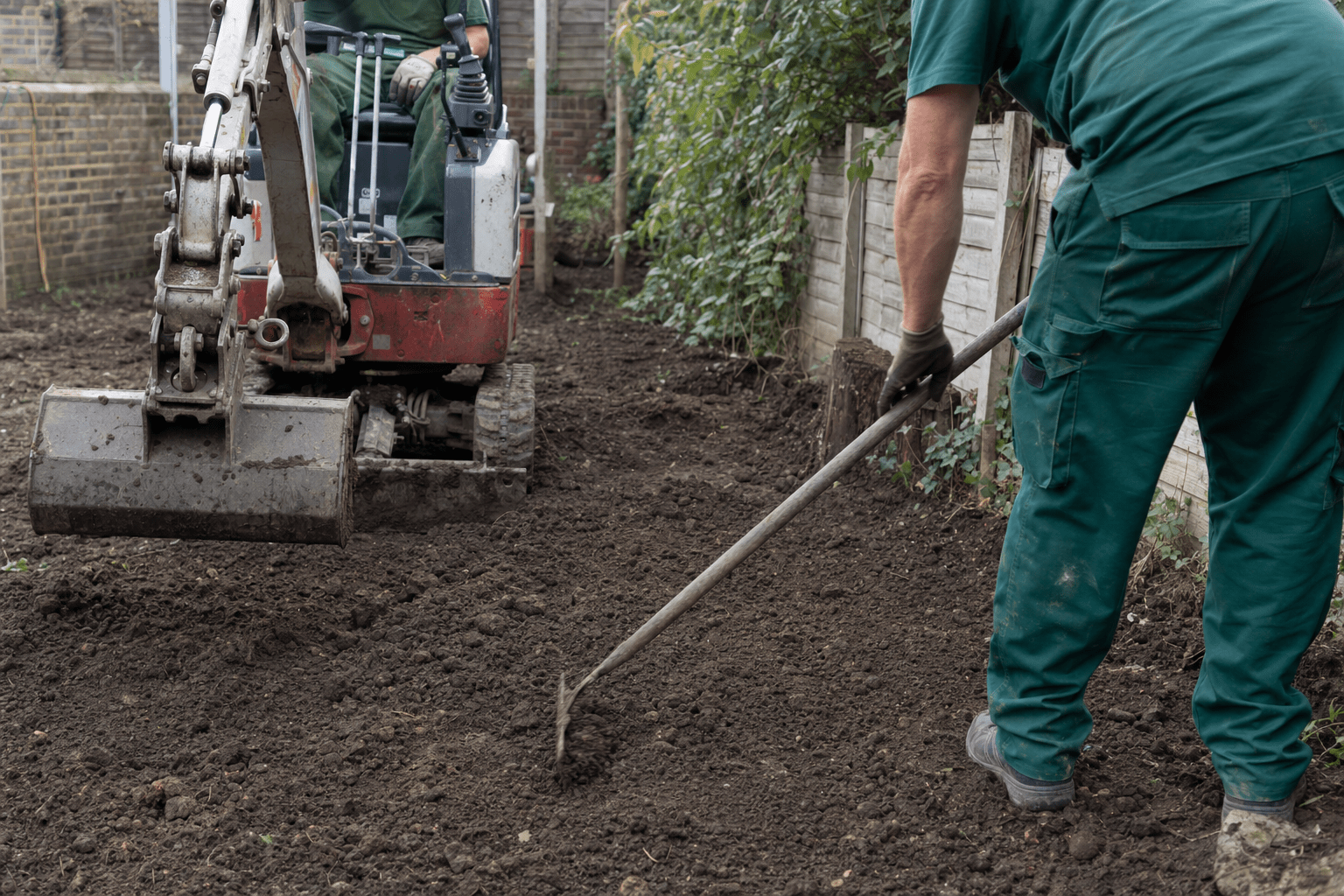
On clay we do not just push mud around. The compacted layer gets broken up so it is no longer a sealed lid, better soil goes on top, and the surface is firmed and graded in one pass instead of slumping over winter.
A small back garden is usually one day. A real slope, or a garden where soil has to be carried through the house, runs to two or three. Any parking or congestion charge is confirmed with you before it reaches the invoice.
Two honest warnings. Regrading sends water somewhere, so it goes into your own ground, never over the fence. And on a steep plot, levelling means retaining walls, which turns a one-day job into a full landscaping and design project with a written quote.
When the lawn is finished: re-turfing a drowned lawn
Grass that spent a week under water usually comes back. Grass that sat in mud all winter, got walked on and went bare usually does not. Tug a handful: no white roots, and grey slimy soil below, means it is gone.
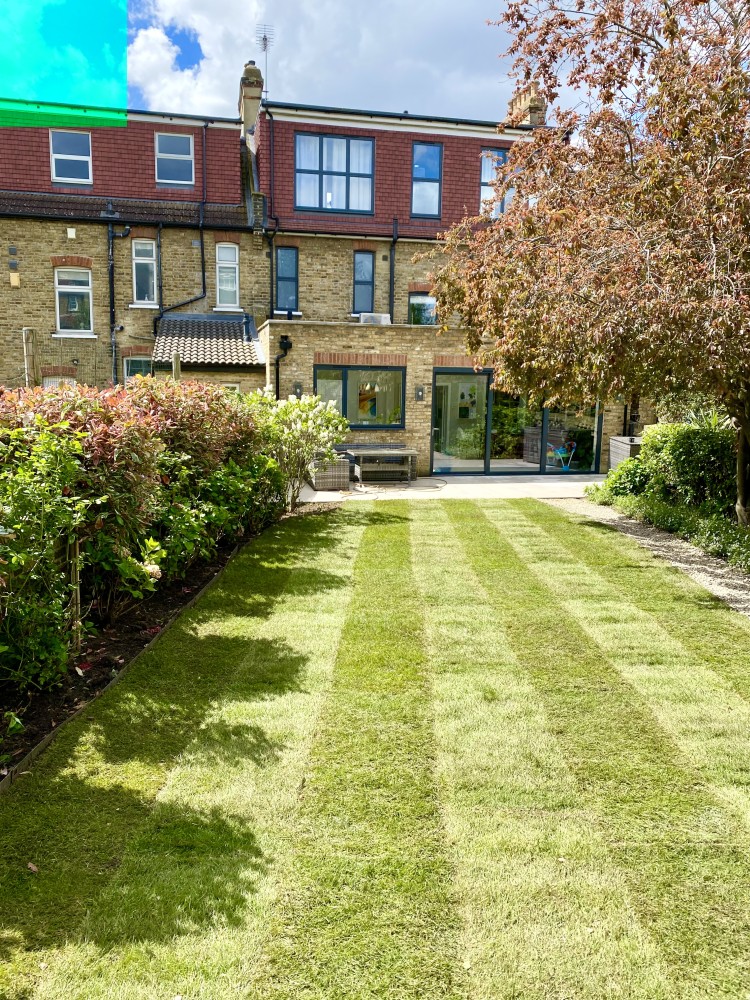
New turf laid on drowned clay dies the way the old lawn did, so the ground work is the job and the turf is the last hour of it. That is why we quote turfing after a free on-site survey rather than over the phone. Our numbers are in the 2026 turfing price guide, and for picking a month, read the best time to lay turf in South East London.
If the mud is only in the two metres by the back door, stop fighting it: a permeable path through that stretch, grass either side.
Is the lawn past saving this winter?
Permeable paths and patios instead of a sea of mud
Permeable means rain passes straight through the surface into the ground below instead of running off. Gravel, resin bound gravel (loose stones glued together so they stay put underfoot) and porous block paving all do it.
In a small terraced garden, the useful move is a narrow permeable path from the back door to the shed or the seating area. You get a dry route in January, the rain still soaks away, and the grass either side takes less traffic.
A solid patio can be helped without ripping it up: a gravel strip along its downhill edge gives water somewhere to go instead of sheeting onto the lawn. If the slabs are green and slippery rather than badly laid, jet washing the patio at £4 per square metre, minimum £140, is the cheaper fix.
Borders that drink: planting that copes with wet clay
Plants will not drain a garden. The right ones live happily in the wet part instead of dying in it every winter, which saves replacing them each spring.
Work from the RHS list of plants for wet soils. Shrubs that cope include Cornus alba, Hydrangea paniculata and Kerria japonica. Astilbe, Hosta and Iris sibirica all take damp clay.
Two tricks. Plant shrubs on a low mound rather than in a dished hole, so the roots sit above the wet. And dig plenty of bulky organic matter into a clay border first, because it opens the structure and lets water move.
For a corner that stays soggy all year, build a raised bed. 6 reasons to use raised beds explains why they suit clay.
What not to do: the advice that makes clay worse
Do not just poke holes in the lawn with a garden fork. Most step-by-step guides online lead with it. On London clay the holes close within weeks and you are back where you started. It is a lawn job, not a drainage fix, and not something we sell.
Do not tip sand on clay. In the amounts a homeowner spreads, sand plus clay sets harder than the clay did alone.
Do not walk on it while it is saturated. Every footprint packs the soil tighter, and mowing sodden ground does the same.
Do not dig a hole and hope. A pit in clay with nowhere to drain to just fills up and stays full.
Do not lay new turf on mud. It looks fixed for six weeks, then rots.
Do not pipe your water into next door. That is how a wet garden becomes a legal problem.
When it is not your garden’s fault: gutters, neighbours and run-off
Before spending anything on the ground, stand outside in heavy rain and watch. A downpipe emptying onto soil at the house wall puts hundreds of litres into one square metre. That is a ladder and half an hour, not a landscaping job.
Where water comes over a boundary, the law starts somewhere that surprises people. Under the common law principle behind the Land Drainage Act 1991, lower land has to accept water running down onto it naturally from higher land. A neighbour is not liable simply for being uphill.
What is not natural is water they have redirected: a downpipe aimed at the fence, a garden paved over with nowhere for rain to go, or a new patio graded towards your boundary. That conversation starts with a polite word and photos taken in a downpour.
When you need a drainage contractor rather than a gardener
We level ground, rebuild surfaces, lay turf and build permeable paths and patios. We do not install French drains, soakaway crates or anything connecting to a public sewer. That is a drainage contractor’s trade, and we say so rather than sell something next to it.
Call a drainage firm, not a gardener, when:
- water stands for days after several dry days
- it smells foul or of sewage
- water rises up through the ground rather than lying on top
- damp is showing inside the house at the same time
- the work would mean connecting to a public drain
The middle ground is a channel drain, the slotted grate you see across a driveway or along a patio edge. Deciding if you need one is its own question, and we answer it in our guide to poor drainage in South East London.
A real job: mud back to lawn in Catford SE6
A back garden of about 60m² near the Ravensbourne end of Catford, unusable since the previous autumn. Water collected across the back third, the grass had gone in the middle, and the owners were putting boards down to reach the shed.
The hole test held water all afternoon, so this was clay and compaction, not a simple dip. The work ran in order: clearance of the overgrowth and rubbish first at £85 per hour for a two-person team, then the surface off, the compacted layer broken up, new topsoil in, and the garden graded to fall to a gravel strip along the back fence.
The levelling was a day and a half for two people at £90-£95 per hour. Turf went down after the ground work, and a narrow permeable path runs from the back door to the shed so the winter route never touches grass. You can see the kind of before and after we mean on our Catford SE6 garden tidy-up page.
When to start the work: the SE London wet-weather calendar
Timing matters more here than in most garden jobs, because the ground has to be workable.
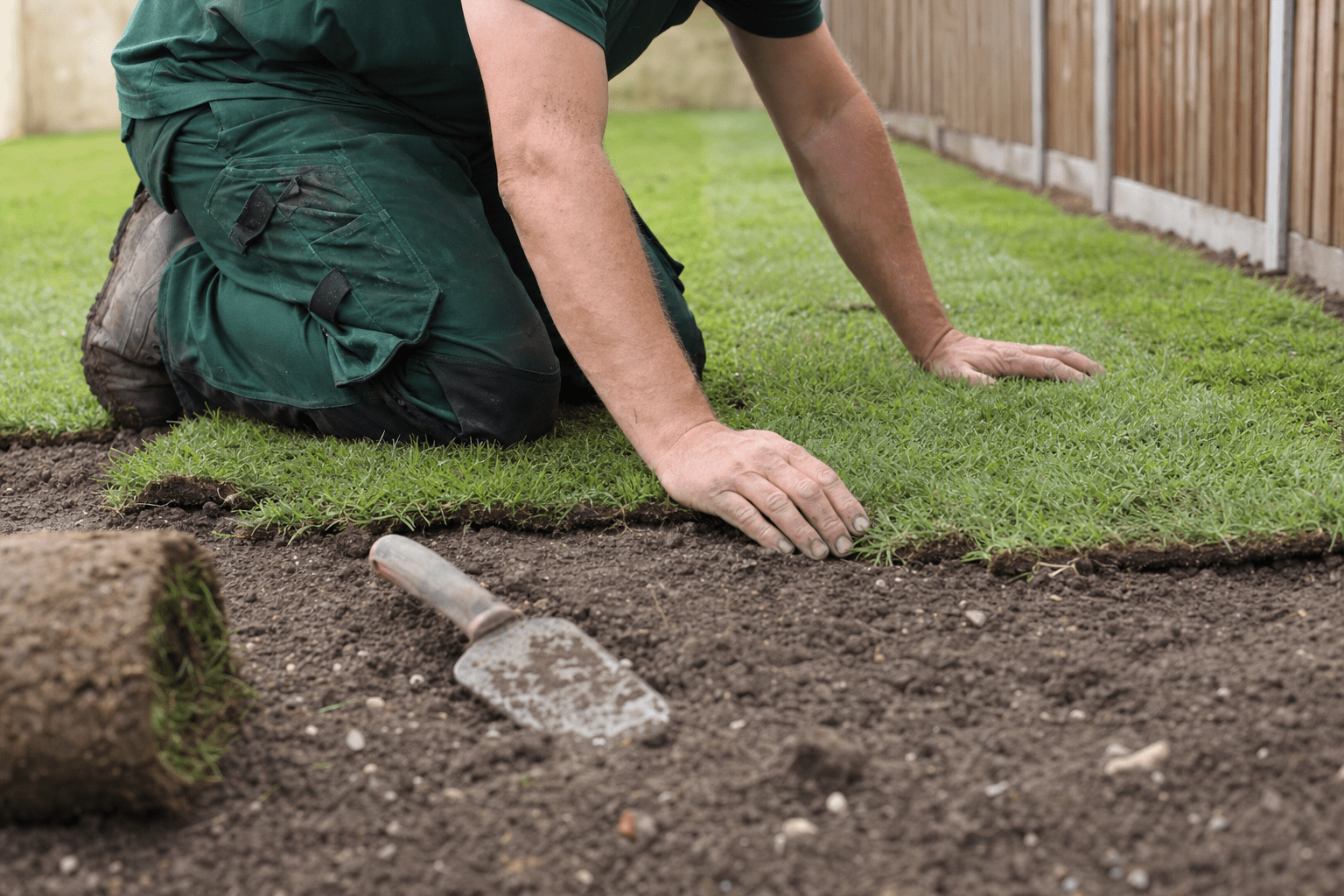
September to late October. The best window. The soil is damp enough to dig cleanly and dry enough to carry weight, and turf laid now roots before the cold. If you are reading this in autumn, book this month.
November to February. Saturated clay. Digging it smears and compacts it, the opposite of the goal. We will still clear a garden, cut growth back and jet wash a patio.
March to May. The second window. The ground dries out and spring turf establishes before summer.
June to August. Clay bakes hard and cracks. Levelling is fine, new turf needs watering you may not be allowed to do under a hosepipe ban.
Waterlogged garden in South East London FAQ
Why does my garden flood every time it rains?
Nearly always one of three things: the ground falls towards the low corner or the house, the clay under a thin layer of topsoil is compacted and sealed, or water arrives from a downpipe, a path or next door. Dig a spade-deep hole, fill it with water, check in four hours. Still full means the soil is the problem. Empty means the shape of the garden is.
How much does it cost to fix a waterlogged garden in South East London?
The usual fix is levelling and regrading, and our rate is £90-£95 per hour for a two-person team, tools and basic equipment included. A small back garden is normally one day. Clearing it first is £85 per hour with a two-hour minimum, and new turf is quoted after a free survey. All our published prices are on the site.
Can you lay turf on clay that floods?
Yes, but only after the ground work. Turf laid straight onto compacted wet clay dies the same winter. The compacted layer has to be broken up, fresh topsoil added and the surface graded to fall away first. If the flooding comes from ground water rather than surface water, fix the drainage or you pay for the lawn twice.
Will levelling the garden stop the flooding?
It stops surface water pooling, which is what most people mean by a flooded garden. It does not lower a high water table, and it does not help if water is fed in from outside your boundary. That is why we do the hole test and check the source before quoting.
How long does a waterlogged lawn take to recover?
Grass under water for a few days in winter usually greens up within four to six weeks of the ground drying out. Grass that sat in mud all season, got walked on and went bare needs replacing, not rescuing. Tug a handful: no white roots underneath means it is finished.
Do I need planning permission to change levels or lay a permeable patio?
For a back garden patio or a regrade at normal garden levels, usually not. A front garden is different: government guidance on the permeable surfacing of front gardens says an impermeable surface over five square metres needs planning permission, a permeable one of any size does not. Raised decking and retaining walls have their own height rules, so check with your council first.
Is my neighbour responsible if water runs off into my garden?
If your garden is lower and water runs downhill naturally, no. Lower land has to accept natural drainage from higher land. If they have redirected it, by aiming a downpipe at the fence, paving the garden over, or grading a new patio towards you, that is not natural run-off and they may be responsible. Take photos in heavy rain and speak to them first.
Can you work on a garden while the ground is still soaked?
We can clear it, cut growth back, take waste away and jet wash a patio in any weather. We will not dig or regrade saturated clay, because working it wet smears the soil and packs it tighter, so you would pay for a job that makes next winter worse. We will tell you to wait, and book the first dry window.
How our landscaping and levelling service can help
- Garden levelling and regrading at £90-£95 per hour for a two-person team, for water pooling in the same spot.
- Garden clearance at £85 per hour, two-hour minimum, for gardens gone to mud and weeds over a wet winter.
- New turf on prepared ground, quoted after a free on-site survey.
- Permeable paths, patios and full redesigns, priced in our 2026 landscaping price guide, written quote within three business days.
- Ongoing garden maintenance at £83 the first hour and £65 every hour after, no minimum charge.
We are a family-run team based in Eltham SE9, working across SE London since 2016. Read about our team, see jobs in our portfolio, and check the areas we cover.
Ready to get it sorted before the wet season peaks?
Send photos and we’ll come back with a price within 24 hours →
Related reading
- Garden Tidy Up in South East London: 7 Things We Do (And What It Costs)
- 7 Tips to Grow A Herb Garden On a Budget
- Artificial Grass Maintenance: The Complete Guide for South East London Gardens
- Best Tips To Get Rid of Unwanted Plants in Your Garden
- Lawn Scarification and Aeration for The Vitality of The Garden

0 comments