

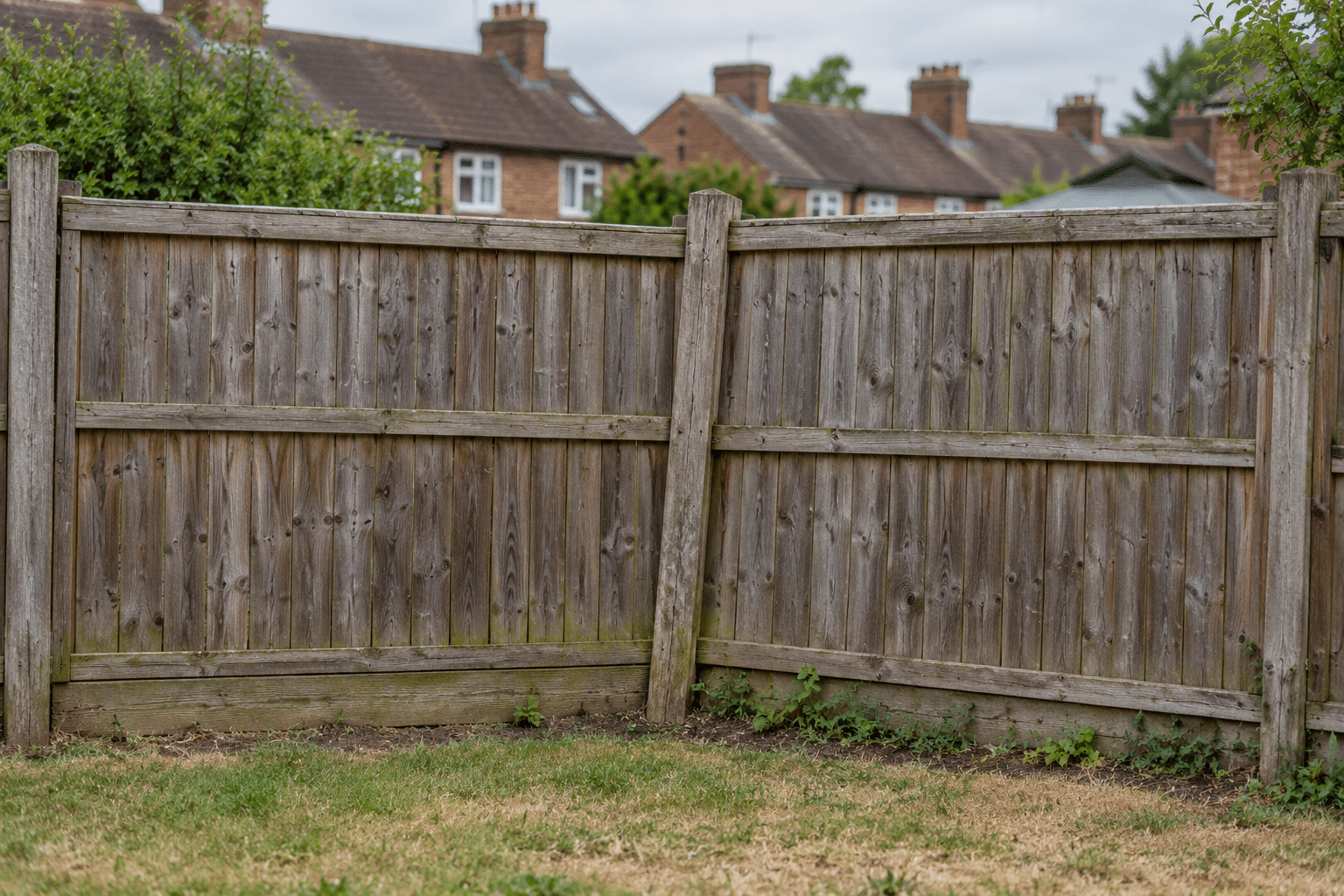
Nothing blew it over. No van reversed into it, no tree came down on it, and the panels are all still where they should be. You leaned on the fence one evening in August, the post gave about an inch, then came back. Now you can rock it with one hand.
The cause is under your feet, not in the weather forecast. This guide covers what a wobbly fence post in dry ground is telling you, the two checks that separate a repair from a replacement, what each one costs, and when to get it done before the autumn rain arrives.
What’s in this guide
- The short version
- Why a Fence Post Starts Leaning in Dry Ground
- What London Clay Actually Does in a Drought
- Wobbly Fence Post in Dry Ground? Do These Two Checks First
- Repair or Replace: The Side by Side
- Leaning Post or Blown Down Fence: Two Different Jobs
- What a Post Replacement Includes, and What It Does Not
- What Changes the Price of a Leaning Post Job
- How Deep a Fence Post Should Go in Clay Soil
- When to Get This Done: The 2026 Timing
- DIY or Get Us In: The Honest Answer
- Stopping It Happening Again Next Summer
- Leaning Fences Across South East London
- About Urban Gardeners
- Frequently Asked Questions
- How Our Services Can Help
The short version
Your post is rocking because the London Clay it sits in has shrunk in the drought and pulled away from the concrete, leaving a gap the post can now move in. The post is often fine. The ground around it is not.
If the timber is still hard below ground level, it is usually a repair. If a screwdriver sinks into the post where it meets the soil, it is a new post. That one test decides the job, and it takes two minutes.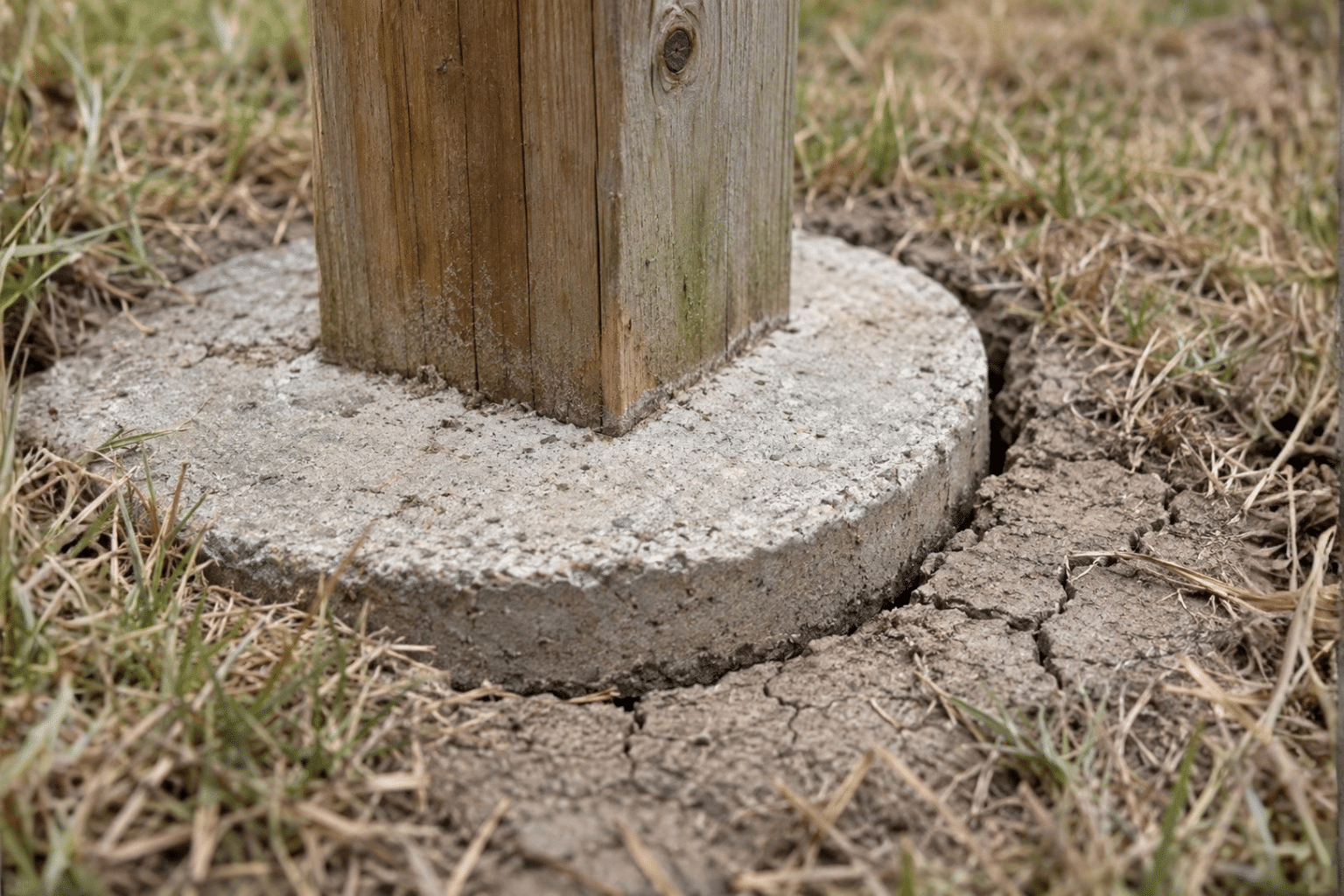
leaning timber fence post with a shrinkage gap around its concrete base in an Eltham SE9 back garden
Not sure if yours is a repair or a replacement?
Send us a photo and we’ll tell you which one it is →
Why a Fence Post Starts Leaning in Dry Ground
A fence post does not hold itself up. The ground presses in on every side of the concrete around it, all the way down, and that is what keeps it upright.
When the soil dries out and shrinks, it stops pressing. You get a thin gap between the concrete and the earth, sometimes wide enough to drop a pencil down. Then the first proper wind comes and the post has somewhere to go. The damage was done in July. The fence lands on the patio in October.
What London Clay Actually Does in a Drought
Most of South East London sits on London Clay, a heavy grey clay under Eltham, Lewisham, Catford, Blackheath and most of the postcodes in between. It is the reason your borders crack open in summer and turn to porridge in February.
Clay changes size with water. The British Geological Survey calls this shrink and swell in clay soils, and it is the most expensive ground problem in the country, costing an estimated £3 billion over the last decade. Sandy soil barely moves. London Clay moves a lot.
2026 gave it every chance. The Environment Agency has Kent and South London, and the Thames area, in official drought status, and south east England got only 54% of its normal rainfall in August. Clay that dry pulls back from everything buried in it.
You cannot water it back either, because the Thames Water hosepipe ban that started on 23 July 2026 is still running, and a watering can is no use at post depth. Our guide to gardening through the SE London hosepipe ban covers what you are still allowed to do.
Wobbly Fence Post in Dry Ground? Do These Two Checks First
Neither needs a tool you do not already own.
Check one, the screwdriver test. Push a screwdriver into the post at ground level, hard, using the flat of your hand. If it skids off, the timber is sound. If it sinks in like polystyrene and comes out with wet brown fibres on it, the post has rotted at the soil line and no amount of new concrete will save it.
Check two, the gap test. Put your fingers in where the post meets the soil and feel round it. A clean open gap of 5mm or more, dry and crumbly at the edges, is clay shrinkage. Loose grey rubble instead means the concrete itself has broken up, which is a different repair.
A sound post with a shrinkage gap is the good outcome, and the one we find most in August and September.

Repair or Replace: The Side by Side
| What you find at the post | What it means | Repair or replace | Typical SE London market cost |
|---|---|---|---|
| Clean gap round the concrete, timber hard | Clay has shrunk back, post is fine | Repair, refill and re-set | Around £60-£120 a post, market estimate, not our rate |
| Screwdriver sinks in at ground level | Rotted at the soil line, post is finished | Replace the post | Around £150-£290 a post fitted, market estimate, not our rate |
| Concrete cracked into loose lumps | Original mix was weak or too shallow | Replace post and concrete | Around £150-£290 a post fitted, market estimate, not our rate |
| Post upright but panel rattling in the slot | Panel clips or nails have worked loose | Repair, refix the panel | Around £40-£90 a panel, market estimate, not our rate |
| Three or more posts leaning the same way | Whole run set too shallow originally | Replace the run | Around £230-£280 a panel with post, market estimate, not our rate |
Those are realistic starting points from what fencing firms across South East London quote, not fixed quotes and not our prices. We quote our own fencing after a free survey, because the honest number depends on what is in the ground. There is a full breakdown in our 2026 guide to garden fencing costs in South East London.
Leaning Post or Blown Down Fence: Two Different Jobs
People use the same words for both and then get quoted for the wrong one.
A blown down fence is already on the ground. The wind did it, usually overnight, and it is often an insurance conversation as well as a fencing one. If that is your situation, read our guide to what to do when a garden fence blows down in SE London instead of this page.
A leaning post is still standing. The panels are intact and the soil is the problem rather than the weather, so you have time to plan it and you usually keep every panel. The catch is that the window closes. A post that rocks freely in September lies flat in the first named storm.
Got a post you can rock with one hand?
Book a free fencing survey across South East London →
What a Post Replacement Includes, and What It Does Not
When we quote a fencing job, the written quote covers:
- Taking out the old post and breaking out the old concrete
- Digging the hole out to the right depth for your soil
- The new post, supplied
- Setting it in concrete, plumb and in line with the rest of the run
- Refitting the existing panels either side
- Leaving the fence solid before we go
What sits outside that and gets priced separately:
- Taking the old post, concrete and any broken panels away
- New panels, if yours are rotten as well as loose
- Gravel boards, the plank or concrete strip along the bottom that keeps the panel off wet soil
- Clearing overgrowth or ivy off the fence line before we can reach it
- Anything on the neighbour’s side that needs their say-so first
Waste disposal is the one that catches people out. Broken post concrete is heavy, and a tip run is a separate line on the quote.
What Changes the Price of a Leaning Post Job
How Many Posts Are Moving
Four posts along one run usually means the whole fence went in too shallow, and replacing them together costs less per post than four separate call-outs.
Whether the Post Can Be Saved
A sound post with a shrinkage gap is refilled and re-set. A rotten one comes out. That difference is most of the price gap in the table above.
What Is in the Hole Already
Old concrete comes out before new concrete goes in. A big old footing in hard clay is 40 minutes of breaking out before the new post even appears.
Access to the Boundary
Most SE London terraced gardens are reached down a side return, the narrow alley between your house and next door’s. Everything goes in and out by hand down that alley, including the barrowed spoil.
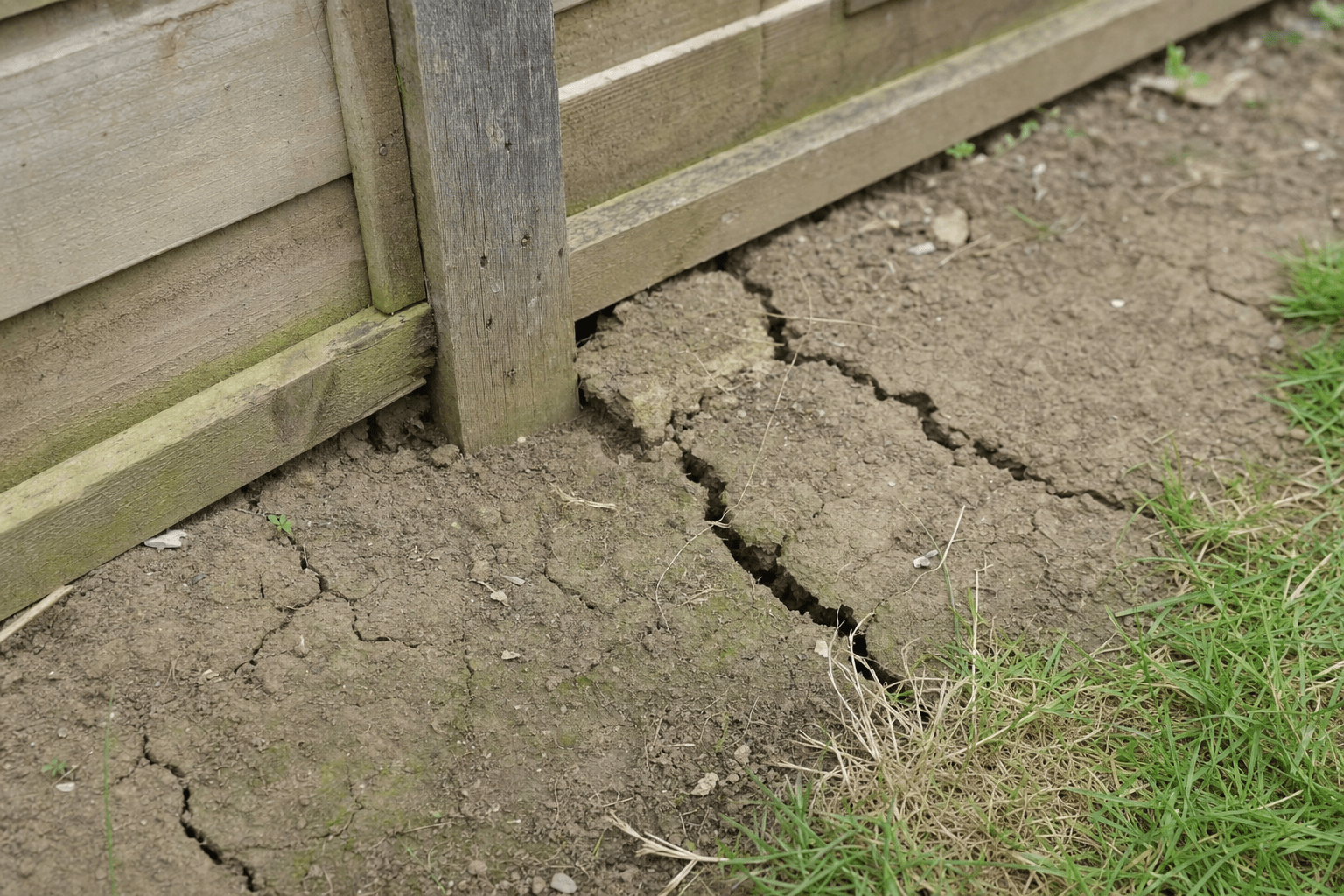 cracked dry London clay soil pulling away from a fence line in Catford SE6
What Is Growing on the Fence
Ivy, a mature climber or a hedge grown into the panels has to come off before the post is even visible, and that part is priced as clearance. Our rate for garden clearance is £85 per hour for a two person team, tools included. There is more in our guide to getting ivy off walls and fences in South East London.
Timber or Concrete Posts
Concrete posts do not rot at ground level, so the screwdriver test never fails on them. They cost more and they are heavier to handle down a side return. Most of our SE London customers stay with timber.
How Deep a Fence Post Should Go in Clay Soil
This is where most leaning posts were doomed from the day they went in.
The British Standard for fencing, BS 1722, works on a simple rule: the post goes into the ground by at least a third of its height above ground. A standard 1.8m fence, the common 6ft panel, needs 600mm of post in the ground. A 2m fence needs 750mm.
In clay you add to that, not take from it. Clay is the ground that moves, so a post set at the bare minimum in Lee SE12 has less margin than the same post in sandy soil. We dig 100mm to 150mm deeper than the book figure on clay sites.
The hole width matters as much. A narrow hole gives you a thin sleeve of concrete with no weight to it, and wind lifts it straight out. 250mm to 300mm across is the working number.
If your posts are leaning after three or four years and the timber is still hard, the depth was wrong. Worth knowing before you pay to have the same fence put back the same way.
When to Get This Done: The 2026 Timing
Now through October is the right window. The clay is at its smallest right now, so the old concrete lifts out of a dry hole far more easily than it will out of a wet one in January.
Once the autumn rain returns, the clay swells back and grips. Some posts feel firmer again, which fools people into thinking the problem fixed itself. The post is now sitting off plumb in a hole it does not fit, and next summer it comes loose a bit further over.
November to February is workable, but the ground is heavy, the spoil is twice the weight to barrow out, and the storm risk has already arrived. Our post on why autumn is the best time to install fencing and decking goes into the earlier slot. March to June is fine for planned work, and a poor time to be doing it in a hurry because the fence already fell over.
DIY or Get Us In: The Honest Answer
One sound post with a shrinkage gap is a home job, and we would rather say so than take your money for it. Clear the loose soil out of the gap, brush it clean, pour in fast setting post concrete, add water and hold the post plumb while it goes off. A 20kg bag of that concrete runs about £8-£12 at UK builders merchants, market estimate, not our rate. Metal post repair spurs, the L shaped brackets you drive in beside a post to brace it, go for roughly £15-£40 a pair across UK suppliers, market estimate, not our rate.
The job turns awkward when the post has to come out. Hiring a post hole digger costs about £30-£50 a day from UK tool hire firms, market estimate, not our rate. You then have a barrow of broken concrete and a dead post to get rid of, down a side return, on a Saturday.
DIY makes sense for: one post that is still hard timber, a gap you can fill from above, and a panel you can lift off and put back on your own.
Professional makes sense for: rotted posts, cracked old concrete, more than two posts on one run, anything over 2m tall, boundaries you share with a neighbour who needs convincing, and any fence with a mature climber growing through it.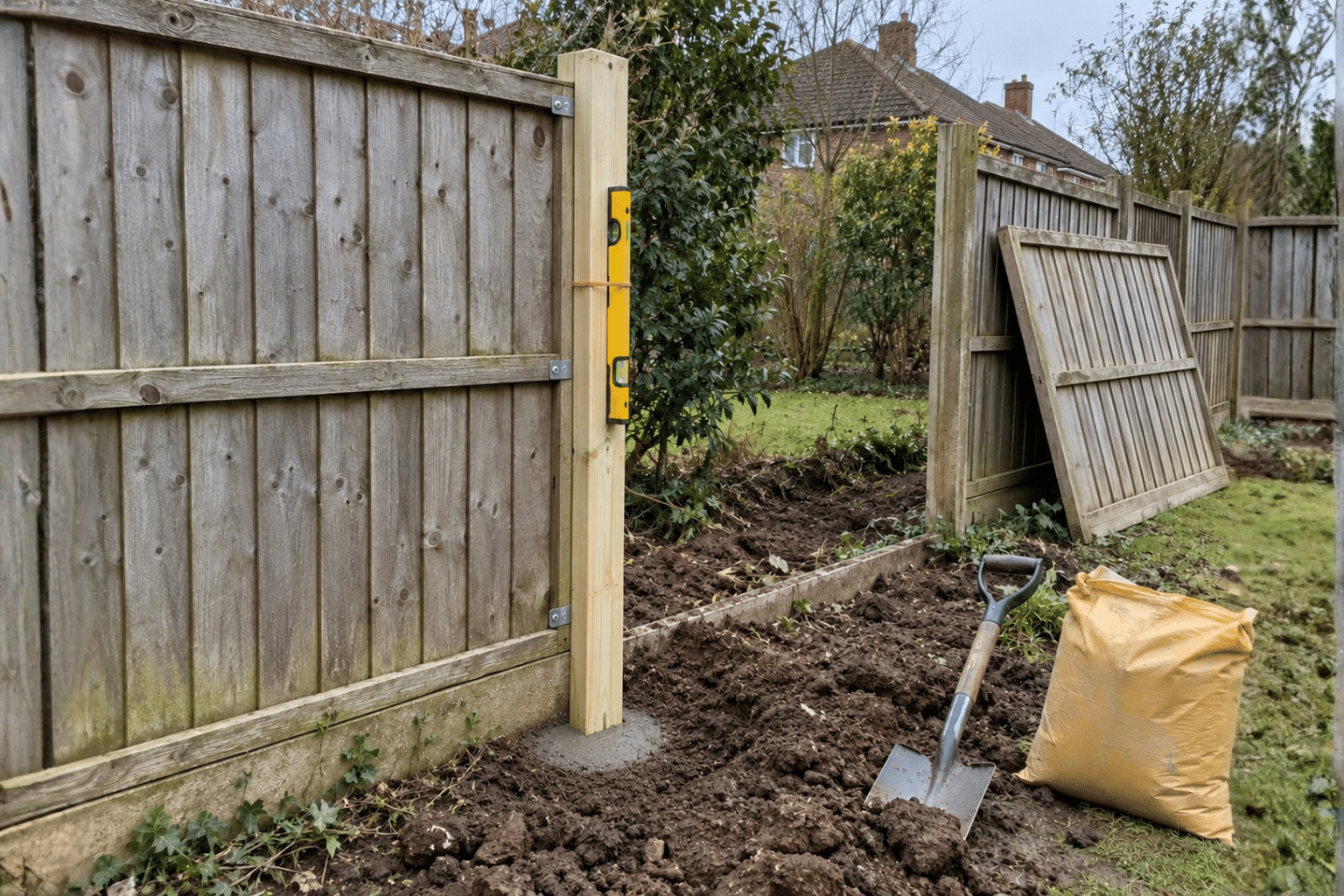
new timber fence post being set in concrete along a back garden boundary in Crystal Palace SE19
You can see a job like that in our portfolio entry on a fence repair in Crystal Palace SE19.
Stopping It Happening Again Next Summer
The clay will dry out again. What you can change is how much the fence cares.
Set the posts deeper than the minimum, in a wider hole, and dome the top of the concrete so rain runs off the timber instead of sitting against it. Fit gravel boards so the panel never touches soil. Keep heavy climbers off the fence, because a fence carrying a wall of ivy in a gale is a sail on a loose post.
One thing not to do: plant a thirsty tree or a big shrub right against the fence line. Roots pull water out of clay faster than sun does, so the ground shrinks hardest where the roots are busiest. Keep anything vigorous two metres back from the boundary. If your garden also puddles in winter, the same clay is behind it, and our guide on fixing poor drainage in South East London gardens covers it.
Leaning Fences Across South East London
The same problem takes a different shape depending on where the garden is.
In Blackheath SE3 and Eltham SE9, gardens are longer and boundary runs are 12 to 20 panels, so clay shrinkage rarely gives you one bad post. You get a run of them tilting the same way, and that is one visit rather than three.
In Lewisham SE13, Brockley SE4 and Catford SE6, the Victorian terraces have short back gardens with shared side boundaries, which makes almost every leaning post a two household conversation. We will speak to the neighbour if it helps.
Around Woolwich SE18 and Greenwich SE10, gardens on the slopes down to the river get a second problem on top: the ground is on the move anyway, so posts lean downhill rather than with the wind. In Lee SE12, Charlton SE7 and Abbey Wood SE2 we see more concrete posts from 1970s builds, which do not rot but do crack. The full list is on our areas we cover page.
Three or four posts going the same way along one boundary?
Tell us your postcode and we’ll survey the whole run →
About Urban Gardeners
We are a family run gardening and landscaping firm based in Eltham SE9, working across South East London since 2016. Deni and Bobby handle most of our fencing, Tilyo does the surveys, and we are fully insured with 111 Google reviews. Finished jobs are on our garden project portfolio, and the team is on our about us page.
Frequently Asked Questions
Will my fence post fix itself when the rain comes back?
No. The clay swells back and grips the concrete again, so the post feels firmer for a few months, but it is sitting off plumb in a hole it no longer fits. The next dry summer starts it moving from a worse angle.
Can I just pour new concrete into the gap around the post?
If the timber is still hard at ground level, yes, and it is a decent fix. Clear every bit of loose soil out first, because concrete poured onto crumbly dry clay sets around rubble rather than against solid ground. If the screwdriver sinks into the post, new concrete just holds a rotten post upright for one more winter.
How do I know if it is my fence or my neighbour’s?
Check your title deeds or the transfer plan from when you bought the house, where boundaries are usually marked with a T. The old rule about the posts facing your own side is a habit, not law, and it is wrong often enough that we would not settle a shared bill on it.
Is a leaning fence post a sign my house is subsiding?
Usually not on its own. Fence posts sit 600mm to 750mm down, house foundations sit far deeper, so a post feels drought long before a wall does. If you also have new stepped cracks in the brickwork or doors sticking, speak to your buildings insurer rather than a gardener.
How long does replacing one fence post take?
About two hours, including breaking out the old concrete and refitting the panels either side. The concrete then needs 24 hours before the fence takes a proper wind.
Can you do it if there is ivy all over the fence?
Yes, we take the growth off first and price that as clearance at £85 per hour for a two person team. Ivy on a loose post is a real risk, because the extra weight and wind load is often what tips a rocking post over.
How Our Services Can Help
- Garden fencing for post replacement, panel repair and full boundary runs, quoted after a free survey, with materials, labour, post and concrete setting in the written quote.
- Garden clearance at £85 per hour for a two person team, tools included, for getting ivy and overgrowth off a fence line before the fencing starts.
- Garden maintenance at £83 for the first hour and £65 for every hour after, no minimum charge, for keeping climbers and hedges off the boundary.
- Garden landscaping and design when the fence is part of a bigger rebuild, quoted within 3 business days of the survey.
- Panel choices are in our post on the best fence panels for privacy and security in Peckham SE15, and our rates are on the prices page.
Want the fence solid before the first autumn storm?
Send photos of the leaning post and we’ll quote within 24 hours →
Related reading
- Garden Fence Blown Down in South East London? What to Do and How Much It Costs to Replace (2026)
- Garden Tidy Up in South East London: 7 Things We Do (And What It Costs)
- How Much Does a Gardener Cost in South East London in 2026?
- Artificial Grass Maintenance: The Complete Guide for South East London Gardens
- Garden Landscaping and Design in South East London, Eltham SE9

0 comments