


It’s the second week of October. You walk down the garden to put the bins out and your shoe sinks a centimetre into the lawn. The fence panel by the shed has leaned since August, and two patio slabs rock underfoot.
Under most of South East London that garden sits on London clay. Clay gives you a short, generous window every autumn. Once winter rain soaks in, most building work waits for spring.
This guide covers the five autumn landscaping projects worth booking now, the month each has to start by on clay, where to find what each costs, and what is honestly better left until March.
What’s in this guide
- The Quick Version: Which Autumn Landscaping Jobs Suit SE London Clay
- Why September to November Suits Landscaping on London Clay
- Project 1: A New Patio or Path Before the Ground Turns to Mud
- Project 2: Replacing Weak Fence Panels Before the Winter Storms
- Project 3: Decking Over a Sloped or Waterlogged Corner
- Project 4: New Turf While the Soil Is Still Warm
- Project 5: Borders and Raised Beds That Root Over Winter
- What to Leave Until Spring on Heavy Clay
- What These Five Projects Cost in South East London
- One Project or Three: How We Phase an Autumn Redesign
- A Real Autumn Job: Before and After in South East London
- DIY or Book a Team: The Honest Split by Project
- Autumn Landscaping Across South East London Areas
- Frequently Asked Questions
- How Our Landscaping Team Can Help
- Posts You Might Like
The Quick Version: Which Autumn Landscaping Jobs Suit SE London Clay
Five projects suit autumn on heavy clay, each with its own cut-off:
- New patio or path: start by mid-November, while mortar can still set above 3°C.
- Fence panels: September to December, before a named storm finds the weak one.
- Decking: any time this autumn, because it sits on a frame above the wet ground.
- New turf: until mid-November, while the soil holds some summer warmth.
- Borders and raised beds: October to early December, so roots grow over winter.
Seeded lawns, soft perennials and big level changes on sodden clay wait until spring.
Want to know which of these five fits your garden before the rain sets in?
Why September to November Suits Landscaping on London Clay
Clay cools slowly in autumn. In September and October the soil still holds the summer’s heat while the air has cooled, so new roots grow and plants lose less water.
The catch is the water. The RHS advice on clay soils says clay dug or walked on while wet becomes puddled and compacted, and that once winter rain has soaked it, it often can’t be worked until mid-spring. Its advice is to dig in autumn and early winter, while the ground is fairly dry.
That’s why we plan every dig to finish by mid-November. After that, a small digger that fits through a side gate leaves ruts that stay until April.
The British Geological Survey notes that the clays most prone to shrinking and swelling are mainly in south-east Britain. Building in autumn lets a patio base or fence post settle through a wet season before its first dry one.
Project 1: A New Patio or Path Before the Ground Turns to Mud
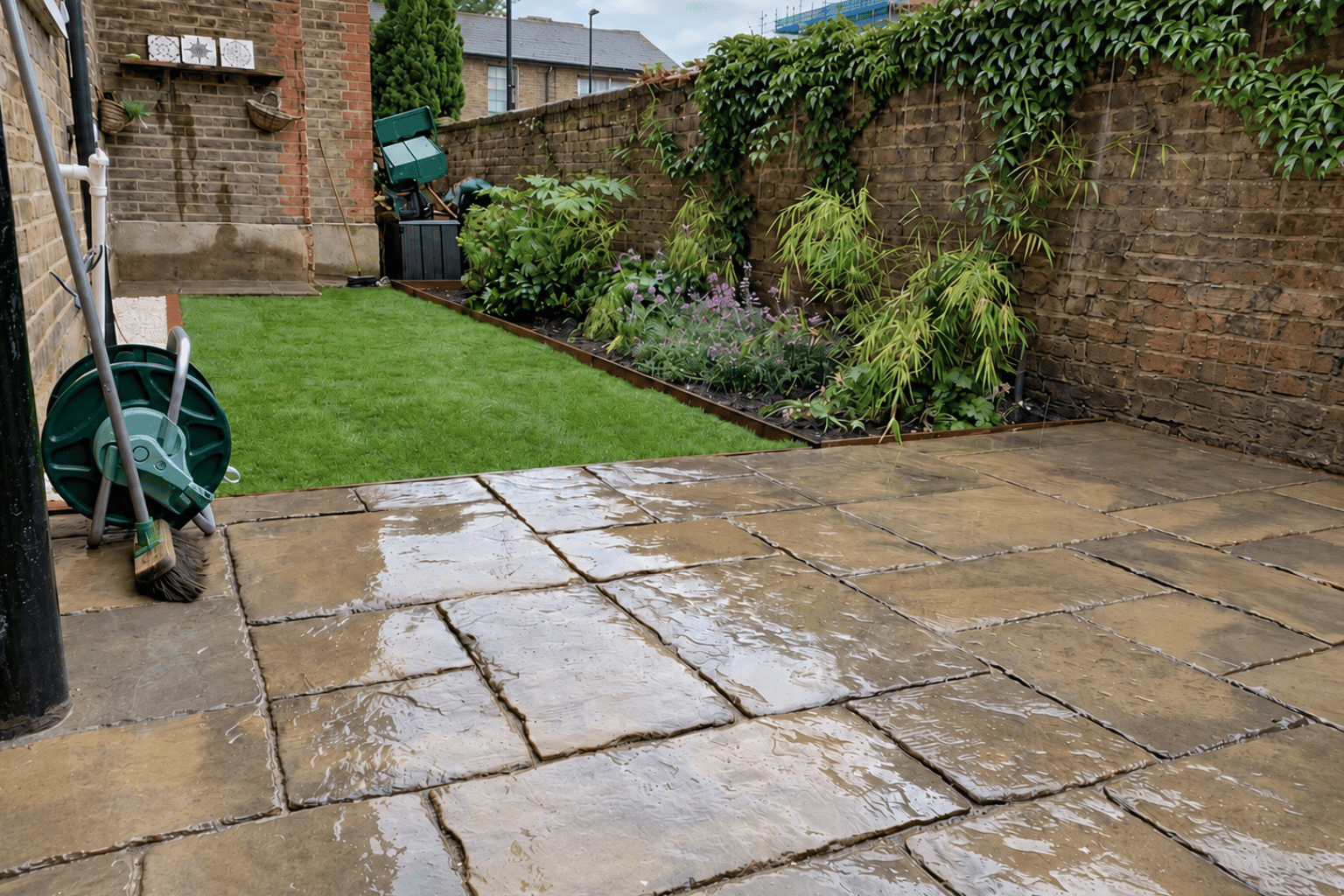
The patio has the tightest deadline of the five. A slab patio sits on a sub-base, a layer of crushed stone packed down hard, with mortar on top. On clay that sub-base has to go in while the ground is firm, because stone spread over wet clay sinks.
Mortar has its own limit. Paving manufacturers advise against laying sand-and-cement mortar unless the air stays at 3°C or above while it sets, overnight included. So we start patios by mid-November and cover fresh joints whenever frost is forecast.
Front gardens carry a rule most people haven’t heard of. Since 1 October 2008, paving over 5 square metres of a front garden with a surface water can’t soak through needs planning permission, unless the rain runs into a lawn or border, according to the government’s guidance on permeable front gardens. Permeable block paving or gravel keeps you clear of it.
Most UK cost guides put a fully laid patio at around £100-£300 per square metre, market estimate, not our rate. Our garden landscaping cost guide for South East London shows how a patio fits into a full redesign budget.
Project 2: Replacing Weak Fence Panels Before the Winter Storms
The Met Office storm-naming season starts on 1 September. By the time most people notice a rattling panel, it has already begun. The panel that flexed all summer is the one that lands in next door’s garden.
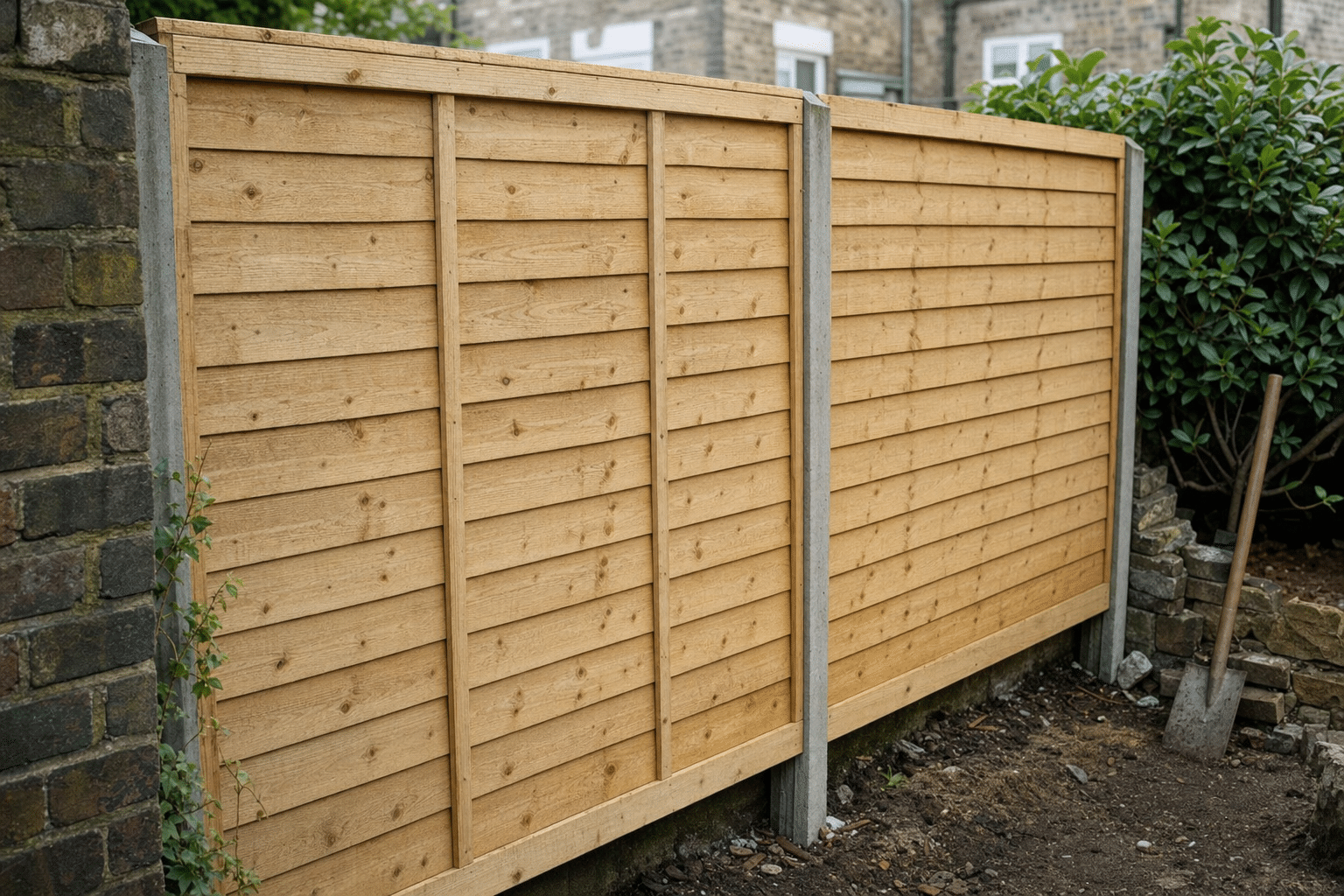
Autumn is good fencing weather on clay. The ground is soft enough to dig a post hole by hand and firm enough for concrete to hold the post straight.
Not every tired fence needs a rebuild. On a fence repair in Crystal Palace SE19, our two-person team replaced two worn panels in 1.5 hours, because the posts were still sound. If a post worries you, our guide to a leaning fence post on London clay explains the screwdriver test for rot.
Under Class A of the Town and Country Planning (General Permitted Development) (England) Order 2015, a garden fence can go up to 2 metres without planning permission, or 1 metre next to a road used by vehicles.
Our garden fencing cost guide for South East London shows today’s per-panel and per-post figures.
Project 3: Decking Over a Sloped or Waterlogged Corner
Most clay gardens have one corner that never dries out, often where the downpipe empties. Grass gives up there, and paving it would need drainage work first.
Decking sits on a wooden frame, so the boards stay off the wet ground and air moves underneath. On a slope the frame’s legs are cut to different lengths, giving you a level platform without moving tonnes of clay.
Keep it low. The same 2015 Order treats a raised platform more than 30cm above the ground as needing planning permission, which matters for a deck off a back door over a steep drop.
Our decking cost guide for South East London breaks prices down by size and by softwood, hardwood or composite boards.
Project 4: New Turf While the Soil Is Still Warm
Turf is grass that has already grown, so it only needs its roots to take hold. Seed has to sprout first, which needs warmth. That’s why turf can go down into mid-November, when sowing seed would be a gamble.
On clay the preparation decides whether the lawn lasts. We strip the old grass, level the ground and spread topsoil or a rootzone mix, so new roots don’t sit on sticky clay. Turf shouldn’t go down on frozen ground or on clay that squelches, and after mid-November that describes most weeks.
New turf typically costs £20-£38 per square metre supplied and laid across London and the South East, market estimate, not our rate. Our turfing cost guide for South East London gives today’s prices by lawn size, for natural turf and artificial grass.
Project 5: Borders and Raised Beds That Root Over Winter
The RHS calls autumn an underused planting season. The soil keeps its warmth and winter rain keeps it moist, so shrubs and trees planted now have roots in place before next summer’s dry spells.
Bare-root plants, lifted from the field without a pot, cost less than potted ones. The RHS lists bare-root trees, shrubs, roses and hedging arriving from late October, for planting between November and March.
On clay, how you plant matters as much as when. The RHS suggests setting woody plants on mounds about 25cm high, so roots sit above the wettest soil. A raised bed built from chunky wooden planks and filled with topsoil and compost drains in a way the clay below never will.
Our raised garden beds cost guide for clay soil covers sizes, timber and fill. We can build the bed and plant it in one visit.
What to Leave Until Spring on Heavy Clay
Some jobs are better booked for March or April, and we’d rather say so now than build them badly in December.
- Sowing a lawn from seed. By November the soil is rarely warm enough. Lay turf now, or sow in April.
- Soft perennials on wet, heavy clay. The RHS says spring is still usually best for perennials in wet or heavy clay gardens.
- Big changes of level after mid-November. Moving waterlogged clay smears it and damages its structure for months.
- Mortared paving in a cold snap. If the forecast shows nights below 3°C, the patio waits.
- Anything on ground that squelches. If your boot print fills with water, nobody should be digging there.
Phasing, two sections down, solves most of these.
What These Five Projects Cost in South East London
There’s no single price for “autumn landscaping”, so the table gives each project’s window and the figures you can rely on today. Our full rates are on our prices page for South East London gardening.
| Project | Book by, on clay | Price guide |
|---|---|---|
| New patio or path | Mid-November | Around £100-£300 per m² laid in UK cost guides, market estimate, not our rate |
| Fence panels | September to December | Priced per panel and post after a free survey; see the fencing cost guide above |
| Decking | Any time this autumn | Priced by size and boards; see the decking cost guide above |
| New turf | Mid-November | Typically £20-£38 per m² laid across London and the South East, market estimate, not our rate |
| Borders and raised beds | Early December | Priced by bed size and planting; see the raised beds cost guide above |
| Clearing the site first | Any time | £85 per hour for a 2-person team, minimum 2 hours, our rate |
| Levelling a slope | Before the ground is waterlogged | Our published levelling price is from £90 per hour for a two-person team |
| Cleaning an old patio instead | All year | £4 per m², minimum £140 covering up to 40 m², our rate |
Most builds start with our garden clearance service with a two-person team, at £85 per hour. If your garden slopes, our guide to garden levelling costs on sloped SE London plots explains how the hours add up.
If your slabs are level and only green and slippery, our patio and driveway cleaning service costs £4 per square metre with a £140 minimum, a fraction of a new patio.
These figures are a realistic starting point, not a fixed quote. Access and the depth of the dig change the final number, and waste removal is quoted separately and confirmed before collection.
Got a photo of the corner you want to change?
One Project or Three: How We Phase an Autumn Redesign
An autumn garden redesign doesn’t have to happen in one go. Most of ours run in stages built around the clay.
Stage one is the hard landscaping in September, October and early November: clearance, levels, the patio, fence posts and finally turf. All of it needs dry ground. Stage two runs from late October into December, when bare-root shrubs and hedging arrive and raised beds go in. Stage three, booked for March or April, covers perennials and seeded areas.
If the weather turns before the turf is down, we leave the ground levelled and lay it in March. Tilyo, our chief landscape gardener, surveys for free, and you get a written quote within 3 business days. Plami then books each stage around the forecast.
Planning to phase a redesign over this autumn and next spring?
An Autumn Job: Before and After in South East London
This one is from our portfolio: a 45 square metre turfing job in Woolwich SE18.
The homeowner had cleared the brambles themselves, but the ground underneath was badly uneven. After Tilyo’s survey, two gardeners took four days.
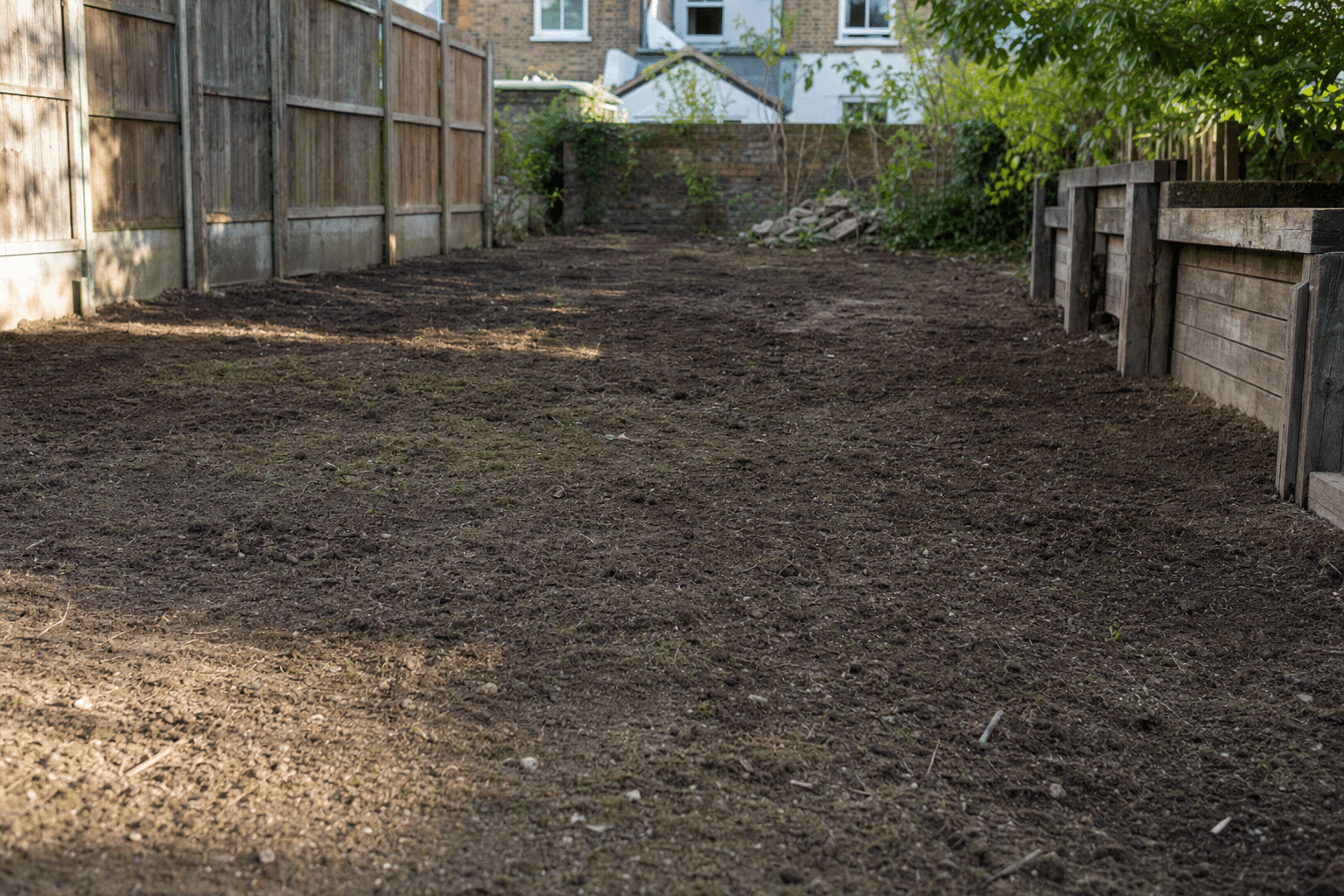
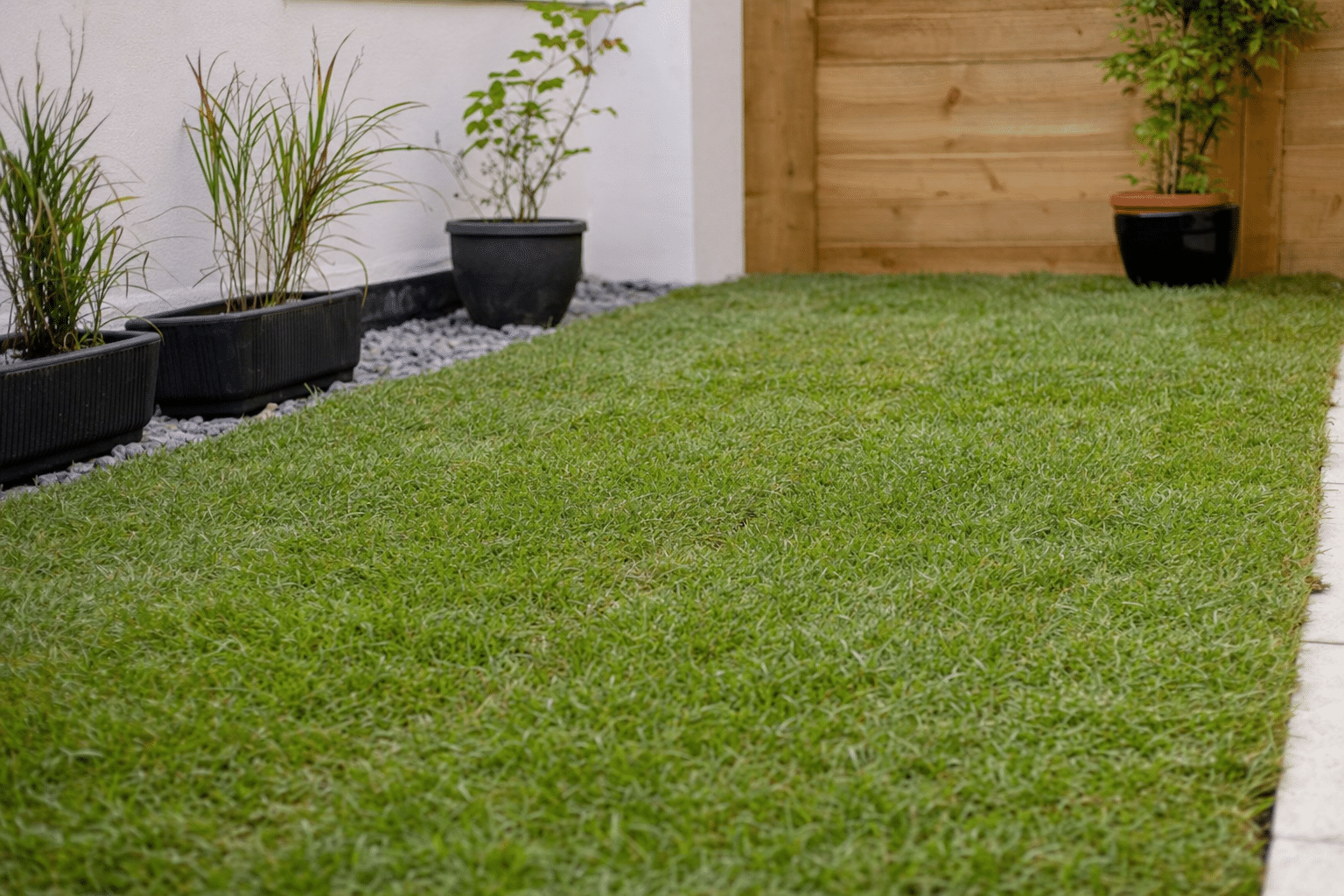
The team broke up the garden with a rotavator, a machine that churns the soil, and removed a large amount of soil to bring it level. On top went a rootzone mix of 50% sand, 40% soil and 10% minerals, so the new roots had something better than raw clay. The turf was laid, rolled and watered.
The spoil came to more than anyone expected, so the homeowner asked for a skip partway through. On our follow-up visits the grass was growing well.
DIY or Book a Team: The Honest Split by Project
Swapping one or two fence panels on sound posts needs a drill, brackets and a second pair of hands. Planting a border or filling a raised bed is very doable while the clay is dry enough to dig.
Patios and lawns are a different scale. A sub-base needs a plate compactor, a heavy vibrating plate that packs stone down, which hires from around £35 for the first day at UK hire shops, market estimate, not our rate. A 15 square metre patio dug 15cm deep also produces over 2 cubic metres of clay, and on a terraced street every bag goes out through the house.
DIY makes sense for: a couple of fence panels on sound posts, planting shrubs and bare-root hedging, and filling a raised bed while the ground is workable.
Professional makes sense for: patios and paths, anything that changes the level of the garden, new lawns on uneven clay, full fence runs with new posts, and any job where the waste goes through the house.
Autumn Landscaping Across South East London Areas
In Blackheath SE3 and Eltham SE9, gardens tend to be larger and more established, with mature trees and long boundaries. Longer fence runs and bigger planting schemes there suit phasing across autumn and spring.
In Catford SE6, many gardens sit behind terraces with no side access. Slabs, turf and clay all travel through the hallway, so we lay protection down and keep the dig tight. Woolwich SE18, home of the turfing job above, mixes Victorian terraces with newer riverside builds.
London clay runs under most of these gardens, so the mid-November cut-off holds across Lewisham, Greenwich, Bromley, Bexley and Southwark. The full list is on our areas we cover page for South East London.
Frequently Asked Questions
Is autumn a good time for landscaping in the UK?
Yes, and in South East London it’s often the best time for building work. The soil is warm and workable in September and October, before winter rain soaks the clay.
Can you lay a patio in October or November?
Yes. October is a good month and early November usually works. Sand-and-cement mortar needs the air at 3°C or above while it sets, so on SE London clay we start patios by mid-November.
Is it too late to lay turf in November?
Not in early or mid-November, if the ground isn’t frozen or waterlogged. After that most weeks on clay are too wet, so we level now and lay in March. Our month-by-month guide to laying turf in South East London has the full calendar.
Can landscaping be done in winter on clay soil?
Some of it. Decking, fence panels and bare-root hedging carry on in dry spells. Digging, levelling and patio bases usually stop once the clay is soaked, and the RHS notes wet clay often can’t be worked again until mid-spring.
Should I plant shrubs in autumn or spring on heavy clay?
Plant shrubs and trees in autumn, while the soil is warm and before it’s waterlogged, so they root over winter. Soft perennials are the exception: on very wet or heavy clay the RHS says spring usually suits them better.
How long does an autumn garden redesign take?
Two fence panels on sound posts took our team 1.5 hours in Crystal Palace, and a 45 square metre lawn with levelling took four days in Woolwich. A full redesign phased over autumn and spring runs across two or three visits.
How far ahead should I book a landscaper for autumn work?
Book in September or early October for anything involving digging, because the clay deadline doesn’t move. The free survey and written quote take up to 3 business days.
How Our Landscaping Team Can Help
Every project here runs through our garden landscaping and design service across South East London, from free survey to final walk round. Nikola and Semir lead on paving, Deni on decking and fencing, and Bobby on groundwork and lawn laying.
- Patios and paths: free survey, written quote within 3 business days.
- Fencing: garden fencing installation and panel repairs, with materials, posts and concrete in the quote.
- Decking: decking installation in softwood, hardwood or composite, frame and basic groundwork included.
- Lawns: turfing with natural turf or artificial grass, including old lawn removal and levelling.
- Clearance before a build: £85 per hour for a 2-person team, minimum 2 hours.
We’re a family business working from Eltham since 2016, with 111 Google reviews. Read more on our about Urban Gardeners page.
Send a few photos for a reply within 24 hours, or call 07760800457, Monday to Saturday, 9am to 6pm.
Ready to get your autumn project in the diary before the clay gets wet?
Posts You Might Like
- Best time to install a fence or decking in South East London, month by month
- Waterlogged garden in South East London: how to fix it and what it costs
Related reading
- Garden Landscaping and Design in South East London, Eltham SE9
- How to Control Garden Pests in Autumn
- Autumn Gardener in South East London: 9 Jobs We Do Before Winter (And What a Visit Costs)
- The Simple Autumn Tidy Up That Makes Spring Gardening Easier
- How Much Does Garden Landscaping Cost in South East London? (2026 Price Guide)

0 comments